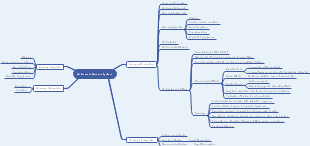
MindMap Gallery CRO and it's APPLICATIONS
CRO, or Contract Research Organization, is a company that provides support to the pharmaceutical, biotechnology, and medical device industries in the form of research services outsourced on a contract basis. CROs offer a wide range of services, including clinical trials management, regulatory and compliance support, data management, biostatistics, pharmacovigilance, and more.The applications of CROs are diverse and essential to the development and commercialization of drugs and medical devices.
Edited at 2022-07-30 15:04:15CRO and it's APPLICATIONS
INTERNAL WORKING SYSTEM
Vertical Deflection System
The main function of this amplifier is to amplify the weak signal so that the amplified signal can produce the desired signal. To examine the input signals are penetrated to the vertical deflection plates through the input attenuator and the number of amplifier stages.
Horizontal Deflection System
The vertical and horizontal system consists of horizontal amplifiers to amplify the weak input signals, but it is different from the vertical deflection system. The horizontal deflection plates are penetrated by a sweep voltage that gives a time base. By seeing the circuit diagram the sawtooth sweep generator is triggered by the synchronizing amplifier while the sweep selector switches in the internal position. So the trigger saw tooth generator gives the input to the horizontal amplifier by following the mechanism. Here we will discuss the four types of sweeps.
Recurrent Sweep
As the name, itself says that the sawtooth is respective that is a new sweep is started immodestly at the end of the previous sweep.
Triggered Sweep
Sometimes the waveform should be observed that it may not be predicted thus, the desired that the sweep circuit remains inoperative and the sweep should be initiated by the waveform under the examination. In these cases, we will use the triggered sweep.
Driven Sweep
In general, the drive sweep is used when the sweep is free-running but it is triggered by the signal under the test.
Non-Saw Tooth Sweep
This sweep is used to find the difference between the two voltages. By using the non-sawtooth sweep we can compare the frequency of the input voltages.
Synchronization
The synchronization is done to produce a stationary pattern. The synchronization is between the sweep and the signal should measure. There are some sources of synchronization that can be selected by the synchronization selector. Which are discussed below.
Intensity Modulation
This modulation is produced by inserting the signal between the ground and cathode. This modulation causes by brightening the display.
Positioning Control
By applying the small independent internal direct voltage source to the detecting plates through the potentiometer the position can be controlled and also we can control the position of the signal.
Intensity Control
The intensity has a difference by changing the grid potential with respect to the cathode.

APPLICATIONS
Real Life Applicaations of CRO
1. There are huge applications of CRO in Radio stations. It is true that our conventional CRO is not used in those radio station but they almost the same to our conventional CRO. The CROs are used in the radio station to observe the sending and receiving signal properties.
2. CRO helps to view the characteristics and property of a signal that is why it also helps to control the analog signals.
3. The shape of voltage and current waveform can be observed by CRO which helps to take the necessary decision in a radio station or communication station.
4. CRO is used for research purposes. When scientists are designed a new circuit, they check voltage, current waveforms of each part of the circuit using the Cathode Ray Oscilloscope.
5. CRO is used with the resonance circuit to observe the bandwidth, wave shape, etc.
6. CRO also used to observe the characteristics of Amplitude Modulation Circuits, Frequency Modulation Circuits, etc.
The cathode ray oscilloscope is an electronic test instrument, it is used to obtain waveforms when the different input signals are given.
The oscilloscope observes the changes in the electrical signals over time, thus the voltage and time describe a shape and it is continuously graphed beside a scale.
By seeing the waveform, we can analyze some properties like amplitude, frequency, rise time, distortion, time interval, and etc.
INFORMATION
The CRO stands for a CATHODE RAY OSCILLOSCOPE.
BLOCK DIAGRAM OF CRO
The CRO stands for a cathode ray oscilloscope. It is typically divided into four sections which are display, vertical controllers, horizontal controllers, and Triggers. Most of the oscilloscopes are used the probes and they are used for the input of any instrument. We can analyze the waveform by plotting amplitude along with the x-axis and y-axis. The applications of CRO are mainly involved in the radio, TV receivers, also in laboratory work involving research and design. In modern electronics, the CRO plays an important role in the electronic circuits.
MEASURMENTS and CALCULATIONS
Measurement of Amplitude
The displays of CRO is used to exhibit the voltage signal like a time function on its display. The amplitude of this signal is stable; however, we can change the number of partitions that cover up the voltage signal within vertical way by changing volt/division button on top of the CRO board. So, we will acquire the signal’s amplitude, which is there on the CRO screen with the help of the below formula.
A = j * nv
‘A’ is the amplitude
‘j’ is the volt/division value
‘nv’ is the no. of partitions that cover up the signal within a vertical way.
Measurement of Time Period
CRO displays the voltage signal as a function of time on its screen. The Time period of that periodic voltage signal is constant, but we can vary the number of divisions that cover one complete cycle of the voltage signal in the horizontal direction by varying the time/division knob on the CRO panel.
T = k * nh
‘T’ is the Time period
‘j’ is the time/division value
‘nv’ is the number of partitions that cover up one whole cycle of the periodic signal within the horizontal way.
Measurement of Frequency
On the CRO screen, the measurement of tile & frequency can be done very simply through the horizontal scale. If you want to make sure accuracy while measuring a frequency, then it assists to enhance the area of the signal on your CRO display so that we can more simply convert the waveform.
Mathematically the measurement of the frequency can be signified as frequency = 1/period.
f = 1/T
WORKING
COMPONENTS
1. Cathode Ray Tube
The CRT (Cathode Ray Tube) is the vacuum tube and the main function of this device is to change the signal from electrical to visual. This tube includes the electron gun as well as the electrostatic deflection plates.The main function of this electron gun is used to generate a focused electronic ray that speeds up to high frequency.
The vertical deflection plate will turn the ray up & down whereas the horizontal ray moved the electrons beams from the left side to the right side. These actions are autonomous from each other and thus the ray may be located anyplace on the monitor.
2. Electronic Gun Assembly
The main function of the electron gun is to emit the electrons to form them into a ray. This gun mainly includes a heater, a grid, cathode, and anodes like accelerating, pre-accelerating & focusing. At the cathode end, the strontium & barium layers are deposited to obtain the high electrons emission of electrons at the moderate temperature, the layers of barium, and are deposited at the end of the cathode.
Once the electrons are generated from the cathode grid, then it flows throughout the control grid that is generally a nickel cylinder through a centrally situated co-axial by the axis of CRT. So, it controls the strength of the generated electrons from the cathode.
When electrons flow throughout the control grid then it accelerates with the help of a high positive potential which is applied to the pre-accelerating or accelerating nodes. The electron ray is concentrated on electrodes to flow throughout the deflection plates like horizontal and vertical & supplies on to the fluorescent lamp.
3. Deflecting Plates
Subtopic
Once the electron ray leaves the electron gun then this ray will pass throughout the two sets of the deflecting plate. This set will generate the vertical deflection that is known as Y plate’s otherwise vertical deflecting plate. The set of the plate is used for a horizontal deflection which is known as X plate’s otherwise horizontal deflection.
Subtopic
4. Fluorescent Screen For CRT
In the CRT, the front face is known as the faceplate, For the CRT screen, it is flat and its size is about 100mm×100mm. The CRT screen is somewhat bent for bigger displays and the formation of faceplate can be done by pressing the molten glass into a form & after that heating it.
The inner face of the faceplate is covered by using phosphor crystal to change the energy from electrical to light. Once an electronics ray hits phosphor crystal, the energy level can be enhanced & thus light is generated throughout phosphorous crystallization, so this occurrence is known as fluorescence.
5. Glass Envelop
It is an extremely evacuated conical form of construction. The inside faces of the CRT among the neck as well as the display are covered through the aquadag. This is a conducting material that acts like a high-voltage electrode. The surface of the coating is connected electrically toward the accelerating anode to help the electron to be the center.ubtopic