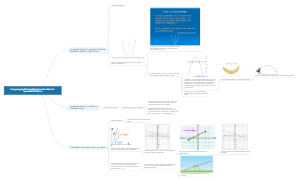
Every year you age (a) and grow at least 2 inches (H) per year.
How do we compute this in Functions?
H(a) = 2 + a (Addition)
How? It's easy. As you age, you will grow.
When do we use Addition? If things adds up at the same time.
A car can travel up to 60 km (D) per hour (t).
How do we compute this in Functions?
D(t) = 60(t) (Multiply)
How? As the car goes by per hour, its adds up to another kilometers.
We can't use addition since the results will be 60 km + 1 = 61.
When do we use Multiplication? When numbers are too big. For example
this equation above.
A Battery (B) loses about 12% per hour (h).
How do we compute this in Functions?
B(h) = 100 - 0.12h (Subtraction)
How? IDK. I use common sense on this one. I can't explain.
When do we use Subraction? IDK TOO!
Squares of side x are cut from each corner of a 10 in x 8 in rectangle, so that
its sides can be folded to make a box with no top.
How do we compute this in Functions?
First, the length of the box is '10x - 2x' & the width of the box is '8x - 2'.
Now for the equation. V(x) = (10 - 2x)(8 - 2x)(x) = 80x - 36x^2 + 4x^3.
How? Cite it as A, B, C, D. First, multiply the A and B giving us the equal to 80.
Second, multiply the A and D equals to -20x.
Third, multiply the B and C having us an answer of -16x
Lastly, multiply the B, D and X and we will be having and answer of +4x^3.
And then we add -20x and -16x equals to -36x^2. The final answer is
80x - 36x^2 + 4x^3.
 Wondershare EdrawMind