MindMap Gallery Technologies
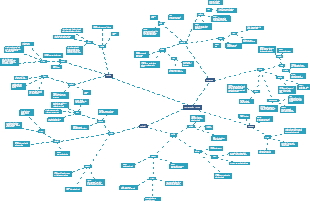
In today's rapidly evolving world, technologies are continuously shaping and revolutionizing various aspects of our lives. This mind map aims to explore the diverse landscape of technologies. By mapping out these technological domains, we aim to understand their interconnectedness, potential synergies, and the implications for the future. This mind map will provide a comprehensive overview of the multifaceted world of technologies and their far-reaching effects on our world.
Edited at 2023-03-15 12:31:38Technologies
Advanced materials and manufacturing
Additive manufacturing (including 3D printing)
Manufacturing physical objects by depositing materials layer by layer according to a digital blueprint or 3D model. Additive manufacturing systems use a variety of techniques to print objects in various sizes (from nanoscale to room-sized) and materials (including plastics, ceramics and metals). Applications for additive manufacturing include rapid prototyping and making custom or small quantity components.
Advanced explosives and energetic materials
Materials with large amounts of stored or potential energy that can produce an explosion. Applications for advanced explosives and energetic materials include mining, civil engineering, manufacturing and defence.
Advanced magnets and superconductors
Advanced magnets are strong permanent magnets that require no or few critical minerals. Applications for advanced magnets include scientific research, smartphones, data storage, health care, power generation and electric motors.
Superconductors are materials that have no electrical resistance, ideally at room temperature and pressure. Applications for superconductors include creating strong magnetic fields for medical imaging, transferring electricity without loss, and hardware for quantum computers.
Advanced protection
Continuous flow chemical synthesis
Systems that produce fine chemicals and pharmaceuticals using continuous-flow processes, rather than batches. Compared to batch chemistry, flow chemistry can make fine chemicals and pharmaceuticals faster, more consistently and with less waste products. Applications for continuous flow chemical synthesis include rapid analysis of chemical reactions, and manufacturing industrial chemicals, agrichemicals and pharmaceuticals.
Clothing and equipment to protect defence, law enforcement and public safety personnel and defence platforms from physical injury and/or chemical or biological hazards. Examples include helmets, fire-retardant fabrics, respirators, and body armour.
Coatings
Substances applied to the surface of an object to add a useful property. Examples include anti biofouling coatings that prevent plants or animals growing on ships or buildings, super-hydrophobic coatings that repel water from solar panels or reduce drag on the hulls of ships, electromagnetic absorbing coatings that make airplanes and ships less visible to radar systems, thermal coatings that reduce heat loss and increase energy efficiency, and anti-corrosion coatings that prevent rust.
Advanced composite materials
New materials created by combining two or more materials with different properties, without dissolving or blending them into each other. Advanced composite materials have strength, stiffness, or toughness greater than the base materials alone. Examples include carbon-fibre-reinforced plastics and laminated materials. Applications include vehicle protection, signature reducing materials, construction materials and wind turbine components.
Critical minerals extraction and processing
Systems and processes to extract and process critical minerals safely, efficiently and sustainably. Australia has an abundance of critical minerals and has the opportunity to be a global leader in the ethical and environmentally responsible supply of key critical minerals. Applications for critical minerals extraction and processing include mining, concentrating minerals, and manufacturing battery-grade chemicals.
High-specification machining processes
Systems and devices that can cut and shape raw materials into complex and highly precise components. Examples include computer numerical control (CNC) mills, CNC lathes, electron discharge machining, precision laser cutting and welding, and water jet cutting. Applications for high-specification machining processes include making aerospace parts, and making components for other manufacturing devices.
Nanoscale materials and manufacturing
Materials with essential features measuring less than 100 nanometres and technologies for their manufacture. Applications for nanoscale materials include, paint, pharmaceuticals, wastewater treatment, data storage, communications, semiconductors, capturing carbon dioxide, and nanoscale tracking markers for critical materials.
Novel metamaterials
New synthetic materials that have properties that do not occur naturally, such as the ability to bend light or radio waves backwards. Applications for novel metamaterials include energy capture and storage, radio antennae, and adaptive camouflage.
Smart materials
Materials that have properties that change in response to external action. Examples include shape memory alloys that change shape when heated and self-healing materials that automatically repair themselves when damaged. Applications for smart materials include clothing, body armour, building materials and consumer electronics.
Advanced data analytics
Systems, processes and techniques for analysing large volumes of data (i.e. ‘big data’) and providing useful and timely insights, usually with limited human intervention. Applications for advanced data analytics include medical diagnosis and treatment, acoustic analytics, regulatory compliance, insurance, climate monitoring, infrastructure forecasting and planning, and national security.
Advanced integrated circuit design and fabrication
Systems and processes to design sophisticated integrated circuits and manufacturing processes to fabricate integrated circuits using process nodes below 10 nanometres. Examples include systems-on-chip (SoC), field programmable gate arrays (FPGAs), stacked memory on chip and specialised microprocessors for defence industry.
Advanced optical communications
Devices and systems that use light to transfer information over optical fibre or free space (i.e. air or the vacuum of space) and use laser technologies, adaptive optics and optical routing to transfer information faster, more reliably, more efficiently and/or using less energy. Applications for advanced optical communications include high-speed earth satellite communications, short-range visible light communications (i.e. ‘Li-Fi’), narrow-beam laser communications and multi-gigabit broadband and corporate networks.