MindMap Gallery Solution Of Partnership
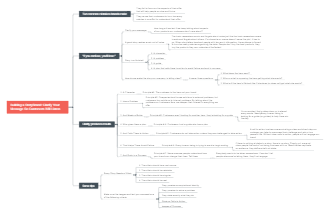
Dissolution of partnership is the legal process of ending a partnership agreement between two or more individuals or businesses. It typically occurs when the partners decide to terminate their business relationship or when specific circumstances arise that require the partnership to be dissolved. The three main characteristics of partnership dissolution are legal process, financial settlement, and tax implications. The legal process involves formalizing the decision to dissolve the partnership through written notification and possibly seeking court approval. The financial settlement addresses the distribution of assets and liabilities between the partners. Finally, tax implications involve reporting any taxable income or losses from the partnership on individual tax returns. This is a mind map about Solution Of Partnership. The map contains two main branches, namely: Without the Courts Intervention, By an order of the course. Each main branch has a detailed description of multi-level sub branches. Suitable for people interested in Solution Of Partnership.
Edited at 2023-07-09 08:39:23DISSOLUTION OF PARTNERSHIP
B. By an order of the cour Section 37 (a) - (f)
SECTION 37 provides: "On application by a partner, the court may decree dissolution of the partnership in any of the following cases:
1. Insanity of a partner
Section 37(a) provides: "When a partner is found lunatic or is shown, to the satisfaction of the court, to be of permanently unsound mind, in either of which cases the application may be made as well on behalf of that partner by his committee, or next friend, or person having title to intervene as by any other partner"
If one partner becomes insane, other partners or their friends can apply for court order to dissolve the partnership. The insanity must be permanent, as recovery may not be possible, as the partner is unable to discharge their duties.
2. Permanent incapacity of any partner to perorm his duties
Section 37(b) provides: "On application by a partner the court may decree dissolution of the Permanent partnership... when a partner, other than the partner suing, becomes in any other way permanently incapable of performing his part of the partnership contract".
If a partner is permanently incapable of performing their duties under a partnership agreement, they may apply for a court dissolution order.
physical diasabilities must be permanent
3. Conduct calculated to prejudicially affect the carrying on of the business
Section 37(c) provides: "On application by a partner, the court may decree a dissolution of the partnership...when a partner, other than the partner suing,has been guilty of such conduct as, in the opinion of the court, regard being made to the nature of the business, is calculated to affect prejudicially the carrying on of the business".
A partner's prejudicial conduct (tingkah laku prejudis) can be used as a basis for dissolution of a partnership. The nature of the business determines whether prejudicial conduct can be considered, and there is no need to prove losses due to the conduct.
Carmichael v Evans In this case, When a partner was discovered boarding a train without a ticket and with the purpose to defraud (menipu), the conviction for dishonesty was deemed damaging to the partnership business.
4. Willful and persistent breach of the partnership agreement
Section 37(d) provides: "On application by a partner, the court may decree a dissolution of the partnership when a partner, other than the partner suing, willfully or persistently commits a breach of the partnership agreement or otherwise so conducts himself in matters relating to the partnership business that it is not reasonably practicable for the other partner or partners to carry on the business in partnership with him".
For example, if a partner persistently refuses to keep proper accounts, the other partner can use that as a good ground for dissolution since such conduct is not reasonably practicable for the other partner to carry on the business with him.
Smith v Jeyes" - According to this case, using money received by the firm for payment of private debts was also a good ground for dissolution.
5. Carrying on at a loss
Section 37(e) provides: "On application by a partner the court may decree a dissolution of the partnership when the business of the partnership can only be carried on at a loss".
must be NET PROFIT
Dissolution of a partnership will occur if it is losing money and there is no possibility of profit. If it is impossible to make a profit, dissolution is possible. If there is still a possibility of profit, the court will refuse to grant a dissolution order.
Handyside v Campbell - The plaintiff sought a decree of dissolution of the partnership, claiming it could only be carried on at a loss. The other partners argued that profit could be made with proper attention. The court refused, citing no proof of practical impossibility of making a profit.
6. Just and equitable (wajar)
Section 37(1) provides: "On application by a partner the court may decree a dissolution of the partnership whenever in any case circumstances have arisen which, in the opinion of the court, render it just and equitable that the partnership be dissolved".
Court may grant dissolution order for firm dissolved on just and equitable grounds upon an application made by any partner, excluding five grounds above.
Re Yenidje Tobacco Co. Ltd." The company was dissolved even though they were making profits. This was because the two persons in the firm who were the only directors and the only shareholder had reached a deadlock (kebuntuan) and only communicated through their secretary.
A. Without the Courts Intervention : Section 34 - 36
By expiration of a fixed term
Section 34(1) (a) provides that subject to any agreement between the partners, a partnership is dissolved, if entered into for a fixed term, by expiration of a fixed term.
A fixed partnership is automatically dissolved after a specified period, unless an agreement is made otherwise.
By completion of a single project
Section 34(1)(b) provides that subject to any agreement between the partners, a partnership is dissolved, if entered into for a single adventure or undertaking, by termination of that adventure or undertaking.
A fixed partnership is a partnership formed for a specific project, which is automatically dissolved when the project is completed unless an agreement is in place.
For example, a partnership between A and B for a housing project in Z Town may continue if a provision is included in the agreement.(if no provision, then dissolve)
By notice
Section 34(1)(c) provides that subject to any agreement between the partners, a partnership is dissolved, if entered into for an undefined time, by any partner giving notice to the other or others of his intention to dissolve the partnership.
A partnership at will is a partnership without a fixed term and dissolves when a partner gives notice to other partners. This will only happen if there is no express agreement to the contrary.
Section 28(1) provides: "where no fixed term has been agreed upon for the duration of the partnership, any partner may determine the partnership at any time on giving notice of his intention to do so to all the other partners".
Section 34(2) states that a partnership is dissolved as of the date specified in the notice, or as of the date of communication if no date is mentioned.
In Sukhinderjit Singh Muker v Arumugam Deva Rajah, the court ruled that the partnership was effectively dissolved due to the defendant's failure to prove an implied agreement between the plaintiff and defendant. The notice required under the sections can be in oral or conduct form, as long as it is an information to dissolve the partnership given to other partners. The other partners must have actual knowledge of the notice. The court held that the plaintiff's letter was sufficient to dissolve the partnership. (notice pun dh cukup)
In Low Pui Heng v Tham Kok Cheong & ors, a partnership was dissolved on April 6, 1968, when the plaintiff was informed of its sale to a limited company. The defendants' actions in selling the partnership were considered notice of their intention to dissolve the partnership. The intention was effective on April 6, but a written notice signed by the partner was sufficient under section 28(2).
By death of any partner
Section 35(1) provides: "Subject to any agreement between the partners, every partnership is dissolved as regard all the partners by the death...of any partner."
Partnership agreements must ensure no one partner's death prevents the firm from being dissolved,If there are no such provisions in the contract, the death of a partner instantly dissolves the business.
In Lee Choo Yamm Holding Sdn Bhd v Khoo Yoke Wah, the court ruled that an agreement to prevent partnership dissolution after a partner's death must have been made before the death, as an agreement made after the deceased's death has no legal effect.
By bankcruptcy of any partner
Section 35(1) provides: "Subject to any agreement between the partners, every partnership is dissolved as regards all the partners by the ... bankruptcy of any partner."
Firm dissolves when a partner declares bankruptcy unless agreement guarantees partnership continuation.
By charging on share
Section 35(2) provides: "A partnership may, at the option of the other partners be dissolved if any partner suffers his share of the partnership property to be charged under this act for his separate debt."
Partners can dissolve a firm if a partner charges their share in the partnership property for debt, like a bank loan, and other partners may dissolve the partnership.
By illegality of partnership
Section 36 provides: "A partnership is in every case dissolved by the happening of any event which makes it unlawful for the business of the firm to be carried on or for the members of the firm to carry it on in partnership."
A partner in a firm may become an enemy alien and the partnership becomes illegal, leading to dissolution. Additionally, new laws may prohibit certain business or activity activities from being carried on.
A partnership becomes illegal if a professional fails to comply with statutory requirements, such as accountants, auditors, doctors, or lawyers. Accountants must have qualifications and comply with the Accountant Act, 1967, while auditors must be approved and licensed. Failure to do so results in partnership dissolution Partnership agreement ensuring continued existence despite illegality is still ineffective..
By number of partners exceeding the max number allowed
Ordinary partnerships have a maximum of 20.4 members. If the number exceeds 20, the partnership becomes void, as seen in Shim Fatt v Leila Road Bus Co. Ltd., where the plaintiff couldn't recover money lent to the defendant as the number of members was more than 20.
general p.ship (2-20)
pro. p.ship (2-unlimited)
By agreement
A partnership can be dissolved by agreement, requiring mutual agreement from all partners. Dissolution occurs when agreed upon in the agreement, and may not occur if disagreements persist.