MindMap Gallery Further Issues of Measurement
Self-report measures are a type of measurement technique in which individuals provide information about their own thoughts, feelings, behaviors, or characteristics. These measures rely on individuals' self-perception and self-reporting of their experiences, attitudes, or beliefs.
Edited at 2023-10-22 13:15:385. Further Issues of Measurement
Self-report measures
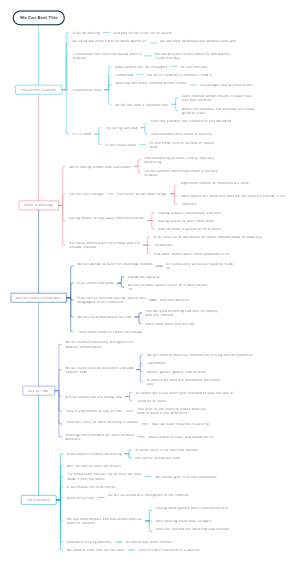
- Trait approach relies predominantly on self-report questionnaires to measure personality (behavioural observation also used) - Social psychology has a tendency to rely on questionnaire data - Therefore, critical considerations are relevant to all research that relies on self-report and questionnaire data
Key questions: - How has the personality measure been developed? - How many items (questions) are used to capture each trait/dimension? - Which type of factor analysis was used? - orthogonal or oblique rotation - How many factors were identified, were they statistically or theoretically defined? - How were those factors labelled? - How was standardisation achieved? (using which population samples?) - Does it show good validity and reliability?
Sources of inaccuracy and bias: - Response set - tendency to respond to all/many questions in a similar way, e.g. "somewhat agree" (could be countered somewhat by including items that few people would endorse) - Acquiescence bias (or dissent bias) - tendency to agree/disagree with questionnaire items irrespective of content (could be countered by reverse scores items) - Demand characteristics - pts alter their response or behaviour because they're part of an experiment, e.g. attempting to provide answers for how they think an ideal pts should respond - Extreme responding - occurs when respondents frequently choose the extreme options on survey items, e.g. strongly agree/disagree options - Social desireability responding - tendency to give answers that will enhance social attractiveness, likeability, etc - Hostility bias - occurs when respondents feel provoked by items (could be countered by sensitively worded items and explanatory instructions) - Nonresponse bias - possible differences between those who complete questionnaires and those who do not
Social desirability
What is social desireability? - Choosing socially acceptable answers to present themselves in a favourable light, and don't attend as much to the trait being measured as to the acceptability of the statement. Reflects a need for approval. - The extent to which a person denies common faults and problems and endorses perfect, well-adjusted behaviour that results in a high social desireability score - Represents unwanted variance, distorting the data - Items in scales are therefore typically designed to refer to minor transgressions or inadequecie sthat most of us suffer from. Some items also refer to 'saint-like' behaviour. - Various measures have been developed to detect socially desirable responding so it can be removed statistically from other questionnaire items - known as 'social desireability', 'validity scales', 'lie scales'
Marlow-Crowne Social Desirability Scale (MC-SDS): - 33 items, all measures in a true/false format - Assesses whether or not respondents are concerned with social approval - E.g. "I always practice what I preach", "I never resent being asked to return a favour", "I'm always willing to admit when I make a mistake"
SD as its own trait - Not necessarily dishonesty, it's different from lying/faking. Some people may just have distorted views of themselves, or have a strong need to have others think well of them - Some argue SD is a trait in itself that correlates with other positve traits, e.g. optimism, happiness, conscientiousness. Also linked with outcomes such as better attendence of drug and alcohol treatment programmes (Zemore, 2012) - Crowne (1964) theorised SD responses reflect a repressive defense against vulnerable self esteem. Therefore could removing pts from studies due to high SD scores bias data (Crowne & Marlowe, 1964)?

Faking and impression management
- Some people taking tests may be motivated to respond in a particular way to cause a desired outcome - "Faking good" - create a favourable impression, e.g. in employment settings - "Faking bad" where people try to appear worse than they really are - in clinical settings (may be cry for help), in forensive settings (want to plea insanity in court, want to demonstrate psychological damage) - The MMPI (personality test) is not available to the public as the test should be properly administered and approved and clients shouldn't know their individual scores for each scale. However there are many adverts that let people take the test, allowing them to 'practice' until they achieve desired results (e.g. for employment, clinical, forensic settings)
Lees-Haley Fake Bad Scale (FBS) or MMPI Symptom Validity Scale: - 43 items in the MMPI aimed at detecting malingering in personal injury claimants - Endorsed by the MMPI publishers in 2006 and incorporated into official scoring keys, but controversial - Some evidence that the validity scales of MMPI-2 could... 1) identify people who were faking bad or faking good, 2) differentiate between psychiatric patients and non-clinical pts who were faking bad - However, one study suggested that unacceptable numbers of those experiencing genuine psychological distress may be labelled as malingerers
Mitigating against impression management: - Use lie scales to 'flag' those who might be lying/faking, e.g. EPQ has a lie scale - Forced choice items - respondents have to choose between 2 'desirable' behaviours - Inconsistency scales, e.g. 2 different responses to 2 similar questions including reverse scored items measuring same concept - Use multiple assessment methods (other than self report), e.g. observational or interview data, third-party reports
Alternatives to self-report measures
- Informant reports by friends, family, partners, peer observers - Behavioural measures - where external judges view and code pts behaviours in experimental or naturalistic - However, each of these methods come with their own 'pros' and 'cons' (McDonald, 2008). Also possibility of 'faking' and potential impacts on personnel selection (Morgesone et al, 2007)