MindMap Gallery Elementary (K-8) Mathematics
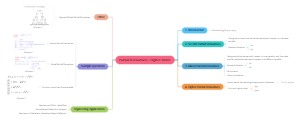
Elementary (K-8) Mathematics is the foundation of mathematical education, covering fundamental concepts and skills from counting and basic arithmetic to geometry and data analysis. It involves teaching students the basics of numbers, operations, fractions, decimals, probability, and spatial reasoning. Elementary mathematics aims to build a solid foundation for students to build upon in higher grades, fostering a love for learning and a curiosity about numbers and patterns. This is a mind map about Elementary (K-8) Mathematics. The map contains 5 main branches, namely: Week 1: Problem Solving, Week 2: Numeration Systems, Week 3: Expanded Notations, Week 4: Base&Property, Week 5: Algorithms. Each main branch has detailed descriptions of multiple sub branches. Suitable for people interested in Elementary Mathematics.
Edited at 2024-02-08 23:51:52Elementary (K-8) Mathematics
Week 5: Algorithms
Addition Algorithms
1. American-Standard (not really the best)  R ---> L No mention of place value By natural instict students will think or want to start from Left to Right 2. Partial Sums 3. with emphasis on Place Value   Asking students to do the steps need to talk about place value for student to understand One of the best algorithms 4. Left to Right  More natural for the student to start from left to right mentions place value 5. Expanded Notation  we want to strive for students to understand each step, place value, and why instead of just memorizing the addition and just needing to carry a number 6. Lattice 
Subtraction Algorithms
 no reference of place value Right to left Last step after learning other methods 2. European-Mexican  instead of 1 less from the value take from the top it changes to 1 more for the bottom value 3. Reverse Indian  Borrow from the bottom instead 4. Left to Right 
Multiplication Algorithms
Division Algorithms
Week 4: Base & Property
Base 2 & 3 Notes
Base 2: 0,1 Ones=2^0 Two's= 2^1 Four's= 2^2 Eight's= 2^3 Examples: 101011 base 2 = (1x2^5)+(0x2^4)+(1x2^3)+(0x2^2)+(1x2^1)+(1x2^0) = 32+0+8+0+2+1 = 43 101011.11 base 2= 43+(1x1/2)+(1x1/4) = 43+1/2+1/4 = 43+ 2/4+1/4 = 43 3/4
Base 3 & 5 Notes Drawn Example

Homework #2
1. Give the Base-10 numeral for each given number. Use expanded notation to explain your answer: 10^0=1 10^1= 10 10^2=100 10^3=1000 10^4=10,000 10^5= 100,000 a) 41.58= (4x8^1)+(1x8^0)+(5x1/8) = (4x8)+(1x1)+(5/8) = 32+1+5/8 = 33 5/8 b) 13415= (1x5^3)+(3x5^2)+(4x5^1)+(1x5^0) = (1x125)+(3x25)+(4x5)+(1x1) = 125+75+20+1 =221 2. Write the number 12 in each given base: a) Base 9  b) Base 8  c) Base 7 
Homework #3
1. Write each of these numbers: a) 29 in base 3= 3^0=1 3^1=3 3^2=9 3^3=27  b) 69 in base 2= 2^0= 1 2^1=2 2^2=4 2^3=8 2^4=16  c) 115 in base 5= 5^0=1 5^1=5 5^2=25 5^3=125  2. How do you know there is an error in each statement? a) 10=243 b) 13 3/4=25.34 There is no 4 in base 3 There is no 5 in base 4
Math Property
Addition putting things together Identity Order Property a+0=a 4+0=4 -2+0=0 0.25+0=0.25 3/4+0=3/4 Commutative Property a+b=b+a Associative Grouping Property (a+b)+c= a+ (b+c) (3+4)+1=3+(4+1) Subtraction - different meanings Take away (no difficulty remembering) (makes most sense to students) Comparison? - Katie has 2 markers, Marks has 5 markers, How many more does Mark have? Missing addends - no properties; subtracting 3 is like adding -3 Multiplication "Groups of..." & repeated addition Identity Property ax1=a 7x1=7 (identity doesn't change) Commutative Property axb=bxa Associative Property (axb)xc= ax(bxc) Zero Property ax0=0 (anything times 0 = 0 always)
Week 3: Expanded Notations
Expanded Notation on Base 5&10 Notes
Ones= 10^0 Tens= 10^1 Hundreds= 10^2 Thousands 10^3 375= 300 +70+5 = (3x100)+(7x10)+(5x1) = (3x10^2)+(7x10^1)+(5x10^0) Base 10= 0,1,2,3,4,5,6,7,8,9 Base 5= 0, 1,2,3,4 Ones= 5^0 Fives= 5^1 Twenty-fives= 5^2 One-Hundred Twenty Fives= 5^3 121 base 5 = (1x5^2)+(2x5^1)+(1x5^0) = (1x25)+(2x5)+(1x1) = 25+ 10+ 1 =36 think about values of the digits depending on what base your in 375.32 = (3x10^2)+(7x10^1)+(5x10^)+(3x1/10)+(2x1/100) 121.5 base 5 = (1x5^2)+(2x5^1)+(1x5^0)+(3x1/5) = (1x25)+(2x5)+(1x1)+(3/5) = 25+10+1+3/5 = 36 3/5
Examples using Expanded Notation Notes
(a) 1,075.31 = 1,000+70+5+3/10+1/100 = (1x1,000)+(7x10)+(5x1)+(3x1/10)+(1x1/100) = (1x10^3)+(7x10^1)+(5x10^0)+(3x1/10)+(1x1/100) (b) 79.003= 70+9+3/1000 = (7x10)+(9x1)+(0x1/10)+(0x1/100)+(3x1/1000) = (7x10^1)+(9x10^0)+(3x1/1000) (c) 1212 base 5= (1x5^3)+(2x5^2)+(1x5^1)+(2x5^0) = (1x125)+(2x25)+(1x5)+(2x1) = 125+50+5+2 (d) 32.12 base 5= (3x5^1)+(2x5^0)+(1x1/5)+(2x1/25) = (3x5)+(2x1)+(1/5)+(2/25) =17 7/25 (e) 2123.34 base 5= (2x5^3)+(1x5^2)+(2x5^1)+(3x5^0)+(3x1/5)+(4x1/25) = (2x125)+(1x25)+(2x5)+(3x1)+(3/5)+(4/25) =250+25+10+3+3/5+4/25 =275+13+15/25+4/25 =288 19/25
Base 3 & 8 Notes
Base 3: 0,1,2 Ones=3^0 Threes+3^1 Nines= 3^2 Twenty sevens= 3^3 2122.12 base 3= (2x3^3)+(1x3^2)+(2x3^1)+(2x3^0)+(1x1/3)+(2x1/9) = (2x27)+(1x9)+(2x3)+(2x1)+(1/3)+(2/9) =60+11+3/9+2/9 = 71 5/9 Base 8: 0,1,2,3,4,5,6,7 Ones= 8^0 Eights=8^1 Sixty-fours= 8^2 512s= 8^3
Week 2: Numeration Systems
Multiplication Combination Strategy Notes
 Using pants and shirts as a demonstration you can see the different combinations that you can do with the orange and purple pants to the white, red, and blue shirts. Each pant can be paired with one of the different shirts meaning you have 3 different combos for each pair of pants. You can draw out each combo or use math. 3 orange pant combos + 3 purple pant combos = 6 combinations or 2 pants x 3 shirts = 6 combinations Multiplication can be done since it shows how much of each pant or shirt you have and multiplying 3 and 2 together you are trying to get the amount of times each clothing piece can be combined to make a different combinations.
Base 10 System Notes
 Base 10 is the values of the 10s in different place values. No matter the place the 10 base each digit in one of the different place values shows a different quanitity Ones = 10 of the one's single unit Tens= a unit of 10 units together Hundreds= 10 units of 10 ten's Thousands= 1000 units of 10 of the 100's
Number Base 10 Example
 One-to-One ten relationship each digit represents a different quantity position tells you the value of the digit When you move from the ones to the thousands each time you need to mulitply by 10 because you are in Base 10 which means each place value increases 10 times as you move from right to left in whole numbers In the decimal place you should do the opposite, instead of mulitplying times 10 you are dividing 10 to show that numbers past the decimal are smaller than the whole numbers. Divide by 10 every tenth, hundredth, or thousandth value everytime you move from a place value.
Decimals
 As you o from left to right after the decimal point each tenth, hundredth, thousandth, etc. units are getting smaller In .35 the 5 hundreth is 10 times smaller than the tenth unit decimal seperates the parts from the whole always will sit right of the unit/whole numbers when smaller than the ones place  The tenth unit representsthe one's unit was cut in 10 equal parts and you take one of those cut units which means you are taking 1/10 of a whole single unit. When calculating for the hundreds the 1/10 is getting 1/10th of times smaller so you multiple 1/10 by 1/10 to get your hundreds units as shown in calculation above.
Examples
 Decimal number indicates what it the unit is as it sits right of a whole unit. the whole number = hours and .3 = mins since minutes is a smaller unit of measurement compared to hours now if you are doing distance measurement the whole = mile and 0.3= is a part of an entire mile so like the Decimal notes section 0.3 is 3/10's of a mile any unit in the tenths is always 1/10 of a one so in this case it's .3 so you will mulitply .3x1/10=3/10 3/10 is parts of a mile Money Examples
Base 10 Digits
Week 1: Problem Solving
Polya's 4 Steps Notes
4 Steps to Solving Problems Understand the problem Know what is being asked from you to do or show Can you say what the problem is asking in your own words? 2. Devise a plan plan what strategy you are going to use in order to solve the problem 3. Carry out the plan Trial and Error, if one strategy doesn't work try another one Charts, diagrams, drawing, tables, etc. 4. Reflect/ Look Back Does the answer make sense to the question? What did you learn from doing the problem? Are all the questions answered?
Student Methods
Each student will understand and comprehend through different methods/strategies. As an educator it's your job to show all the different unique ways that they could problem solve. Acting out the problem provides a real-life visualization Use blocks, beads, or substitute physical objects Drawing pictures, writing it out using numbers, charts, diagrams, etc. Strategy sharing helps other students to learn from other students or you as an educator
Examples of Problem Solving Notes
Writing Out
Writing Probelm There is 7 people in 1 room each person shakes every persons hand once How many handshakes happened in total? One method to solve it would be by writing out the number of people in the room as shown in the left side in descending order. Now next to each person write down the number of hands they will be shaking After each person shakes others hands the number decreases because you don't count the people before them since they have already shook their hands once 1st person= 6 2nd person= 5 3rd person= 4 4th person= 3 6+5+4+3+2+1= 21 total handshakes 5th person= 2 6th person= 1 7th person= 0
Drawing Pictures
Drawing Problem There is 7 people in 1 room each person shakes every persons hand once How many handshakes happened in total?  Write out the number of people next to each person draw 7 circles to represent each person in the room each time cross out the 1 person to show who have shook everyones hand that don't need to shake again after crossing every person out each time count the amount of circles that have a strike going through it
Acting Out
Acting Out There is 7 people in 1 room each person shakes every persons hand once How many handshakes happened in total?  Act out the problem with students, whether it's using cookies, crayons, high-fives, etc. In this case it's hand shaking. The visual above represents the 7 students going in order and shaking hands with each student only once. 1st person gets to shake everyone's hand 2nd person shakes everyone except 1st Person because they already shook hands the first round 3rd person shakes 4, 5, 6, & 7 only because the 1st and 2nd round they shook Person 1 & 2 This process follows for every person left in line to shake hands with The 7th person gets to shake no ones hand because all the other rounds he shook hands with 1, 2, 3, 4, 5, & 6 as shown in the visual student representation Acting out the problems allows for students to experience and visualize what the problem is asking for to let them get the feel of how to solve the problem using another strategy.
Homework #1
1. There are 12 basketball teams in a league. If each of the teams plays each of the other teams once and only once, how many games take place?  2. I have four 3-cent stamps and three 7-cent stamps. Using one or more of these stamps, how many different amounts of postage can I make?