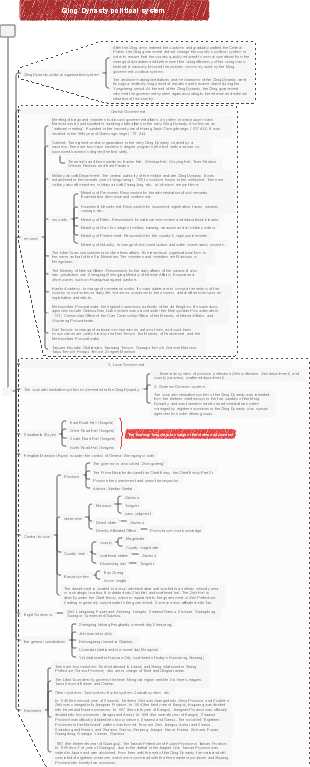
MindMap Gallery Internal Organizations of the Six Ministries of the Qing Dynasty
The theme of this mind map is: "Internal Organizations of the Six Ministries of the Qing Dynasty". The specific content includes a detailed introduction to the Ministry of Personnel, the Ministry of Household Affairs, the Ministry of Rites, the Ministry of War, the Ministry of Punishment, and the Ministry of Industry. On the basis of the Ming Dynasty, the six ministries of the Qing Dynasty were governed by In order to meet the actual needs of the users, many changes have been made, including the establishment of internal institutions, the establishment of officials, etc.
Edited at 2022-09-05 15:56:14Find a streamlined guide created using EdrawMind, showcasing the Lemon 8 registration and login flow chart. This visual tool facilitates an effortless journey for American users to switch from TikTok to Lemon 8, making the transition both intuitive and rapid. Ideal for those looking for a user-centric route to Lemon 8's offerings, our flow chart demystifies the registration procedure and emphasizes crucial steps for a hassle-free login.
これは稲盛和夫に関するマインドマップです。私のこれまでの人生のすべての経験は、ビジネスの明確な目的と意味、強い意志、売上の最大化、業務の最小化、そして運営は強い意志に依存することを主な内容としています。
かんばんボードのデザインはシンプルかつ明確で、計画が一目で明確になります。毎日の進捗状況を簡単に記録し、月末に要約を作成して成長と成果を確認することができます。 実用性が高い:読書、早起き、運動など、さまざまなプランをカバーします。 操作簡単:シンプルなデザイン、便利な記録、いつでも進捗状況を確認できます。 明確な概要: 毎月の概要により、成長を明確に確認できます。 小さい まとめ、今月の振り返り掲示板、今月の習慣掲示板、今月のまとめ掲示板。
Find a streamlined guide created using EdrawMind, showcasing the Lemon 8 registration and login flow chart. This visual tool facilitates an effortless journey for American users to switch from TikTok to Lemon 8, making the transition both intuitive and rapid. Ideal for those looking for a user-centric route to Lemon 8's offerings, our flow chart demystifies the registration procedure and emphasizes crucial steps for a hassle-free login.
これは稲盛和夫に関するマインドマップです。私のこれまでの人生のすべての経験は、ビジネスの明確な目的と意味、強い意志、売上の最大化、業務の最小化、そして運営は強い意志に依存することを主な内容としています。
かんばんボードのデザインはシンプルかつ明確で、計画が一目で明確になります。毎日の進捗状況を簡単に記録し、月末に要約を作成して成長と成果を確認することができます。 実用性が高い:読書、早起き、運動など、さまざまなプランをカバーします。 操作簡単:シンプルなデザイン、便利な記録、いつでも進捗状況を確認できます。 明確な概要: 毎月の概要により、成長を明確に確認できます。 小さい まとめ、今月の振り返り掲示板、今月の習慣掲示板、今月のまとめ掲示板。
Internal Organizations of the Six Ministries of the Qing Dynasty
1. Introduction
After the rulers of the Qing Dynasty entered the Pass and unified China, they established six ministries, all of which were directly responsible to the emperor. The top officers among the six departments have the same official rank, but each department is responsible for completely different areas. The highest officers of the six ministries are generally called Tang Guan, while the subordinate officials of each ministry, such as Lang Zhong, Yuan Wai Lang, and Principal Officers (mostly referred to as seventh rank or below), are more often called Si Guan. According to the Guangxu Dynasty's "Da Qing Hui Dian" and "Official Table of Past Dynasties", the official positions of various ministries in the Qing Dynasty include Shangshu (from the first rank), left and right ministers (from the second rank), Langzhong (from the fifth rank), and Yuanwailang (from the fifth rank). Grade), chief officer (primary sixth grade), as well as hall chief, secretary, pen post style, seventh grade Xiaojing official, etc.
2. Officials
The system of ranking and narration, the method of taking exams and deposing the emperor, the canon of granting and awarding, and the method of finalizing the registration system. Hundreds of divisions can be reached at the ministry. The minister and minister will lead their subordinates to make decisions. Major matters will be dealt with, and minor matters will be dealt with. Then go ahead and distribute the state duties.
Department of Literature and Selection: Responsible for the removal of ranks of civilian officials and the selection of officials
Department of Merit Examination: in charge of the examination, release and punishment of officials
Department of Conferment Verification: In charge of the matters of ennobling, commending, granting, and succession of chieftains to civil officials.
Jixunsi: in charge of officials’ names, funerals, and honors
3. Household Department
In the Qing Dynasty, the Ministry of Household Affairs was mainly responsible for managing many basic national affairs such as territory, fields, household registration, taxes, salaries, and finance. Therefore, the Ministry of Household Affairs was considered to be one of the departments with the largest workload among the six ministries.
Fourteenth Qing Dynasty Officials Division: Each division is in charge of the revenue and expenditure of food that should be saved for several days, and is also responsible for matters that do not belong to the province.
Qian Fatang and Baoquan Bureau: responsible for minting coins of the country
Cangchang Yamen: Responsible for allocating warehousing and cargo across the country
The three treasuries of the Ministry of Household Affairs (silver treasury, satin treasury, and pigment treasury): each control the spending of imperial silver, satin, and pigments.
In 1906 AD (the 32nd year of the reign of Emperor Guangxu of the Qing Dynasty), the rulers of the Qing Dynasty announced the "imitation of constitutional government". In the same year, the Household Department, which had been in use for more than 1,000 years, was renamed the "Du Branch".
The Fourteenth Qing Dynasty Officials Division: Henan, Shandong, Shanxi, Shaanxi, Zhejiang, Jiangxi, Huguang, Guangdong, Guangxi, Sichuan, Fujian, Yunnan, Guizhou, and Jiangnan.
4. Ministry of Rites
In charge of ceremonial affairs, schools and imperial examinations. It is used to test the five rites of auspiciousness, good luck, military, guest, and bad luck; it is in charge of national school affairs, imperial examinations, and the affairs of the vassal and foreign countries.
Ritual and Cleaning Department: Responsible for a series of events such as etiquette and preparations for imperial examinations
Ancestral Sacrifice Bureau: Responsible for auspicious and unlucky rituals
Host and Guest Cleaning Department: Responsible for receiving guests and stipulating basic etiquette when meeting guests.
Jingshan Qingli Division: Responsible for banquets, food, food, livestock and prison matters
Huitong Fourth Translation Bureau: Responsible for translation work with foreign envoys
Bureau of Engraving and Sealmaking: Responsible for the production of imperial treasures and seals used by officials at all levels.
7. Ministry of Industry
He is in charge of the system of civil construction, the way of using utensils, the method of spacing and lowering canals and weirs, and the ceremony of offering billions of dollars to mausoleums. It oversees all civil engineering, water conservancy projects, machine manufacturing projects (including weapons, ammunition, military equipment, etc.), mining, metallurgy, textiles and other government-run industries across the country, and is also responsible for part of the financial currency and unified weights and measures.
The Qing Dynasty Officials Department: responsible for the construction and repair of palaces and offices.
Yu Heng Qing Official Division: Responsible for manufacturing, sending and receiving various official utensils, in charge of weights and measures and coining money
Dushui Qingli Division: Responsible for estimating and selling project costs, and in charge of producing edicts, official documents, etc.
Tuntian Cleaning Department: responsible for the repair and write-off of the mausoleum, collecting materials and part of the tax revenue
Manufacturing warehouse: responsible for manufacturing the emperor's chariot, registration boxes, treasure boxes, ceremonial guards, sacrificial vessels, etc.
Jieshenku: Control the sending and receiving of funds
Material Estimation Office: Responsible for estimating and auditing the quantity of work materials, supplying and selling projects such as temples, palaces, city walls, ministries, and government offices in the capital.
In the 32nd year of Guangxu (AD 1906), when the Qing government was "preparing for the establishment of a constitution" and reforming the official system, it merged the Ministry of Industry into the Ministry of Commerce and changed it to the Ministry of Agriculture, Industry and Commerce.
6. Ministry of Punishment
He is in charge of the government decrees of punishments in the world, to praise and uphold the people, to judge the importance of all laws and regulations, to judge the incoming and outgoing, to judge the appropriateness of forgiveness and slowdown, to collect the amount of stolen goods, punishments and loans. To make a decision, take care of the big things, and do the small things, so as to suppress the country's offenses. (From Volume 53 of "Guangxu Huidian")
The Seventeenth Qing Dynasty Officials Division: In addition to being in charge of criminal cases in the province, many of them were also in charge of criminal cases or other affairs in other provinces.
Seventeen Qing officials: Zhili, Fengtian, Jiangsu, Anhui, Jiangxi, Fujian, Zhejiang, Huguang (Hunan, Hubei), Henan, Shandong, Shanxi, Shaanxi, Sichuan, Guangdong, Guangxi, Yunnan, Guizhou
Supervisory Department: The escape of the bannermen in charge
Autumn Trial Division: In charge of autumn trial and court trial cases.
Division of reduction: In the event of an imperial edict, we will review the reduction of grade in each province and the case currently under trial.
Prison Hall: In charge of jailers, inspecting criminals in the North and South Prisons, and distributing prison clothes, prison food, medicine, etc.
The stolen goods and fines treasury: responsible for collecting and releasing stolen money and confiscated items in current cases and sending them to the household department, and keeping the cash bank and the hall seal of the department.
The Atonement Department: Responsible for atonement matters. If a criminal makes atonement, he will submit the case to the Ministry of Accounts and submit the atonement money.
Supplement: The Zhili Qing Li Department is also in charge of eight periods of nomadic Chahar left-wing criminal cases, the Fengtian Qing Li Department is also in charge of the criminal cases in Shengjing, Jilin, and Heilongjiang, and the Shaanxi Qing Li Department is also in charge of the criminal cases in Gansu and Xinjiang. Criminal cases.
5. Ministry of War
The Qing Dynasty is responsible for the organization responsible for the registration of green camp soldiers and military officers across the country. In charge of the awarding and sealing of military officials at home and abroad, as well as the system of carrying, mailing, screening, concise methods, military status, and military records.
The Military Selection and Purification Division: assesses the grade of military officials, selects and replaces them, promotes them, inherits them, grants them gifts, and manages the chieftains.
Chai Jia Qing Li Division: in charge of the affairs of the country's horse administration and evangelism.
The Ministry of Civil Affairs: responsible for the military officials' merit citations, reviews, pensions, military briefings, inspections, patrols, etc., as well as the management of confinement and maritime embargo.
Arsenal Qingli Division: in charge of the country's military registration, weapons and martial arts examinations.
Inspection and Salary Department: in charge of the inspection and military official’s salary.
Huitong Pavilion: manages the affairs of Jingshi Yichuan.
Good News Office: Handle delivery of documents.
In 1906 AD (the 32nd year of the reign of Emperor Guangxu of the Qing Dynasty), the Qing government announced the abolition of the Ministry of War, which had been in use for thousands of years, and officially changed the department in charge of the military to the Ministry of War.
central theme