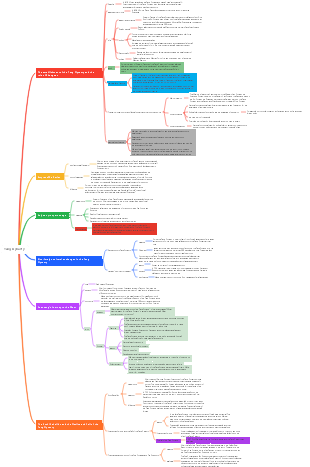
The political organization system of the Tang Dynasty
The core political system of the central government in the Tang Dynasty was the system of three provinces and six ministries. In the Tang Dynasty, there were actually six provinces: Zhongshu Province, Shangshu Province, Menxia Province, Dianzhong Province, Secretary Province, and Internal Affairs Ministry. The Tang Dynasty is a hierarchical decision-making mechanism. Decisions are made at the top where there is no precedent. Specific matters are decided by the six ministries and twenty-four departments.
1. Three provinces, six ministries and twenty-four departments
Division of labor among the three provinces
Menxia Province, Zhongshu Province
"Confidential Affairs", government affairs ruling. One-by-one decision-making bodies
Shangshu Province
It has six departments under its jurisdiction: "officials, household rituals, military punishment, and work" - one executive agency
Political Affairs Hall (in charge of the emperor)
Shangshu Province
Ministry of official affairs
Tobe
Department of Household Affairs
Ministry of Rites
Department of Ancestral Temple
Department of Food and Beverage
Ministry of Justice
Department of Criminal Affairs
Ministry of Industry
Department of Water Resources
Relations between the three provinces:
Zhongshu Sheng: Caozhao Zhiling (Zhongshu Ling, Minister, Zhongshu Sheren)
Menxiasheng: review, review, seal and refute (Shizhong, Shilang, give the matter)
Shangshu Ling: directs government affairs (Shang Shuling is not the operator of specific affairs. After Emperor Taizong of the Tang Dynasty, it was suspended but not given, and he was left and right)
Six official ranks
Doctor (from the fifth grade)
Yuanwailang (from the sixth grade)
Chief (from the eighth grade)
nine temples
It developed from the Jiuqing system among the Three Gongs and Nine Qings in the Qin and Han Dynasties.
Fifth prison
Imperial College: Education
Ordnance Supervisor: Weapons Manufacturing
Shaofu Supervisor: Different functions
General Supervisor: Utensil and Silk Manufacturing
Metropolitan Water Supervisor: Vessel and Water Transport Affairs
Note
①Prime Minister: Tongzhongshu’s third rank: Tongzhongshu’s Pingzhangshi (regardless of whether the status is high or not, all affairs are discussed with the same rank;
② The six ministries and twenty-four departments focus more on government affairs and have the function of participating in decision-making to a certain extent:
③The Fifth Supervisor of Jiu Temple is responsible for specific affairs, and the two have an up-and-down relationship.
2. Supervision organization
Yushitai
Official position: Censor doctor
Deputy position: Censor Zhongcheng
subordinate
Taiwan Academy: Shi Yushi
Palace Courtyard: Palace Attendant and Censor
Procuratorate: Supervisory censor
Pick up hundreds of officials, push them to jail, and supervise the cashiers of the treasury.
Judge Wang
Trial and Prison--Dali Temple
Judicial Administration--Ministry of Justice
2. Local Government
administrative level
state
Chief Executive: Governor
Shangzhou: more than 100,000 households
More than 20,000 households in Zhongzhou
Xiazhou: less than 20,000 households
county
Shang County: more than 6,000 households
Zhong County: 3,000 to 16,000 households
Lower county: less than 3,000 households
3. Kaiyuan and Tianbao years
status quo
The military pressure caused by the Anshi Rebellion also brought financial pressure, which led to adjustments in the personnel structure. Missions appear in large numbers.
The emergence of envoys has impacted the original system. At that time, there was a saying that "when you are an envoy, you should be serious, and when you are an official, you should be light".
Supervision location: Shidao interview handler:
Searching and fleeing households: envoys to households and envoys to persuade farmers:
Rectifying water transportation: Jianghuai and Henan transshipment envoys:
Military border defense: Jiedu envoy, Jinglue envoy...
Characteristics of missionary dispatch:
① Not destined to be Cao Siyi - the person will be directly selected by the high-level organization without going through the original selection process. Not restricted by six ministries and twenty-four divisions, it has more power to respond dynamically.
② Special orders - always report directly to the emperor or the political hall.
4. After the Anshi Rebellion
status quo
More envoys appeared. Since the Shangshu Province could not direct the envoys, the government had to rely on the political hall to integrate the old and new systems, which eventually led to changes in the central system.
The name of the political affairs hall was changed to "Zhongshumenxia", and five rooms were listed behind it. One was called the official room, the second was called the cardinal room, the third was called the military room, the fourth was called the household room, and the fifth was called the punishment room. . "New Book of Tang"
Under the Gate of Zhongshu
The difference between Zhongshu Menxia and San Sheng
The three provinces have a clear division of labor and mutual checks and balances. The Government Hall is the central government's highest government adjudication and execution agency. It is the meeting place for the three provinces' chief ministers, rather than an entity outside the three provinces. Decision-making and administration are separated in the three provinces.
Under Zhongshu's door is the prime minister's office, which is superior to the three provinces. It decides the government affairs of the three provinces and directs the envoy system: its power not only reflects the agreed political policies, but also directly controls the government affairs. The decision-making under Zhongshu's sect is integrated with administration.
Establishment of the Privy Council
During the reign of Emperor Daizong of the Tang Dynasty, privy envoys were first established, served by eunuchs. They were responsible for accepting the performance of officials in Beijing and various places, and conveying the emperor's orders to the two provinces under the Zhongshu family. They could be regarded as running errands specifically for the emperor. But in the later period, as the eunuchs became more powerful, the power of the Privy Council became stronger, and they were even able to suppress the prime minister for a time.
At the end of the Tang Dynasty, Zhu Wen appointed his close confidant Jiang Xuanhui as the privy envoy, and scholars began to replace eunuchs as privy envoys. Jiang Xuanhui's task was actually to monitor Tang Zhaozong who was under house arrest.
Zhu Wen usurped the Tang Dynasty and successfully established the Later Liang Dynasty. He changed the Privy Council to the Chongzheng Yuan. The Chongzheng Envoy was the Privy Envoy, with the same power as the prime minister. He was responsible for giving advice, deliberation, and advisory duties. In the Song Dynasty, it developed into the Privy Council in charge of military affairs.
 Wondershare EdrawMind