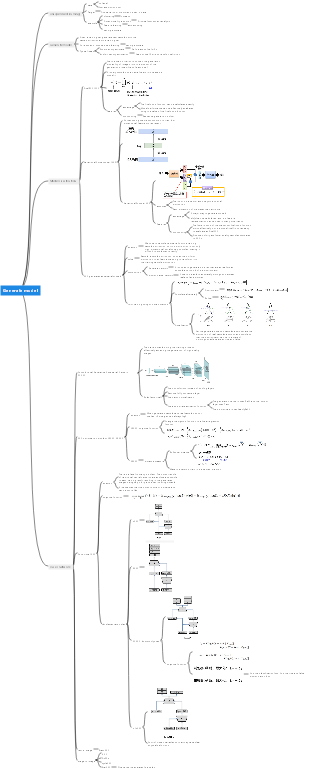
MindMap Gallery Competitive product analysis and sorting
You should look beyond the “product” to look at competition; there is actually a difference between competitive product analysis and market analysis; at different stages of the product, the goals of competitive product analysis should be focused.
Edited at 2022-02-15 15:23:34Competitive product analysis
Tao (idea)
We should look beyond the “product” to look at the competition
How are competing products doing?
how he did it
Why did he do this
What will he do next?
There is actually a difference between competitive product analysis and market analysis
Market analysis
analysis purpose
Aiming at finding market opportunities and helping product positioning, it is more macro-level, does not have in-depth analysis of specific products, and has a large number of products.
Quantity
Larger
Analysis Dimensions
Analysis dimensions include market size, growth trends, market share, competition status, market opportunities, market segmentation, user portraits, product analysis, etc.;
Competitive product analysis
analysis purpose
Competitive product analysis aims to compete, learn from, and understand the market.
Quantity
More than 5
Analysis Dimensions
Analysis dimensions include function, design, technology, team, operation, users, etc.
product analysis
analysis purpose
Product analysis is for the purpose of learning, optimization and reference
Quantity
Product analysis is for the purpose of learning, optimization and reference
Analysis Dimensions
Analysis dimensions include product design and product business model analysis
Product experience analysis
analysis purpose
Product experience analysis is for the purpose of learning and reference
Quantity
Mostly 1 product
Analysis Dimensions
The analysis dimension is the product design dimension
At different stages of the product, the goals of competitive product analysis should be focused
product concept stage
Analyze concerns
Solve the "what to do" problem
Analyze goals
Find product opportunities, decide whether to do it or not, and clarify product positioning
product planning stage
Analyze concerns
Solving “how” questions
Analyze goals
Establish differentiation, help with needs analysis, and help develop feature lists
product development stage
Analyze concerns
Solve the problem of "how to optimize it after making it"
Analyze goals
Optimization of experience design
Product operation stage
Analyze concerns
Solve the "push out" problem
Analyze goals
Understand the changing market environment, provide early warning of risks, understand competitors in order to formulate competitive strategies, learn to optimize, and learn from each other's strengths to offset weaknesses.
Don’t underestimate competitive product analysis
For enterprises, competitive product analysis can assist them in formulating product strategies and product plans, keeping abreast of competitors' situations, learning from each other, learning from each other's strengths, and creating competitive products. At the same time, competitive product analysis can also help companies discover market risks in a timely manner, such as policy changes, new technologies, new competitors, and the emergence of new substitutes.
For individuals, whether they are product operators or product managers, competitive product analysis is an important part of professional skills. Doing more competitive product analysis can also improve our "product sense."
Why do competitive product analysis?
strategy
At the product strategic level, it provides a relatively objective reference basis for enterprises to formulate product strategic planning and product layout;
Through competitive product analysis, we help you position your products and find suitable market segments.
tactics
At the tactical level of the product, we learn from each other's strengths and weaknesses based on analyzing competitor products, especially in terms of product functionality and user experience.
early warning
Competitive product analysis can help us warn and avoid risks, such as policy changes, the emergence of new technologies, the emergence of new competitors, disruptive substitutes on the market, etc., which will affect the success or failure of our products.
When to do competitive product analysis?
concept
Focus: market analysis, profit model, strategic positioning
Goal: Find product opportunities, judge whether it should be done, and help product positioning
product definition
Focus: market analysis, product functions, user scale, technology, APPEALS
Goal: Differentiation, help with needs analysis, help formulate product feature list
product development
Focus: product functions, user experience
Goal: Reference for design
operations
Focus: market strategy, layout planning, pricing, APPEALS
Objectives: Industry environment early warning, competitor monitoring, formulating competitive strategies, and learning from competing product promotion methods
The purpose of competitive product analysis
policy support
Should you do it or not, product positioning, refining selling points, and formulating competitive strategies
Determine whether to enter a new market or create a new product
Help new products position themselves, find market segments, and avoid direct competition with giants
Develop product competitive strategies by analyzing competing products
When selling products and bidding, refine selling points to help sell products.
Learn from
Copy money, compare benchmarks, catch up with gaps
Help discover needs and find product opportunities by analyzing successful products in the industry
Help form the product’s feature list by learning from competing products
Provide reference for functional prototyping
Learn how to operate and promote competing products
Market warning
Macro environment early warning, industry environment early warning, competitor monitoring
Macro environment early warning: detect changes in the political environment, economic environment, technological environment and social environment.
Industry environment early warning: Discover changes in suppliers, customers, existing competitors, new entrants and substitutes.
Competitor monitoring: Monitor the market performance of competing products, promotion methods of competing products, and the emergence of new competitors.
Law (process)
Purpose of analysis (clear goals)
What is my product? (Which product are you doing competitive product analysis for?)
What stage is my product currently in?
What are the main issues and challenges facing my product?
What is the purpose of doing competitive product analysis? (Learning and reference, decision support, market warning)
What is the goal of doing competitive product analysis? (Should we do it, what is the positioning, what is the selling point, what is the competitive strategy, narrowing the gap, benchmark comparison)
What is the output of competitive product analysis?
Determine and analyze competing products (select competing products)
Direct competing products: same product form and same user group
Competing Brands: Coca-Cola VS Pepsi-Cola
Indirect competing products: different product forms, similar user groups
Category Competing Products: Coca-Cola VS Wanglaoji
Substitutes: products that seize the time of similar users, or products that subvert the usage habits of similar users (such as Kodak film and digital cameras)
Time competitors: robbing users of time resources
Budget competitors: Stealing users’ budget resources
Cross-over killer: Some seemingly unrelated products may compete with your product or even kill your product because they can meet the same needs! Cross-border killers especially require industry leaders to be vigilant.
Reference product: A product that may not compete with your product, but is worth learning from.
Principles for choosing competing products
Products with TOP3 market share
Products backed by large companies
Products learned through user feedback
The "Founding Father" of this field
Determine the analysis dimensions (eight analysis dimensions)
Functional design: Functional analysis needs to be accurate to third-level functions
user experience
User profile: including portraits, data, and feedback
Profit model: Common profit models include payment, free value-added, phishing, advertising, e-commerce, channel commissions, and accumulated funds.
Marketing: including product selling points, prices, promotion channels, and promotional strategies (6) Team background: including talent composition, financial advantages, resource advantages, and technical background
Corporate strategy: Based on corporate strategy, product strategies can be inferred
Layout planning: What is the next step for competing products?
Analytical method
Collect competitive product analysis
The required information can be obtained through industry media, communities, third-party platforms, patent websites, corporate and personal network resources, product experience testing, customer service consultation, search queries, etc. Of course, there are also some unconventional methods, such as clichés, fake recruitment, fake cooperation, fake bidding, headhunting, etc. Enterprises can make judgments based on their own circumstances.
Information collation and analysis
The key is to retain reliable and true information, eliminate interference and false data, and label the data sources.
Suggestions and Summary
Output the results of competitive product analysis. After completing the competitive product analysis, you need to write an analysis report, and the report needs to be centered around the analysis objectives. The specific forms usually include word, PPT, Excel, etc.
technique (method)
comparative method
Through horizontal comparison of competing products, analyze and find out their respective advantages and disadvantages. Commonly used methods include tick comparison, rating comparison, and description comparison.
matrix analysis
Matrix analysis method, also known as positioning grid and four-quadrant analysis
Analyze the positioning, features, and advantages of your own products and competing products through a two-dimensional matrix. It can help us understand market segmentation, product positioning, competitive advantages, and discover new opportunities.
Competitor tracking matrix
Through the competitive product tracking matrix, you can track and record the historical versions of competing products, find the development rules of each version, and then speculate on the next action plan of competing products.
Functional teardown
Functional disassembly is to decompose competing products into first-level functions, second-level functions, third-level functions or even fourth-level functions in order to fully understand the composition of competing products and avoid omissions. You can prepare for the next step of product exploration, either in the form of a brain map or an Excel sheet.
Explore needs
Exploring needs is to explore the deeper levels of functions satisfied by competing products in order to find better solutions and improve the competitiveness of one's own products. There are three levels of user needs, in order: program-level needs → problem-level needs → human-level needs.
Usually what users propose are solutions, that is, solution-level requirements. We need to continue to dig deeper and explore what problems this solution solves for users. After locating the specific problems, we need to go one step further to find the corresponding human-level needs. You can use the "5 WHY analysis method".
PEST analysis
The PEST analysis method is a model that analyzes the macro environment, finds opportunities through analysis, and identifies threats and challenges. The macro environment will affect industry development, the industry environment will affect corporate development, and the corporate environment will affect product development.
Porter's Five Forces Model
Porter's five forces model is used to analyze the industry environment. It is a tool formed to evaluate the attractiveness and profitability of a certain industry. It can be used as a reference for companies to make decisions on whether to enter a new industry. This model represents the existence of five basic competitive forces in an industry.
SWOT analysis
SWOT analysis is also a commonly used method in competitive product analysis. Through analysis, strengths, weaknesses, opportunities, and threats can be obtained in order to formulate competitive strategies, such as promoting strengths (leveraging strengths), avoiding weaknesses (avoiding weaknesses), pursuing profits (seizing opportunities), Harm avoidance (avoiding threats), etc.
Addition, subtraction, multiplication and division
When a competitor already has a commanding lead, instead of thinking about how to be better than him, imagine how to do it differently. The use of addition, subtraction, multiplication and division is also very simple. Drawing the value curve of competing products through the "Strategy Canvas" and doing "addition, subtraction, multiplication and division" on the opponent's value curve can help us carry out differentiated innovation.
device (tool)
Competitor canvas
Competitive product canvas can help novices get started quickly. It is equivalent to the MVP of competitive product analysis reports. It can quickly verify whether the analysis ideas are correct (or meet the leadership requirements) and avoid rework.
Lean Canvas
The Lean Canvas is a great tool to use when it comes to product business models.
It can be used for product business model planning and product business model analysis.
The Lean Canvas can help product managers think and make decisions more comprehensively, plan and analyze products from a system and business perspective, and establish an overall view of the product.
strategy canvas
We can also use the strategic canvas to do competitive product analysis, graphically describe the relative strength and weakness of products and competing products in various competitive factors, and use the strategic canvas to achieve product differentiation and innovation.
The horizontal axis of the strategy canvas shows the competitive elements of the product, and the vertical axis reflects user experience and evaluation. We draw the performance points of competing products in each dimension and connect them into a line to get the "value curve."
The value curve feeds back the strength of the product in each competitive dimension, thereby analyzing the strategic outline of the product.