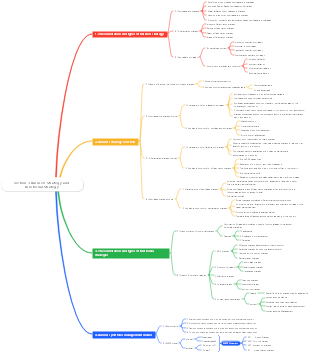
MindMap Gallery 2024 Advanced Accounting C1.1 Strategic Management Overview
2024 Advanced Accounting Textbook Mind Map, corporate strategy refers to a series of overall and long-term plans made by an enterprise based on a comprehensive analysis of its internal conditions and external environment in order to achieve long-term survival and development.
Edited at 2024-03-19 21:14:15This is a mind map about bacteria, and its main contents include: overview, morphology, types, structure, reproduction, distribution, application, and expansion. The summary is comprehensive and meticulous, suitable as review materials.

This is a mind map about plant asexual reproduction, and its main contents include: concept, spore reproduction, vegetative reproduction, tissue culture, and buds. The summary is comprehensive and meticulous, suitable as review materials.
This is a mind map about the reproductive development of animals, and its main contents include: insects, frogs, birds, sexual reproduction, and asexual reproduction. The summary is comprehensive and meticulous, suitable as review materials.
This is a mind map about bacteria, and its main contents include: overview, morphology, types, structure, reproduction, distribution, application, and expansion. The summary is comprehensive and meticulous, suitable as review materials.
This is a mind map about plant asexual reproduction, and its main contents include: concept, spore reproduction, vegetative reproduction, tissue culture, and buds. The summary is comprehensive and meticulous, suitable as review materials.
This is a mind map about the reproductive development of animals, and its main contents include: insects, frogs, birds, sexual reproduction, and asexual reproduction. The summary is comprehensive and meticulous, suitable as review materials.
C1.1 Strategic Management Overview
The connotation of strategy and enterprise strategic management
connotation
Corporate strategy refers to a series of overall and long-term plans made by an enterprise based on a comprehensive analysis of its internal conditions and external environment in order to achieve long-term survival and development.
Enterprise strategic management is a dynamic management process that selects and formulates effective strategies to achieve enterprise goals on the basis of analyzing the internal and external environment of the enterprise, and puts the strategies into implementation, control and evaluation. All overall and long-term plans for the enterprise belong to the category of strategic management.
in principle
1||| goal feasibility principle
2||| resource matching principle
3||| Responsibility implementation principle
4||| Collaborative management principles
elements
1||| Business Scope
2||| growth vector
3||| Competitive Advantage
4||| synergy
system
Overall corporate strategy (corporate-level strategy)
The overall corporate strategy is the action plan used by the company's top decision-makers to guide and control the company, and is generally formulated by the company's board of directors.
Overall corporate strategy classification
growth strategy
stable strategy
contraction strategy
Business strategy (business unit strategy/competition strategy/division strategy)
Business strategy refers to the departmental strategy designated by each strategic business unit under the guidance of the company's strategy, including making strategic decisions for specific products, markets, customers or geographical areas.
Business strategy classification
Cost leadership strategy
Differentiation Strategy
centralization strategy
functional strategy
Functional strategy refers to the strategy formulated by an enterprise based on specific management intelligence in order to implement and support corporate strategy and business strategy. The focus of corporate functional strategy is to improve the utilization efficiency of corporate resources and reduce costs.
Functional strategy consists of some detailed plans and plans, involving all areas of business management, such as research and development strategy, production strategy, human resources strategy, marketing strategy, etc.
program
Strategic management (application) procedures refer to specific procedures for enterprises to apply strategic management tools and methods.
content
Strategic Analysis
starting point. The main purpose is to evaluate the key factors affecting the current and future development of the enterprise.
strategy formulation
strategy implementation
strategic control
strategic evaluation
Strategic Realignment
Corporate vision, mission and strategic goals
Vision
mission
Strategic objectives
Strategic goals are the basic basis and starting point for enterprises to formulate strategies, and are the guidelines for strategy implementation and the evaluation criteria for strategic control.
The six main contents of the strategic goal system:
profit target
product goals
market competition goals
development Goals
Employee development goals
social responsibility goals
The basic goal of any corporate strategy is to obtain strategic competitiveness and excess profits
Methods to measure the competitive advantages of different companies
Key performance refers to KPI, balanced scorecard BSC, economic value added EVA, etc.
Strategic Analysis
一、 external environment analysis
(1) Macro-environmental analysis (PESTEL analysis method)
Key elements
1||| political environment factors
Including: social system, government policies, political groups and political situation, international trade barriers, bilateral relations, etc.
2||| economic environment factors
Including: economic structure, economic growth rate, fiscal and monetary policy, energy and transportation costs; consumption propensity and disposable income, unemployment rate, inflation and deflation, interest rates, exchange rates, etc.
3||| technical environment factors
Including: innovation mechanism, technology investment, overall technology level, technology transfer and technology replacement speed, R&D investment of corporate competitors, quality level and treatment of social technical talents, etc.
4||| ecological environment factors
Mainly refers to various natural resources and green environmental protection issues, such as water resources, land resources, pollution, etc.
5||| legal environment factors
Mainly refers to legal restrictions or legislative changes, such as national or local legal norms, national judicial and administrative law enforcement status, etc.
6||| social environmental factors
Including: education level, lifestyle, social values and customs, consumption habits, cultural traditions, etc.; population, transportation, infrastructure, etc.
step
1||| Consider each factor separately and identify the factors that need to be considered most
2||| Carefully analyze these factors and clarify their impact on corporate strategy
3||| Evaluate these factors and identify key strategic factors
(2) Industry environment analysis
Industry competition level analysis
(1) Analysis of the degree of competition among existing enterprises
1||| Industry growth rate analysis
2||| Industry concentration analysis
3||| Degree of difference and substitution cost analysis
4||| Economies of scale analysis
5||| Exit cost analysis
(2) Competitive threat analysis of new entrants
1||| Economies of scale
2||| Enter the advantage factors first
3||| Sales network and relationship network factors
4||| Legal and regulatory factors
(3) Threat analysis of substitute products or services
Market Bargaining Power Analysis
(1) Analysis of bargaining power between enterprises and suppliers
Influencing factors
1||| number of suppliers
reverse
2||| Importance of suppliers
forward
3||| Supply volume of a single supplier
forward
(2) Analysis of bargaining power between enterprises and customers
Influencing factors
1||| price sensitivity
The degree of price sensitivity depends on the degree of product differentiation and the level of substitution costs.
The degree of price sensitivity of customers also depends on the impact of the company's products on the customer's cost structure.
2||| relative bargaining power
(3) Michael Porter’s “Five Forces Model”
1||| Competition among new entrants
2||| Bargaining power of suppliers
3||| Bargaining power of buyers
4||| Threat of substitute products
5||| Level of competition among competitors in the same industry
(3) Business environment analysis
competitor analysis
competitive positioning analysis
consumer analysis
Consumption segmentation, consumption motivations and consumers’ unmet needs
Financier analysis
Analysis of labor market conditions
二、 internal environment analysis
(1) Enterprise resource analysis
Tangible resource analysis
Intangible resource analysis
HR analytics
(2) Enterprise capability analysis
R & D capabilities
Key factors to maintain competitive vitality of enterprises
It is mainly measured from several aspects: R&D plan, R&D organization, R&D process and R&D effect.
Production management capabilities
Mainly involves five aspects: production process, production capacity, inventory management, human resources management and quality management
Marketing ability
Product competitiveness, sales activity ability, market decision-making ability
financial capability
Ability to raise funds
Profitability in using and managing funds raised
Organizational management capabilities
Division of tasks in the functional management system
Job responsibilities
Centralization and decentralization situations
Organizational structure (line functions, business units, etc.)
Matching management level and management scope
(3) Enterprise core competitiveness analysis
Three elements of core competitiveness
Advantages over the company's competitors
valuable to customers
Difficult to imitate or copy
(4) value chain analysis
basic activities
Internal logistics, production operations, external logistics, marketing, service
Support activities
Procurement, technology development, human resource management, corporate infrastructure
Three main sources of corporate competitive advantage
Value activities themselves, internal connections in the value chain, and vertical connections in the value chain
(5) Strategic map analysis
balanced scorecard theory
The role of strategic maps
financial level
customer level
internal business process level
learning and growth aspects
Specific steps of strategy map
1||| Determine the shareholder value gap
2||| Align your customer value proposition
3||| Determine value improvement timeline
4||| Identify value creation processes or strategic themes
5||| Improve strategic asset readiness
6||| Determine strategic action plans and budget
Advantages of strategic maps
Disadvantages of strategic maps
strategy formulation
strategy development process
1. strategic suitability analysis
2. strategic screening
3. Feasibility analysis of strategy
4.
5. Strategic selection and action plan development
Types of strategy development
According to strategic level:
Corporate overall strategy formulation, business strategy formulation, and functional strategy formulation
According to the strategic development ideas:
Internal development strategy formulation, merger and acquisition strategy formulation, joint development and strategic alliance formulation, and internationalization strategy formulation
strategy implementation
strategy implementation model
1||| command mode
2||| transformative model
3||| cooperative model
4||| cultural model
5||| growth model
Strategy implementation support system
1||| organizational support system
2||| resource support system
3||| management support system
strategic control
Strategic Control and Management Control
broad strategic control
Strategy formulation control, management control, operation control
strategic control in a narrow sense
management control
management control procedures
five steps
1||| Breakdown of strategic goals
2||| Establishment of control standards
3||| Management Control Report
4||| Business performance evaluation
5||| Manager motivation
management control mode
Four major models
budget control model
Excitation control mode
institutional control model
Evaluation control mode
Goals, advantages, disadvantages
Comparison and selection of four major models