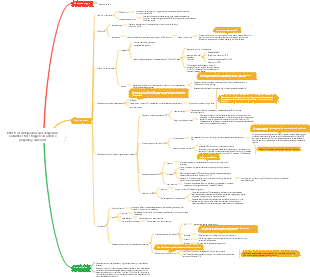
MindMap Gallery Literature Review Re-examination of the Audience Commodity Theory under the Platform Economy——Based on Marxist Political Economy
This is a mind map about literature review "Re-examination of "Audience Commodity Theory" under the Platform Economy - Based on Marxist Political Economy", including a brief framework and nouns and quotations.
Edited at 2022-10-28 18:24:32This is a mind map about bacteria, and its main contents include: overview, morphology, types, structure, reproduction, distribution, application, and expansion. The summary is comprehensive and meticulous, suitable as review materials.

This is a mind map about plant asexual reproduction, and its main contents include: concept, spore reproduction, vegetative reproduction, tissue culture, and buds. The summary is comprehensive and meticulous, suitable as review materials.
This is a mind map about the reproductive development of animals, and its main contents include: insects, frogs, birds, sexual reproduction, and asexual reproduction. The summary is comprehensive and meticulous, suitable as review materials.
This is a mind map about bacteria, and its main contents include: overview, morphology, types, structure, reproduction, distribution, application, and expansion. The summary is comprehensive and meticulous, suitable as review materials.
This is a mind map about plant asexual reproduction, and its main contents include: concept, spore reproduction, vegetative reproduction, tissue culture, and buds. The summary is comprehensive and meticulous, suitable as review materials.
This is a mind map about the reproductive development of animals, and its main contents include: insects, frogs, birds, sexual reproduction, and asexual reproduction. The summary is comprehensive and meticulous, suitable as review materials.
"Reexamination of the "Audience Commodity Theory" under the Platform Economy——Based on the Perspective of Marxist Political Economy" Lu Rong Ge Haoyang
simple framework
1. Research background
The rise of platform economy
The unique theoretical perspective of audience commodity theory
question
No detailed examination of the theoretical basis
Failure to reflect on applicability in platform economy
Purpose
Sort out and analyze the emergence, development and controversy
Understand the theoretical connotation and theoretical limits
Better conduct our own research on the political economy of Internet platforms
2. The era of traditional media: Smythe’s “audience commodity theory” and its development
Smythe’s “audience commodity theory”
origin
Thoughts on blind spots in Western Marxist research
Neglect of the economic functions played by the mass communication system
Basic logic (picture)
defect
It only explains the exchange value of “audience goods” or “audience power goods” without explaining the value itself.
How is the value of “audience commodity” or “audience commodity” determined, and what kind of workers’ abstract labor is condensed in it?
There are contradictions in the judgment of whether "audience labor" produces value and surplus value
Jehari and Levant’s “Viewing Time Commodity Theory”
origin
Make up for the lack of value determination of "audience commodities" in Smythe's theory
The value of the "viewing time commodity" is determined by the viewing labor time invested by the audience.
defect
meaningless tautology
It is not stated how the value of the “viewing ability product” is determined.
Conflicting accounts of the sources of surplus value derived from mass media
Is the surplus value obtained by mass media directly created by "audience labor"? Or is it a sharing of the surplus value of industrial capital in the distribution field?
Alan Meehan’s Concept of the “Ratings Commodity”
basic logic
In the field of communication, there are three types of commodities: information commodities, audience commodities and ratings commodities.
3. The era of social media: What exactly is commoditization?
Kang Xianjin and Matthew McAllister
Google enables widespread, transformative commoditization of users through omnidirectional surveillance
Mickey Lee
What Google sells is three kinds of information: keywords, ratings, and search results.
Alan Fisher
What is commodified is the acquaintance, social interaction and friendship between users (commodification of relationships)
Internet drives mobile devices
Rozelle
Named Mobile “Proseller Goods”
What is commoditized is user attention and user information (commodification of data)
4. Fox’s “Internet Proseller Commodity Theory”
Purpose
A comprehensive examination of production relations in social media platforms
Basic point
In social media, users realize the unity of producers and consumers in terms of identity, and are dual objects of commodification.
Social media platforms take ownership of data commodities with the help of Terms of Use and Privacy Policies and sell them to advertisers at a profit
Surveillance is an inherent feature of the capital accumulation model of social media platforms
defect
Skipping the question: What kind of activity can be called ‘labor’? Is it feasible to take it for granted that all activities are regarded as labor?
We have found the wrong real production subject of "data commodities" (the purpose of human labor), and failed to correctly reveal the production relations in social media platforms.
There is no clearer definition of "Internet prosumer goods". Does it refer to the user itself as a commodity? Or does it refer to "audience power" in Smythe's sense? Or "audience attention"?
5. Conclusion
Summary of reasons
There is a "logical cycle" in the theory itself
Abuse of universal connections between things
It is difficult to get rid of the dependence on the logical cycle path of "audience commodity - audience labor"
preventive solution
We should not blindly copy the theoretical logic and theoretical perspectives of the “audience commodity theory” of communication political economy.
Return to the basic theories and methods of Marxist political economy
nouns and quotes
①"Internet platform"
Currently, an important carrier of information is data stored in computer systems. The demand for data collection, processing and transmission has given rise to a new form of production organization - the Internet platform.
① [Canada] Nick Srnicek: "Platform Capitalism", translated by Cheng Shuiying, Guangzhou: Guangdong People's Publishing House, 2018, p. 49.
② "Audience Commodity Theory"
Dallas Smythe
One of the founders of the school of communication political economics, he proposed the prototype of the "audience commodity theory" in the 1950s, and formally proposed a systematic "communication" in his 1977 paper "Communication: Blind Spots of Western Marxism" Audience Commodity Theory”.
Why was it proposed?
It begins with reflections on the blind spots in Western Marxist research: “The analysis of Western Marxists ignores the political and economic significance of the mass communication system...Marxists and those radical social critics who invoke Marxist terminology often Locating the significance of the mass communication system in its ability to produce 'ideology', they believe that ideology, the invisible 'glue', enables capitalism to become a whole... However, for Marxists In short, this explanation is unsatisfactory.
definition
Scholars of communication political economics have widely used the classic analytical framework of “audience commodity theory” proposed by Dallas Smythe, treating the Internet platform as a new communication medium to conduct critical research on political economy. The "audience commodity theory" makes "audience" or "user" an active subject in the platform economy, opening up a unique theoretical perspective for the study of the political economy of Internet platforms.
③"Viewing time commodity theory"
Sut Jhally and Bill Livant
Why was it proposed?
Revising Dallas Smythezheng’s “Audience Commodity Theory”
definition
If viewed from a media perspective, "what the media sells to advertisers is viewing time," so the essence of the "audience product" produced by mass media and sold to advertisers is a "viewing time product." In their theory, the audience no longer performs marketing labor for advertisers, but performs "viewing labor" for the media. This labor produces "viewing time commodities" that can be appropriated by the mass media. The mass media Viewing time merchandise” is sold to advertisers to obtain residual value.
Theoretical model (pictured)
④Apply the “audience commodity theory” to Google
Hyunjin Kang and Matthew P. McAllister
How to use it?
Google has achieved widespread and transformative commoditization of users through omnidirectional surveillance. In the Google platform, not only users are commoditized, but also various components of users, including their activity data, aggregate awareness (keyword trends), and social relationships. Compared with traditional media, Google's comprehensive monitoring of users through interactive technology has strengthened the level of user commercialization.
Theoretical model (pictured)
⑤ "Internet Prosumer Commodity Theory"
fox
Reflected in his book Digital Labor and Karl Marx
Theoretical model (pictured)