 Wondershare EdrawMind
MindMap Gallery GMAT-SC test center appearance summary
- 26
GMAT-SC test center appearance summary
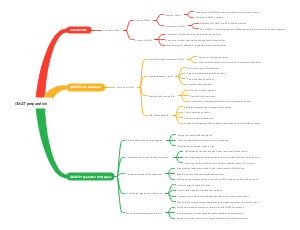
Anyone who takes the GMAT exam knows how hard SC is. This is what I compiled by myself, how to solve the problem according to the grammatical forms that appear in the SC questions. Hope it helps you.
Edited at 2020-09-06 06:24:24
- bacteria
This is a mind map about bacteria, and its main contents include: overview, morphology, types, structure, reproduction, distribution, application, and expansion. The summary is comprehensive and meticulous, suitable as review materials.
- Plant asexual reproduction
This is a mind map about plant asexual reproduction, and its main contents include: concept, spore reproduction, vegetative reproduction, tissue culture, and buds. The summary is comprehensive and meticulous, suitable as review materials.
- Reproductive development of animals
This is a mind map about the reproductive development of animals, and its main contents include: insects, frogs, birds, sexual reproduction, and asexual reproduction. The summary is comprehensive and meticulous, suitable as review materials.
GMAT-SC test center appearance summary
- bacteria
This is a mind map about bacteria, and its main contents include: overview, morphology, types, structure, reproduction, distribution, application, and expansion. The summary is comprehensive and meticulous, suitable as review materials.
- Plant asexual reproduction
This is a mind map about plant asexual reproduction, and its main contents include: concept, spore reproduction, vegetative reproduction, tissue culture, and buds. The summary is comprehensive and meticulous, suitable as review materials.
- Reproductive development of animals
This is a mind map about the reproductive development of animals, and its main contents include: insects, frogs, birds, sexual reproduction, and asexual reproduction. The summary is comprehensive and meticulous, suitable as review materials.
- Recommended to you
- Outline
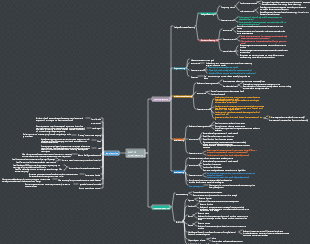

SC
syntax
There is no main predicate verb in the sentence
Nouns and pronouns act as appositives to form double subjects
There is no conjunction between sentences: run-on
Sentence Structure
Test points
attributive clause
that cannot introduce non-restrictive attributive clauses
Be careful with the ", that" structure brought about by parentheses
Attributive clauses cannot modify an entire sentence
Restriction - "SVO which", which jumps to modify any previous noun, judged by the meaning of the sentence
Non-limited - "SVO, which", which modifies the noun or noun phrase closest to it
RUN-ON
Conjunction - joins two sentences
AS, conjunction, one means because (=for=because), the second means "with", the third means "just like; just as"
Just as…so…fixed collocation
The predicate verbs before and after the sentence should be unified
WHEREAS, conjunction, sometimes indicating a contrasting transition
Common conjunctions: FANBOYS-For, And, Nor, But, Or, Yet, So.; when, while, although, though, because, before, after, if, whenever, wherever, etc.
Conjunctions can connect sentences, but they don’t have to connect sentences.
Note that the sentence "I run, jump." does not commit any test-related problems. It can be said that it is not excellent, but it cannot be said that this sentence is wrong. Weirdness and awkwardness are not the test points.
Adverb - cannot connect sentences
Four major adverbs: then/ thus/ therefore/ however
noun parallel
noun parallel to noun
phrase parallel
Judged by the modifying effect of the phrase
Verb phrases should be parallel to verb phrases
Sentence parallelism
The main clause should be parallel to the main clause
The clause must be parallel to the subordinate clause - the introductory word cannot be omitted for parallel clauses
When it is difficult to judge, choose a clause and a clause that is parallel
parallel structure
Test points
open parallel
Sign words: And, But, Or, Yet, Rather than
The essential structure is "sentence partB", partB can be parallel to any part of the sentence part
There are so many possibilities, so don’t make assumptions
Don't judge the meaning of the sentence by reading the question. Look at the grammatical structure of the sentence first and then the meaning. The options determine the meaning.
closed parallel
Sign words: not only…but also…; both…and…; either…or…; neither…nor…; not…but…
Parallelism recognizes the functional properties of enclosed structures rather than their appearance
not only…but also…inversion: Not only inversion <auxiliary verb/modal verb subject>, but also in forward order.
Many are parallel
In the questions, two signal words are usually given
The rules for the juxtaposition of multiple words and phrases are the same as the juxtaposition of both.
Exception: Only neat parallelism is allowed - parallelism between sentences, not run-on.
Conjunctions and semicolons do not necessarily follow sentences. Symbols are not test points. Do not go to places that are not test points to do questions!
open parallel steps
When you see the sign word, confirm that this question is about parallelism.
Analyze options: Determine the nature of each option partB, whether it is a word, a phrase, or a sentence
Work forward and backward according to the subdivision of words, phrases and sentences to see if there are any parallels in the sentences.
If there is no corresponding parallel structure in "sentence", the item is excluded
Check whether the logical meaning of the parallel sentences in the remaining options is reasonable.
closed parallel steps
Similar steps to open parallel problem solving
It can be judged whether it is a word, a phrase, or a sentence by the nature of the closed structure of the ununderlined part of the question stem.
"Comparative than" appears in the sentence
If more than/less than means "more than/less than" modification, it is not a comparison.
multiple
Multiples as much as/ as many as uncountable/countable
Multiples the amount of /the number of uncountable countable
A is a multiple of B
times as adij./adv. as, as cannot appear in single form
(as) compared to/with
compare structures
Knowledge points
Usage of compare/contrast
(as) compared to/with (GMAT does not differentiate between to and with), omitting the subject and linking verb, that is, A be compared with/to B, and in contrast to are both idiomatic uses, and the objects of comparison must be equal. .
Test points
noun and noun ratio
Examine the comparison between "a certain noun after as/than" and "the subject of the sentence where the comparative is located".
The objects of comparison must be comparable
The internal relationship form of comparison must be consistent (not appearance)
Comparison between preposition position and preposition position
Subordination and subordination comparison (of/'s)
Comparison between modifying relationship and modifying relationship (modification of adjective properties)
Sentence vs. Sentence
Predicate verbs can be preceded
Subject and predicate can be omitted
The form of the predicate verb must be consistent can/do/be, etc.
step
When you see "comparative than" or multiples, make sure this question is about comparison.
Analyze options: which options are noun-to-noun comparisons and which are sentence-to-sentence comparisons
If it is a noun, determine whether the comparison object is comparable and determine the form of the internal relationship.
If it is a sentence, please note that the predicate verb can be preceded, and the subject and predicate can be omitted in the sentence
You can compare in any way, and you can only eliminate the most unlikely answers.
There is doing/done in the question, and the subject is on the horizontal line
after doing/ before doing/ despite doing/ if done, SVO
Although/ though/ when/ while doing/ done/ n./ adj. , SVO.
n, SVO.
Like/ Unlike n, SVO.
adj, SVO.
logical subject
Test points
Doing/done, SVO. or the doing/done in SVO, doing/done. must comply with S
The focus of the sentence: "Because doing/done, there is the result of the stem verb V"
The SVO that modifies O, doing. is the same as the SVO that expresses the same meaning, which. The latter is better
Because grammatically, the speaker of the doing/done action in SVO, doing/done. can be S, it can be O, or it can even be the entire sentence. But in SVO, which., the supplementary modification of which can only be O.
Like and unlike can only be followed by a noun, and this noun is compared with the subject of the main clause.
It's a comparison, not an analogy. It depends on the meaning of the sentence.
Sandwich modification is not a mistake, it is just suboptimal; it is not an absolute rule.
There may be ambiguities, but they cannot be eliminated as the first step and should be analyzed at the end.
adj, SVO.
-ed modifies person, -ing modifies object; adjective modifies subject S
SVO, with n noun modifier.
Independent nominative case
Test points
Noun modifiers: done passive/doing active/to do indicates purpose/adj indicates modification/preposition indicates location
n will not repeat any noun in the previous main clause SVO; nor is it required that this n must be related to the main clause
with can be omitted or omitted; with with as an ordinary preposition in with n is translated as "carrying"
There is no logical relationship between the main clause and the with structure; therefore, if there is a better option that can reflect their true logical relationship, such as although/because, etc., it is best to choose the latter first
SVO, _______.
Possible test points
run-on
Independent nominative case
Clause: general appositive, adverbial clause
Since the subject is not underlined, your logical subject-participle modification will not be tested.
Lexical
object case of personal pronouns
Demonstrative pronouns appeared out of thin air
Is the introductory word of the attributive clause - the relative pronoun - used correctly?
pronoun
pronoun type
Personal Pronouns
Nominative: I/ you/ we/ he/ she/ it/ they
Accusative: me/ you/ us/ him/ her/ it/ them
Demonstrative
this/ that/ these/ those
The GMAT test does not recognize demonstrative pronouns, such as That is a car./ I like these.
relative pronoun
introductory word of attributive clause
that/ which/ who/ whom/ when/ where
why: explain the reason
whose: can refer to people or things
Knowledge points
After a preposition or verb, the pronoun takes the accusative form
Using demonstrative pronouns out of thin air will not be recognized on the GMAT exam. However, this/that/these/those can also be used as ordinary pronouns to refer to a certain noun. (Compare structure)
Use who for people, which for things, and that for people or things. For the person who is the object, use who (sometimes also use who)
when: It must modify a certain time; the antecedent is time, so you must use when
Where: It must be a real place, like situation, it is not a real place. [If you want to write a virtual location, such as condition, you must use the "preposition which"]
Test points
In most cases, the pronoun refers to the preceding noun (the noun that has appeared before)
Unknown reference: Only when the "form and meaning of the sentence" are unclear, is the real reference unclear.
In an adverbial clause or an adverbial clause, the pronoun can appear first (not the antecedent)
As long as the main clause SVO has an object to refer to, it is OK
Example: In his school, Tom is popular.
Note: Singular and plural nouns are not a test point in the GMAT!
tense
Time: past, present, future, past future
Status: general, ongoing, completed, completed ongoing
Which tense to use depends on how we emphasize the impact of the action on the future.
voice
initiative
passive
be past participle
Causative verb: have sth done-use active to express passive
Tone
statement, question, imperative, virtual
Verb forms vary depending on mood
The predicate precedes the corresponding subject
verb
Knowledge points
Singular and plural forms
General: The singular form of the noun means the verb is singular, and the plural form of the noun means the verb is plural.
Collective nouns, such as the family, can be singular or plural
According to the meaning of the sentence, express a whole or all the internal members
Uncountable nouns, such as water, singular form
Quantification: numerals, quantifiers, prepositions
the fish
fish, singular
Fish, the singular and plural have the same shape, and can be singular or plural
Judge by whether there are signal words in the ununderlined part
noun 1 preposition noun 2
The singular and plural depend on the singular and plural form of the noun 1
the number of the students uses the singular verb as the predicate
Fixed match
a number of = many, use plural
Neither either…or…/Either of the two is neither neither…nor…, the proximity principle depends on the part after or/nor
Restrictive attributive clauses can jump to modify nouns, so they must be judged by the meaning of the sentence.
Flip
Trigger condition: preposition/prepositional phrase indicating location, predicate, subject
Past future tense: used to describe the future that was thought to be at a point in time in the past - with a virtual flavor
Perfect Continuous Tense: a continuous state used for an action to do something within a certain period of time
signal word
In
In 1990/the action corresponding to XX in the past year is the past tense
In 2020/The action corresponding to XX in a certain future year is the future tense
Since
Since 1990Corresponding action-present perfect tense
After
After 1990 corresponding action-simple past tense
By
By 1990Corresponding action-past perfect tense
Until recently
recently is not any time signal word
Corresponding action until recently - simple past tense
Earlier in the year
Earlier in the year corresponding action - past perfect tense
Test points
time is greater than state
Look at the ununderlined part [when]
Choose the same camp, not the perfect answer
Through logical judgment of sentence meaning [time]
Occasionally take the test [state]
Two past actions appear, Use the past perfect tense for actions that occurred earlier.
Must use present tense
Natural laws: animals and plants, astronomy and geography
Character characteristics: talent, appearance (do not consider changes brought about by time, unless the difference between the present and the past is clearly mentioned
Novel plot/laws and regulations
In paraphrasing, the expression of the simple present tense cannot be changed.
Singular and plural forms of verbs
but! The singular and plural forms of nouns are not test points in the GMAT
Pay attention to signal words
if introduces subjunctive mood
Conditional sentence: subject will come first
require/ request/ demand/ propose that sb/sth (should) (not) do
When you see an option that omits should, don’t select it immediately. Look for other syntax and lexicon before choosing.
as if=as though
For the current virtual: were/did
Example: He speaks English so fluently as if he lived in Britain.
Virtual past: had done
Example: He spoke English so fluently as though he had lived in Britain.
Pay attention to the questions
When you see a passive sentence, see if it can be reduced to active
After passing the present simple tense, think about whether this question is true.
The GMAT test is not whether you use the subjunctive mood, but whether you use the subjunctive mood correctly.
logic
Sentence meaning
Is it consistent with common sense?
Compare options
Lift the trunk
Sentence focus
Lift the trunk
uniqueness of sentence meaning
Compare options
You can feel it by looking at "Logical Subject"
semantic repetition
Compare options
For example, a sentence is modified by both annually and each year.
Respect the original sentence
It is easy to cause controversy and the inspection rate is extremely low.
If there are no above four issues, then consider whether to respect the original sentence
concise
simplicity principle
Active>Passive
Subject, predicate and object>subject list>there be
Simple sentences>clauses>combined sentences (and connects two sentences)
verb>noun>doing
Parallel structure: word>phrase>sentence
appositive first
When expressing because, because/since/for is the most concise
Notice
Never use the principle of simplicity in the first step