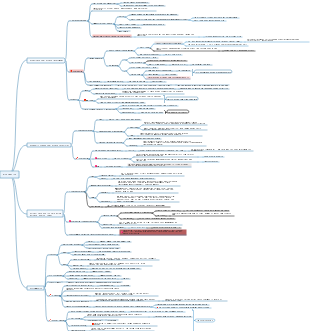
MindMap Gallery CFA Level 2 Rights Mind Map
This self-made mind map is suitable for JC online courses. All knowledge points are sorted out for everyone, making it easier for everyone to read and review when preparing for the exam, helping everyone deepen their memory and improve review efficiency.
Edited at 2021-05-31 16:39:18This is a mind map about bacteria, and its main contents include: overview, morphology, types, structure, reproduction, distribution, application, and expansion. The summary is comprehensive and meticulous, suitable as review materials.

This is a mind map about plant asexual reproduction, and its main contents include: concept, spore reproduction, vegetative reproduction, tissue culture, and buds. The summary is comprehensive and meticulous, suitable as review materials.
This is a mind map about the reproductive development of animals, and its main contents include: insects, frogs, birds, sexual reproduction, and asexual reproduction. The summary is comprehensive and meticulous, suitable as review materials.
This is a mind map about bacteria, and its main contents include: overview, morphology, types, structure, reproduction, distribution, application, and expansion. The summary is comprehensive and meticulous, suitable as review materials.
This is a mind map about plant asexual reproduction, and its main contents include: concept, spore reproduction, vegetative reproduction, tissue culture, and buds. The summary is comprehensive and meticulous, suitable as review materials.
This is a mind map about the reproductive development of animals, and its main contents include: insects, frogs, birds, sexual reproduction, and asexual reproduction. The summary is comprehensive and meticulous, suitable as review materials.
equity
concept
liquidation value<intrinsic value=fair market value<investment value(=IV synergy)
sum of the parts valuation(breakup value,private market value)
conglomerate discount explanation
inefficiency of internal capital markets;endogenous factors
valuation process
understand the business
industry(porter’s five forces)
company(cost leadership;differentiation;focus)
forecasting company performance
select model
converting forecasts to a valuation
situational adjustments(control premium;lack of marketability analysis)
make the investment decision
return
HPR (holding period return)
=(p1-p0 D)/p0
realized return
backward-looking, based on historical data
realized alpha(ex post alpha)
expected return
forward-looking
expected alpha(ex ante alpha)
It needs to be annualized, and the calculation is the same as HPR (Div/p➕delt p/p)
Alpha (abnormal return)
momentum valuation indicators
trend investment
unexpected earning=EPS-E(EPS)
Standardized unexpected earnings=EPS-E(EPS)/standard deviation of{EPS-E(EPS)}, the standard deviation is past unexpected earnings
relative strength(RSTR)indicators
Cannibalizatiin
A new product that threatens to cannibalize demand for an existing product
B/S.I/S forcaste
return on invested capital(ROIC)
Not affected by leverage
return on capital employed
before tax, different tax structures can be compared
I/S: R (3), COGS (historical average gross profit margin), SGA (historical expense rate), Net int exp (debt level * market interest rate) tax rate (use effective tax rate
B/S: Working capital item (turnover), long-term assets and liabilities (according to plan or budget)
In the short term, use a separate forecast of the income statement and the balance sheet to forecast the next year. Long term use of model g
summary
Discount rate r
different caliber
required rate of return
cost of capital/equity
opp cost
IRR (efficient market)
ERP (equity risk premium)
=Rm-Rf Risk premium of the broad market index
calculate
historical estimate
Sample selection
index should be relatively stationary
time period(more longer,more precise)
Contradiction, solution: period-, frequency
The impact of different methods
1
arithmetic mean
Big,ERP,Re,value-
geometric mean
Small,ERP-,Re-,value
Rf risk-free rate of return
long term:Rf, short term:Rf-;Re not certain
survivorship bias is a bias that only occurs based on historical data
(results over-estimate return on index)Rm, ERP, Re
forward-looking(ex-ante)estimate
GGM
Rm=D1/P0 g (data for the entire market), ERP=rm-rf
Rm the return rate of the entire market
D/P is div yield
macroeconomic model (supply-side estimate)
ERP={(1 i)(1 EPS%)(1 P/E%)-1} div yield-Rf
i(expected/estimatte inf) The growth rate of listed companies EPS% takes precedence over GDP% (substitutable but not equal to); pay attention to the nominal or real growth rate
survey estimate
calculate
CAPM
Notes on public beta
Sample selection time range: common (5y monthly data, 60 observations); fast growing market (2y weekly observations)
Blume adjust
=2/3unadjusted beta 1/3
non public beta (pure play method)
eg add leverage Basset=1/(1 D/E) *Bequity
D/E of listed companies for deleveraging, D/E of unlisted companies for leverage
multifactor model
Variables must meet zero sensitivity and have no multicollinearity.
require return=Rf Bmkt(Rmkt-RF) Bsize(Rsmall-Rbig) Bvalue(Rvalue-Rgrowth) Bliq(Rll-Rhl)
Fama-French model (3 risk factors)&Pastor-Stambaugh model (4 risk factors)
Describe the characteristics according to B: B is greater than 0 and satisfies the previous attributes in the brackets, and vice versa.
build-up method
1
B=1, applicable to unlisted companies
R=rf equity risk premium size premium specific-company premium
2
bond yield plus risk premium method
cost of equity=YTM on the company long term debt risk premium
Understand the risk consideration model when it comes to overseas investments
Country spread model
Equity risk premium=Equity risk premium for a developed market country premium
Country risk premium model
RP factor adjustment for each developed country
discounted div valuation
minority shareholders
concept
Gordon growth(maturity);two stage(growth transition company);three stage(initial growth)
spreadsheet modeling
(excel)apply to any pattern of div growth.flexibility and computational
The intrinsic value of preferred shares is equivalent to a perpetual annuity, g=0 (capitalization rate=r-g=r)
g(sustainable growth rate)
g=b*ROE=(1-pay out ratio)ROE
b=(NI-div)/NI=1-div/NI
r
Determined by the discount rate corresponding to the time period
GGM
Assumption:div will grow at a constant rate,g,forever;r>g
calculate
V0=D1/(r-g)
When D1 is not equal to D0 (1 g), D1 shall prevail
Pay attention to the time point where the terminal value is located
PVGO (present value of growth opportunities)
=D1/(r-g)-E1/r
If E0 is not equal to E1, give priority to E1
The model dividend growth starts from D1 and does not require the growth to start from time o.
P/E
market P/E(P/E)
justified P/E(V/E)
Leading P/E=P0/E1=(1-b1)/(r-g)
trailing P/E=P0/E0=(1-b0)(1 g)/(r-g)
The difference between the questions E1 (expected, estimated).E0
multistage
two/three stage;H model
H model note the year
calculate
Valuation
terminal value (calculated by 1GGM2 price multiple EPS*PE
Free cash flow method
controlling shareholder
Calculate items
NCC
WCinv
FCinv
N.B.
formula
FCFF
FCFE
Consider preferred stock
valuation
single stage
two-stage
three-stage
Residual income valuation
Formula calculation
shareholders' residual income
RI=NI-BO*Re=B0(ROE-r)
As the company matures, ROE approaches Re
Note: The question may have known EBIT recommendation NI;
B0~B1
B0 NI-Div=B1
NI, DIV, NI form may be per share
equity value=RI PV0 B0
company residual income
EVA(Economic value added)=EBIT(1-T)-CAPITALInitial*WACC
Firm value=EVA PV0 capital0
EVA PV0 = MVA company's overall excess return in the current present value
single-stage
V0=RI1/(r-g) B0=BO(ROE-r)/(r-g) B0
Justified P/B
=1 (ROE-r)/(r-g)
eg;P/B>1,ROE>r,RI>0, there is excess return
Asking for implied g
multistage RI Model
stage1
BO(RI1)~B1(RI2)...
stage2
PVt=RIt 1/(r-g)
g=0,perpetual annuity
g=-1,RI is zero
g=w-1,RI decreased to zero
subtopic
RI decreased to some level,RI PVt=Vt - Bt
BO is displayed as BV. If BV is not equal to FV, B0 is inaccurate.
persistence factor
0<w<1, the larger the value, the slower the decay, the smaller the value, the faster the decay.
High and low influencing factors
Advantages and Disadvantages
RI<0 is also acceptable, BO large part
Assuming the premise is clean surplus relation, the only factor affecting the change of equity is R/E, eg: OCI changes greatly, that is, the model is unavailable.
market valuation price multiples
P/E
calculate
leading(forward)P/E & Trailing P/E
Drawback
NI<=0, not available; E includes unsustainable projects; EPS distort
EPS normalize (remove the impact of economic cyclicality)
historical ave EPS; while ignoring the increase in EPS caused by scale factors
ave ROE;
PEG ratio
P/B
B:BVPS
If B does not contain preferred shares, use the equity on B/S minus preferred equity when calculating
Advantages and Disadvantages
BV stable than EPS, always >0; suitable for financial institutions BV=MV
ignore size difference; influenced by accounting choices
justified P/B
=(ROE-g)/(r-g), combined with residual income model
P/S
Advantages and Disadvantages
not volatile as P/E ratio
justified P/B
=(1-b)(1 g)/(r-g)
EV/EBITDA
enterprise value=MV common stock MV preferred stock MV of debt-cash-short term investment
EBITDA Advantages
Applicable to different financial leverage and different capital-intensive tax rates; generally positive
The lower the better
D/P
trailing div yield
leading div yield
justified div yield=(r-g)/(1 g)
The bigger the better
Calculate Portfolio Return
Harmonic mean, weighted harmonic mean (most accurate) Count both
private company valuation
financial statement adjustment
normalized earnings
Eliminate nonrecurring, unusual items, overvalued exp, and assets that have nothing to do with the company's daily operations.
synergy
For strategic investors plus
estimate cash flow
FCFF,FCFE
Valuation
income approach
free cash flow method(2 stage)
capitalized cash flow method(CCM,single stage)
Note: capitalization rate:r-g
excess earnings method (EEM, essentially calculating the value of intangible assets)
5 steps
market approach methods
guideline public company method (GPCM), comparable company law
guideline transactions method (GTM), comparable transactions method
prior transaction method(PTM)
Asset-based approach
appropriate for
Financial assets, investment banking, real estate; small business or early stage company
Drawback:regardless The value generated by company growth. Based on the current situation, the calculated value is low. Not applicable FV is difficult to measure
discount rate for private
First calculate according to the method of listed companies
CAPM;Expanded CAPM;build-up method
then adjust
4 factors
Discount and premium for controlling interest
Discount for lack of control calculation=1-1/(1 control premium)
discount for lack of marketability
total discount
=1-(1-DLOC)(1-DLOM)