 Wondershare EdrawMind
MindMap Gallery Self-Study on Engineering Management--Engineering Economics 04624 Subject
- 64
Self-Study on Engineering Management--Engineering Economics 04624 Subject
Self-study Engineering Management - Engineering Economics 04624 subject, including cash flow and its composition, time value of funds and equivalent calculations, basic methods of economic evaluation of investment projects, etc.
Edited at 2024-03-06 20:09:41
- bacteria
This is a mind map about bacteria, and its main contents include: overview, morphology, types, structure, reproduction, distribution, application, and expansion. The summary is comprehensive and meticulous, suitable as review materials.
- Plant asexual reproduction
This is a mind map about plant asexual reproduction, and its main contents include: concept, spore reproduction, vegetative reproduction, tissue culture, and buds. The summary is comprehensive and meticulous, suitable as review materials.
- Reproductive development of animals
This is a mind map about the reproductive development of animals, and its main contents include: insects, frogs, birds, sexual reproduction, and asexual reproduction. The summary is comprehensive and meticulous, suitable as review materials.
Self-Study on Engineering Management--Engineering Economics 04624 Subject
- bacteria
This is a mind map about bacteria, and its main contents include: overview, morphology, types, structure, reproduction, distribution, application, and expansion. The summary is comprehensive and meticulous, suitable as review materials.
- Plant asexual reproduction
This is a mind map about plant asexual reproduction, and its main contents include: concept, spore reproduction, vegetative reproduction, tissue culture, and buds. The summary is comprehensive and meticulous, suitable as review materials.
- Reproductive development of animals
This is a mind map about the reproductive development of animals, and its main contents include: insects, frogs, birds, sexual reproduction, and asexual reproduction. The summary is comprehensive and meticulous, suitable as review materials.
- Recommended to you
- Outline
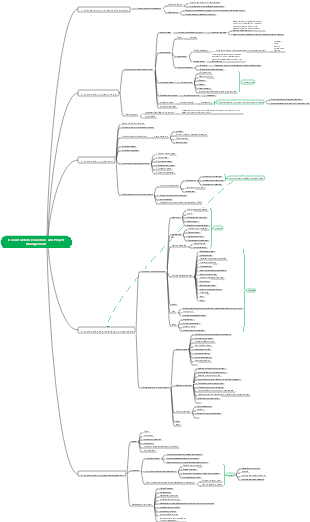
Engineering economics
introduction
The emergence and development of engineering economics
Targeted at engineering projects Using economic analysis methods as a means Study economic issues and economic laws in the field of engineering Study how to effectively utilize resources and improve economic efficiency
2. Research objects The relationship between engineering and economics The practical effect of engineering technology How to promote economic growth through technological innovation and progress
Research objects and characteristics of engineering economics
research content Basic knowledge of engineering economics Evaluation indicators and feasibility of independent solutions Choice of multiple plans Financial, national economic, social and environmental assessment risk and uncertainty analysis of the project Improvement analysis of solutions (value engineering)
Features: Comprehensive Practicality comparative Predictive Quantitative
Basic principles of economic evaluation of investment projects
Cash flow and its composition
Concept: Funds flowing out or into the system (project) during the entire calculation period Net cash flow: cash inflow – cash outflow
cash flow diagram
Sequence diagram describing cash inflows and cash outflows at various points in time during the entire calculation period of the project Components: size of cash flow, direction of cash flow, timeline, time point
Time value of money and equivalent calculation
time value of money
The difference in value of equal amounts of funds incurred at different times Money increases in value over time. Once money is invested, it cannot be spent.
Factors affecting funds: the size of the fund itself, yield (or interest rate), length of time, inflation factors, risk factors
Manifestations: Interest Remuneration for giving up the right to use funds interest rate The ratio of the interest received to the principal in an interest calculation period. Usually expressed as a percentage
Calculation: ① Simple interest method: interest is calculated on the original principal in each period ② Compound interest method: The interest for each period is calculated based on the sum of the original principal and the interest of the previous period.
3. Expression form I--Interest P--principal n--number of interest calculation periods i--Interest rate F - Sum of principal and interest
Simple interest method F=P(1 i*n) I=P*i*n Compound interest method F=P(1 i)n I=F-P=p[(1 i)n-1
Equivalent calculation of funds
Taking into account the time factor, different amounts of funds at different points in time may have the same value under certain interest rates.
basic formula
i--Interest rate P -- present value F--final value n --number of interest calculation periods
One-time payment type
The present value formula of compound interest: P=F/(1 i)n
Basic formula for equivalent calculation:
i--Interest rate P--present value F--final value n --number of interest calculation periods A--equal annuity
Future value formula for equal payments
F=A*(1 i)n-1/i
The formula of equal installment sinking fund A=F*i/((1 i)n-1)
The present value formula of equal payments P=A*((1 i)n-1)/(i(1 i)n)
Equally paid capital recovery formula A=P*(i(1 i)n)/(1 i)n-1)
Nominal interest rate and real interest rate
The time unit for calculating interest is different from the time unit for interest rate, resulting in the conversion of nominal interest rate and actual interest rate.
r--nominal interest rate i --actual interest rate P--principal at the beginning of the year F--Principal and profit at the end of the year L--interest generated within 1 year m--number of interest calculations in 1 year
F=P(1 r/m)m L=F-P=P*((1 r/m)m-1) i=L/P=(1 r/m)m-1
push to process
Basic methods of economic evaluation of investment projects
Engineering project investment
In order to achieve a specific purpose and achieve expected returns, all the capital investment made by the investment entity from the beginning of the project preparation to the completion and commissioning of the project
constitute
Approximate method
Construction investment: all construction costs spent during project preparation and construction
Interest during the construction period: interest that occurs during the construction period when raising debt funds and is allowed to be included in the original value of the fixed assets after it is put into production according to regulations, that is, capitalized interest
Working capital: after the production and operation project is put into operation, the working capital necessary to purchase raw materials, fuel and power, etc.
formed assets approach
Fixed asset expenses
Intangible asset expenses
Other asset charges
Preliminary expenses
Cost expenses: all expenses incurred by the enterprise to produce products or provide services during the operation period
Production cost plus period cost estimating method
Total cost = manufacturing cost period cost ① Manufacturing costs: direct labor costs, direct material costs, manufacturing costs, other direct expenses Period expenses: administrative expenses, financial expenses, sales expenses
factors of production method
Total cost = purchased raw materials, purchased fuel and power, wages and benefits, repairs, other expenses, depreciation, amortization, interest expenses
Related concepts
Operating cost = total cost - depreciation - amortization - interest expense Fixed costs are costs that are within a certain range of production and do not change with production. Variable costs: Various expenses that change in proportion to the increase or decrease in output Sunk cost = book value of old assets – current market value Opportunity cost: the cost of using resources for one purpose and giving up other uses cost
Income, taxes and profits
Income: The income of an enterprise from production and operation activities and non-production operation activities that can lead to an increase in the enterprise's net assets, including operating income, investment income, and non-operating income ● Narrow sense: the operating income obtained by an enterprise from its production and operation activities
Income from selling products or providing services after the project is completed and put into operation Annual operating income = Product sales unit price X product annual sales volume
Taxes: Taxes levied based on the turnover of goods or services include value-added tax, business tax, consumption tax, resource tax, urban maintenance and construction tax, education surcharge, etc.
profit: Profit = operating income - total costs - business taxes and surcharges.
income tax Income tax payable = taxable income x applicable tax rate net profit Net profit = profit - income tax
Economic benefit evaluation
Concept: the ratio of useful results achieved by people in economic practice activities to labor consumption
Evaluation Principles of Economic Benefits Combining technology and economics Combining qualitative and quantitative analysis Combining financial analysis with national economic analysis Meet the principle of comparability
Several aspects of the principle of comparability Comparable to meet needs Comparable output, Comparable quality, Comparable varieties Comparable consumption costs Comparable price Comparability of time
Basis for the indicator system: whether to consider the time value of funds
static evaluation index
(1) Meaning: From the date of project construction, the length of time required to use the project's annual net income to recover all the investment at the beginning of the period
total investment return Net profit margin on capital static payback period interest coverage ratio debt service ratio Assets and liabilities
Formula: CI --cash flow CO --cash outflow Pt=T-1 The absolute value of the cumulative net cash flow in year (T-1)/the net cash flow in year T Pc--Benchmark investment payback period Pt≤Pc, the plan is feasible
Dynamic evaluation indicators
Internal rate of return: IRR Meaning: The rate of return when the net present value is equal to zero Economic meaning: The profitability of the project that has not yet recovered the investment Single plan: IRR≥ic Accept the plan Net present value NPV: (1) Meaning: According to a given discount rate, discount the net cash flows occurring in each year of the project calculation period to the sum of the present values at the beginning of the construction period Calculation: Single plan: NPV≥0, accept the plan Net present value rate NPVI: Meaning: Meaning: the ratio of the project's net present value to the project's total investment present value Single plan: NPVI>0, accept the plan Mutually exclusive solutions with the same life span: the larger the NPVI, the better the economic effect of the solution net annual value Present value of costs and annual value of costs Dynamic payback period
(1) Meaning: taking into account the time value of funds, the time required to recover all investment with the net income of each year of the project
Calculation formula CI--cash inflow CO--cash outflow Pt--dynamic payback period ic--base discount rate
Calculation formula Pt--dynamic payback period T-The number of years in which the discounted present value of the cumulative net cash flow of the project in each year has a positive value Pt=T-1 The absolute value of the discounted present value of the accumulated net cash flow in the previous year/the discounted present value of the net cash flow in the current year Evaluation criteria: Pc - benchmark investment payback period Pt ≤ Pc, the plan is feasible
Plan options and types
Plan type
independent plan Among a set of alternative investment options, the adoption of one option does not affect the adoption of other options Comparison and selection: no constraints (depends on own economics) Evaluation method ① Investment rate of return, static investment payback period (static) ② Net present value, net annual value, internal rate of return (dynamic) resource constraints Choose from thousands of alternatives to maximize the total investment benefit
mutually exclusive scheme Various solutions for the same project can be substituted for each other. If you adopt one solution, you cannot adopt other solutions. Comparison and Selection: Absolute Effect Test Examine the economic effects of each option and find out all feasible options Relative effect test Compare the solutions that pass the absolute effect test in pairs until the optimal solution is found. Evaluation method ① Static: incremental investment return rate, incremental investment payback period, annual conversion cost, total comprehensive cost knife ② Dynamic: net present value and net annual value, internal rate of return, present value of expenses and annual value of expenses, dynamic investment payback period Wu
Related programs: In a set of alternatives, if one option is adopted or abandoned, it will affect the cash flow, adoption or abandonment of other options, etc.
Functional analysis and decision-making
Functional Analysis
The process of researching and analyzing the functions of the value engineering object as a whole and its components, confirming necessary functions, supplementing insufficient functions, eliminating unnecessary functions, and establishing and drawing functional system diagrams
step
Definition of function
Point out the essential attributes of the product or component
Function organization
According to a certain logical system, connect the functions of each component to each other, draw a functional system diagram, and analyze research problems from the relationship between local functions and overall functions, so as to grasp necessary functions, discover and eliminate unnecessary functions, and clarify functional improvements. area
Functional evaluation
Quantitatively evaluate the functional value of the identified specific functions and functional areas, and further determine specific goals for functional improvement.
Determine the functional evaluation value F of the object Calculate the current cost C of the object function Calculate and analyze the value of an object V Calculate cost improvement expected value AC Determine the key objects and priorities for improvement based on the value of the object and the expected value of cost reduction.
Basic theories and methods of value engineering
Value Engineering The thinking method and management technology to reliably realize the necessary functions of the object under study at the lowest life cycle cost, thereby increasing the value of the object V=F/C (Value=Function/Cost) The greater the function of the object, the lower the cost and the greater the value
Function
An attribute of a research object that can satisfy a certain need Necessary functions vs. unnecessary functions Deficit functionality vs. excess functionality Basic functionality vs. Accessibility functionality Use function ys, taste function
life cycle cost
All costs incurred during the entire life cycle (research and development, design and manufacturing, use until scrap)
Production costs: costs within the production enterprise
Cost of use: various fees paid by users during use
The relationship between product functions and costs
Ways to improve product value Function remains unchanged, cost reduced Cost remains unchanged, functionality improved Improve functionality and reduce costs The cost is slightly increased but the functions are greatly improved. Slightly reduced functionality and substantial cost reduction
Economic evaluation of public projects
Economic evaluation of investment projects
1. Concept of economic analysis On the premise of rational allocation of social resources, from the perspective of the overall interests of the national economy, calculate the contribution of the project to the national economy, analyze the economic efficiency, effect and impact of the project on society, and evaluate the macroeconomic rationality of the project
content of economic analysis Identification of benefits and costs Determination of shadow prices and parameters Adjustments to benefit and cost values Project national economic profitability analysis Plan economy must choose Comprehensive evaluation and conclusion
parameter: Common parameters ① Social discount rate: The benchmark value for measuring the economic internal rate of return in the economic analysis of construction projects. It is also the discount rate for calculating the project’s economic net present value. ② Shadow wage: the cost paid by society due to the use of labor and consumption of labor resources in construction projects Shadow price-----calculated based on the specific conditions of the project Land shadow price: the cost that society pays for the use of land resources in construction projects
Economic Analysis of Equipment Renewal
Equipment wear and tear
During the use (or idleness) of the equipment, due to the influence of physical effects, chemical effects or technological progress, the continued use of the equipment will no longer maintain good performance, or although it can be used, it is no longer economically reasonable, etc. At this time, the equipment suffers In addition to wear and tear, these losses are called equipment wear and tear.
Tangible wear and tear - physical damage and loss to equipment Invisible wear---relative depreciation of equipment due to technological progress Comprehensive wear---During the use of equipment, there is both tangible wear and invisible wear.
Compensation for equipment wear and tear: In order to maintain the features and functions required for the normal operation of the equipment, timely and reasonable compensation must be made for equipment that has suffered wear and tear.
Equipment life
natural lifespan The entire time it takes for a device to be used from a new state until it can no longer be used and becomes obsolete. Depreciation life The time from when the equipment is used until the book value of the equipment approaches its salvage value technical life The interval from the beginning of the equipment's use until it is obsolete due to technological backwardness economic life From an economic perspective, the most reasonable service life of the equipment
Updated features of the device
The device prototype update only solves the damage problem of the device, and does not perform technical updates on the original device and new device updates. Use new equipment with more advanced technology, better performance, and higher production efficiency to replace old equipment that cannot continue to be used technically or is not economically suitable to continue to be used. Economic life calculation
Risk and uncertainty analysis of investment projects
uncertainty analysis
The process of analyzing the uncertainty factors that affect the project, calculating the impact of increases or decreases in those uncertain factors on project benefits, and identifying the most sensitive factors and their critical points.
Method: Break-Even Analysis Under certain market and operating management conditions, calculate the break-even point of the project when it reaches full production, and study the analysis method of the balance relationship between project cost and income. Break-even point (BEP): As various uncertain factors affecting the project change, there will be a turning point in the project's profits and losses. At this point, the project operating income is equal to the total cost.
1. Linear break-even analysis Sales revenue: R=(P-T)*Q=P(1-t)Q Total cost: C=F V=F vO Qbep=F/ Economic significance: The output that the project must achieve without incurring losses. The smaller the output, the stronger the project's ability to resist risks.
Nonlinear break-even analysis Sales revenue:R=aQ bQ2 Total cost:C=c dQ eQ Optimal input output:
sensitivity analysis An analytical method that examines the impact of changes in various uncertain factors involved in the project on the economic evaluation indicators of the basic plan of the project, identifies sensitive factors, determines their sensitivity, and predicts the risks that the project may bear based on this.
Risk Analysis
Through the identification of risk factors, qualitative or quantitative analysis methods are used to estimate the possibility of each risk factor and its impact on the project, reveal the key risk factors that affect the success or failure of the project, and propose early warnings, forecasts and corresponding countermeasures for project risks, so as to An analytical method for investment decision-making services
Analysis method: Probability analysis program ① Risk identification: find out risk factors ② Risk estimation: Estimating the probability and consequences of risk events ③ Risk assessment: judgment criteria ④ Risk response