MindMap Gallery Computer Network Chapter 2
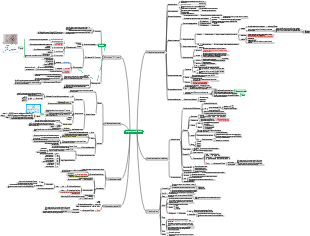
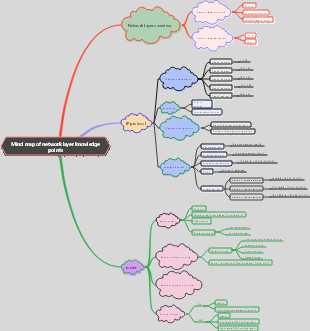
This is a mind map about Chapter 2 of computer networks, including the basic concepts of the physical layer, The transmission media below the physical layer, etc.
Edited at 2023-11-27 16:45:08This is a mind map about bacteria, and its main contents include: overview, morphology, types, structure, reproduction, distribution, application, and expansion. The summary is comprehensive and meticulous, suitable as review materials.

This is a mind map about plant asexual reproduction, and its main contents include: concept, spore reproduction, vegetative reproduction, tissue culture, and buds. The summary is comprehensive and meticulous, suitable as review materials.
This is a mind map about the reproductive development of animals, and its main contents include: insects, frogs, birds, sexual reproduction, and asexual reproduction. The summary is comprehensive and meticulous, suitable as review materials.
This is a mind map about bacteria, and its main contents include: overview, morphology, types, structure, reproduction, distribution, application, and expansion. The summary is comprehensive and meticulous, suitable as review materials.
This is a mind map about plant asexual reproduction, and its main contents include: concept, spore reproduction, vegetative reproduction, tissue culture, and buds. The summary is comprehensive and meticulous, suitable as review materials.
This is a mind map about the reproductive development of animals, and its main contents include: insects, frogs, birds, sexual reproduction, and asexual reproduction. The summary is comprehensive and meticulous, suitable as review materials.
physical layer
2.1 Basic concepts of physical layer
Problems to be solved by the physical layer
The physical layer considers how data bit streams can be transmitted over the transmission media connecting various computers.
The main tasks of the physical layer protocol
Mechanical properties
Specify the shape and size of the connector used for the interface, pins and arrangement, etc.
Electrical characteristics
Indicates the voltage range that appears on each line of the interface cable
Features
Indicates the meaning of a certain level of voltage appearing on a certain line
process characteristics
Specify the order of occurrence of various possible events for different functions
2.2 Transmission media below the physical layer
guided transmission media
twisted pair
Unshielded twisted pair
Shielded twisted pair
coaxial cable
Inner conductor, insulation layer, outer conductor shielding layer, insulation protective sheath layer
Optical cable (fiber optic)
multimode optical fiber
There are multiple light rays incident at different angles transmitted in an optical fiber.
Fiber characteristics
unguided transmission media
radio
multipath effect
The superposition of signals from multiple paths will generally produce great distortion.
bit error rate
The greater the signal-to-noise ratio, the lower the bit error rate
microwave
straight line propagation
Satellite Communications
infrared
visible light
2.3Transmission method
serial transmission
Bits are transmitted one after another on a transmission line, which is suitable for long-distance transmission.
Parallel transfer
Multiple bits are transmitted on multiple transmission lines, which is suitable for internal computer transmission and short-distance transmission.
synchronous transmission
Bits are transmitted one after another with no gaps in between. Each bit lasts the same time and requires synchronization of the clocks of both sending and receiving parties.
asynchronous transfer
Transmission is carried out in units of bytes, the interval is not fixed, the bytes are asynchronous, and the bits are synchronous.
2.4 Coding and Modulation
Common terms
information
Text, images, videos, etc.
data
The entity that delivers the message
Signal
Electromagnetic representation of data
analog signal
Digital signal
coding
A digital signal is converted into another digital signal and transmitted over a digital channel.
Analog signals are converted into digital signals and transmitted in digital channels.
Common encoding methods
non-return-to-zero
Return to zero system
Manchester encoding
Differential Manchester encoding
modulation
baseband modulation
bandpass modulation
basic modulation
AM, frequency modulation, phase modulation
Multivariate Amplitude and Phase Mixed Modulation
Quadrature Amplitude Modulation QAM
code element
A modulated basic waveform carrying bit information
2.5 channel limit capacity
Signal distortion factors
code element transmission rate
Transmission distance
Noise interference
transmission media
Nye's criterion
In a low-pass channel with a bandwidth of W (HZ), if the impact of noise is not considered, the maximum rate of symbol transmission is 2W (symbol/second). If the transmission rate exceeds this upper limit, serious inter-symbol crosstalk problems will occur, making it impossible for the receiving end to identify the symbols.
Shannon formula
The ultimate information transmission rate of the channel C=Wlog2 (1 S/N) (bit/s)
The greater the bandwidth of the channel or the signal-to-noise ratio in the channel, the higher the ultimate transmission rate of information.
The significance of the Ney's criterion and Shannon's formula: When the channel bandwidth is certain, according to the Ney's criterion and Shannon's formula, in order to increase the information transmission rate, a better modulation method must be used, and efforts must be made to improve the signal-to-noise ratio in the channel.
Channel multiplexing technology
frequency division multiplexing
Each signal occupies different bandwidth resources at the same time.
time division multiplexing
All users occupy the same bandwidth at different times
statistical time division multiplexing
A time division multiplexing method that dynamically allocates line resources according to actual user needs. Line resources are allocated to the user only when he has data to transmit. When the user suspends sending data, line resources are not allocated to him, and the transmission capacity of the line can be used by other users.
code division multiplexing
Distribution principle: different and orthogonal to each other.
normalized inner product
The normalized inner product of two different stations is 0;
The normalized inner product of itself and itself is 1;
The normalized inner product of its complement is -1.