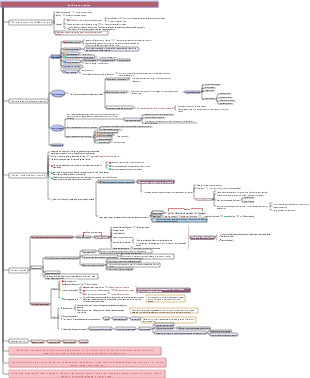
MindMap Gallery Educational Psychology = Learning of Skills
An article about educational psychology and skills learning mind map, including skills and their characteristics and functions, motor skills, mental skills, etc.
Edited at 2023-11-22 18:45:07This is a mind map about bacteria, and its main contents include: overview, morphology, types, structure, reproduction, distribution, application, and expansion. The summary is comprehensive and meticulous, suitable as review materials.

This is a mind map about plant asexual reproduction, and its main contents include: concept, spore reproduction, vegetative reproduction, tissue culture, and buds. The summary is comprehensive and meticulous, suitable as review materials.
This is a mind map about the reproductive development of animals, and its main contents include: insects, frogs, birds, sexual reproduction, and asexual reproduction. The summary is comprehensive and meticulous, suitable as review materials.
This is a mind map about bacteria, and its main contents include: overview, morphology, types, structure, reproduction, distribution, application, and expansion. The summary is comprehensive and meticulous, suitable as review materials.
This is a mind map about plant asexual reproduction, and its main contents include: concept, spore reproduction, vegetative reproduction, tissue culture, and buds. The summary is comprehensive and meticulous, suitable as review materials.
This is a mind map about the reproductive development of animals, and its main contents include: insects, frogs, birds, sexual reproduction, and asexual reproduction. The summary is comprehensive and meticulous, suitable as review materials.
Skill learning
Skills and their characteristics and functions
Concept: a law-compliant activity pattern formed by individuals through practice
Features
Skills come from practice
can manifest as either physical or cognitive actions
Compliance with rules or procedures is the prerequisite for skill formation
The role of skill learning
Skill learning helps improve learning efficiency
The formation of skills contributes to the mastery of relevant knowledge
The formation of skills is conducive to the development of intelligence and ability
Classification
Motor skills: also known as motor skills and operational skills, refer to operational activities consisting of a series of external movements in a reasonable program
Mental skills: Intellectual skills or intellectual skills refer to a way of cognitive activity carried out in the human brain with the help of internal language
Motor skills
Features
Objectivity: the object of the action - operating objective objects or muscles; the process of operation - expressed through explicit body movements
Accuracy: Meets specification requirements and complies with the action principle. There are standards to follow regardless of the strength, speed, amplitude or structure of the movements.
Coordination: It consists of a series of action components, each of which operates in an integrated and non-interfering manner and sequence. Each action component follows the action rules in a temporal and spatial sequence and achieves the integration of kinesthetic and visual senses.
Adaptability: able to adapt to various changing conditions, integrating stability and flexibility in the activity room
Classification
precision of movement
Gross motor skills: skills of large-scale movements in a large space
Fine Motor Skills: Skills that require delicate coordination and small movements in a small space.
Continuity of action from beginning to end
Continuous action skills: During a long sequence of actions that need to be completed, Requires continuous and uninterrupted adjustment and correction of motor skills based on complex internal and external stimuli
Discontinuous motor skills: contain only short sequences of movements and perform precise techniques and make specific responses to a specific external stimulus. consists of sudden bursts of action
environmental stability
Closed motor skills: occur in a fixed environment and under unchanged conditions, and completely rely on internal feedback information of muscles for guidance.
Open movement skills: occur under changing conditions of time or space, and practitioners adjust their movements accordingly according to changes in external stimuli.
How to develop motor skills
Guidance and Demonstration
Accurate demonstration and explanation
Necessary and appropriate practice
Sufficient and effective feedback
Establish a stable and clear kinesthetic sense
practise
First, start to make rapid progress
Second, there is an obvious temporary pause period in the middle, which is the plateau period.
During the learning process, students' academic performance and learning efficiency have stagnated for a period of time, and even the knowledge they have learned feels vague.
Appears mid-practice
New activity structures and new ways of completing activities are needed
A decrease in interest in practice, or even boredom or physical fatigue, leading to a temporary pause in practice performance
Third, progress is slower in the later stages
Fourth, the general trend is progressive, but sometimes there are temporary regressions
feedback
Result feedback, situational feedback, situational feedback, internal kinesthetic feedback
formed sign
Conscious control is weakened and actions become automatic
Enhanced kinesthetic feedback
Able to use subtle clues
Form memory for exercise programs
Ability to maintain normal operating levels under adverse conditions
Theory of the Formative Stages of Motor Skills
Fitts and Posner: cognitive stage, connection forming stage, automatic stage
Feng Zhongliang’s four-stage theory: operational orientation, operational imitation, operational integration, and operational proficiency
mental skills
Gary Perlin's theory of the stages of mental skill formation
orientation phase of activity
Material activity or materialization activity stage
audio speech stage
Silent "external" speech stage
inner speech stage
Training requirements
1. Stimulate enthusiasm and initiative in learning
2. Pay attention to the completeness, independence and generality of the prototype
3. Adapt to the stage characteristics of training and use language correctly
4. Pay attention to individual differences among students