 Wondershare EdrawMind
MindMap Gallery Postgraduate Entrance Examination Educational Psychology Mind Map
- 47
Postgraduate Entrance Examination Educational Psychology Mind Map
This is a mind map about educational psychology for the postgraduate entrance examination, including psychological development and education, mental health education, an overview of educational psychology, etc.
Edited at 2023-11-15 15:38:18
- bacteria
This is a mind map about bacteria, and its main contents include: overview, morphology, types, structure, reproduction, distribution, application, and expansion. The summary is comprehensive and meticulous, suitable as review materials.
- Plant asexual reproduction
This is a mind map about plant asexual reproduction, and its main contents include: concept, spore reproduction, vegetative reproduction, tissue culture, and buds. The summary is comprehensive and meticulous, suitable as review materials.
- Reproductive development of animals
This is a mind map about the reproductive development of animals, and its main contents include: insects, frogs, birds, sexual reproduction, and asexual reproduction. The summary is comprehensive and meticulous, suitable as review materials.
Postgraduate Entrance Examination Educational Psychology Mind Map
- bacteria
This is a mind map about bacteria, and its main contents include: overview, morphology, types, structure, reproduction, distribution, application, and expansion. The summary is comprehensive and meticulous, suitable as review materials.
- Plant asexual reproduction
This is a mind map about plant asexual reproduction, and its main contents include: concept, spore reproduction, vegetative reproduction, tissue culture, and buds. The summary is comprehensive and meticulous, suitable as review materials.
- Reproductive development of animals
This is a mind map about the reproductive development of animals, and its main contents include: insects, frogs, birds, sexual reproduction, and asexual reproduction. The summary is comprehensive and meticulous, suitable as review materials.
- Recommended to you
- Outline
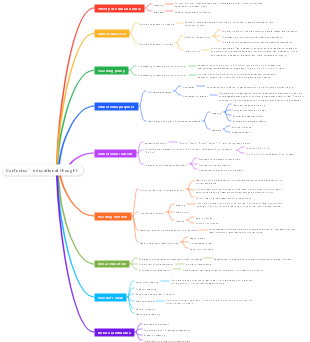
educational psychology
1. Overview of educational psychology
1. Research objects
The science of basic psychological laws of teaching and learning
①Interaction model of learning and teaching [How students and teachers can achieve better interaction through educational influence (intermediary)]
② Factors in learning and teaching (which factors affect students’ learning and which factors affect teachers’ teaching)
③The process of learning and teaching (how learning occurs, how to maintain students’ learning status after it occurs, and how to keep learning content permanently in students’ memories after maintenance)
2. Research tasks
1.what (description and measurement)
2.why (understanding and explanation)
3.how (prediction and measurement)
3. Historical development
1. Start-up (before 1920s)
①Thorndike
"Educational Psychology" The first person to name educational psychology, Educational psychology has become an independent discipline, "Father of Educational Psychology"
②Russia Ushinsky "Man is the Object of Education" "The founder of Russian educational psychology." Kapdelev's "Educational Psychology"
2. Development period (1920s to late 1950s)
①Behaviorist learning theory becomes the dominant learning theory
Use objective experiments to study human psychology (representative figure: Thorndike)
② "Learn by doing"
Dewey, pragmatism
③Vygotsky’s “Zone of Proximal Development”
Education and teaching play a leading role in children’s development
our country "Educational Practical Psychology" translated by landlord Yue "Educational Psychology" by Liao Shicheng, my country's first educational psychology textbook
3. Mature period (1960s to late 1970s)
Overall: Teaching focuses on combining with reality, serving teaching practice, serving the school, and conducting experiments based on the needs of the school.
①Bruner
"Structure teaching" - cognitivism
②Rogers
Humanism “student-centered”
③Carry out experiments
Zankov conducted experiments in teaching and development
4. Deepening and expansion period (after the 1980s)
① Initiative
② Reflectiveness
③Cooperative learning
④Social culture
5. Research trends
① Learner’s subjectivity: Constructivism
② Learner’s initiative: self-education ability
③Learn internal processes and mechanisms: Study how the brain processes deep information
④Social environment
⑤Actual situation
⑥Cultural background
⑦Learning environment design and effective teaching model: such as "cooperative learning"
⑧Use of information technology: research on artificial intelligence, "homeschooling", etc.
2. Psychological development and education
1. Psychological development
1. Definition: The continuous and stable internal psychological change process that occurs throughout an individual's life, from birth to aging.
2. Classification
(1) Cognitive development
①Definition: The process by which individuals acquire knowledge and use knowledge to process information. (over the head) (eg: memory, imagination, language, attention)
Cognition: Perception, imagination, memory and other thinking activities performed by individuals in the process of understanding things.
②Rule 1. Human cognitive rules are from simple to complex, from concrete to abstract. 2. The process from unconscious learning to conscious learning. 3. Our cognitive development progresses from generalization to differentiation. 4. It has the coexistence of continuity and stages, directionality and sequence, and imbalance (different speeds in different stages, different cognitive development in different stages at the same stage), Characteristics of coexistence of differences and commonalities.
③Theory Piaget's stage theory of cognitive development. Vygotsky's theory of cultural and historical development.
(2) Personality development
①Definition: A person’s unique and stable way of thinking and behavior that distinguishes him from others. e.g. motivations, emotions, thoughts, values
Personality: The unique unified pattern that constitutes a person's thoughts, emotions and behaviors.
②Rule 1. Continuity and stages coexist 2. Directionality and sequence 3. Imbalance 4. Differences and commonalities coexist
③Theory Erikson's theory of psychosocial development. Kohlberg's stage theory of moral cognitive development.
2. Cognitive Development Theory
1. Piaget’s stage theory of cognitive development
1. Concept of cognitive development
① Schema: an organized, repeatable pattern of behavior or thinking formed by children’s adaptation to the environment.
② Assimilation: The process in which individuals use existing diagrams to incorporate new stimuli into existing cognitive structures (schema).
③Adaptation: The process of individuals changing existing schemas or forming new schemas to adapt to new stimuli.
④Balance: The individual reaches a state of "balance" with the environment through assimilation and adaptation.
Cognitive development view: On the basis of innate genetic schemas, individuals continuously assimilate and adapt to the environment and then achieve balance.
2. Development stage theory
(0-2 years old) sensorimotor stage 【1. Gain action experience by exploring the relationship between perception and movement. 2. You cannot use language or abstract symbols to name things. 3. Obtained object permanence (9-12 months): When things are moved away from your eyes, you know that they are not gone. 】
(2-7 years old) Preoperational stage (operational: internal intellectual operations) [1. Can use language and abstract symbols to name things, but cannot grasp the generality and generality of concepts well. 2. Animism: The belief that everything has life. 3. Egocentrism: Believing that everything in the world has the same reaction as oneself. (Group monologue) 4. The development of thinking is irreversible, rigid, non-conservative, and one-dimensional, that is, the concept of object conservation has not yet been obtained. 】
(7-11 years old) Concrete operational stage [1. Preliminary logical operations can be performed, but they cannot be separated from the support of specific things. 2. Follow the rules rigidly. 3. It is reversible, decentralized and multi-dimensional in thinking. 】
(11-16 years old) Formal operations stage [Abstract thinking has been developed. At this time, children can think in a propositional manner, close to the adult level, and can conduct inductive and deductive reasoning. 】
Features: 1. Don’t jump. The previous one is the foundation of the next one. 2. There are individual differences due to various factors.
3. Factors affecting development
①Maturation: the growth of an organism. It is not a decisive factor, but a premise that provides the possibility of development.
②Practice and acquired experience: Experience gained from repeated interactions between people and other objects.
③Social experience: People acquire laws, morals, etc. in the process of interaction, such as education, activities, etc.
④ Balance: It is a self-regulation process, which reflects students’ initiative in learning and plays a decisive role.
4.Application
① Teaching promotes the active construction process within children: active learning → constructing an environment that promotes initiative.
②Teaching should adapt to the development stage of students, and should provide just the right education, that is, causing students' cognitive imbalance, but not exceeding the students' existing level, so that students can continuously improve.
③There are individual differences in the teaching process, so teachers must teach students in accordance with their aptitude.
5. Neo-Piagetianism (expanded)
Accelerate children's development
specific tasks
train
Social interaction (people to people)
2. Vygotsky’s theory of cultural and historical development
1. Theoretical meaning
①Activity theory: People's psychological activities are restricted by the labor activities they engage in, and different cultural groups form concepts in different forms.
② Human psychological activities and labor activities are mediated by tools.
Material production tools: the role of people on things.
Tools of mental production: linguistic symbol system. (Unique to human beings, advanced psychological functions.)
③Internalization theory: Advanced psychological functions are formed by the internalization of external collective activities. Process: starting from listening to others to solving the problem yourself with the help of words. Solving the problem yourself with the help of words is divided into three processes: from mumbling to whispering, lip movements, and finally to internal thinking.
2. Concept of psychological development
1. Two psychological functions
① Low-level psychological functions: they are the result of animal evolution, such as natural memory, unintentional attention, etc.
②Advanced psychological function: It is the result of historical development. He uses language symbols as an intermediary, which is unique to humans, such as logical memory, intentional attention, etc.
2. The meaning of the concept of psychological development: an individual from birth to adulthood. Under the influence of environment and education, the process of gradually developing from low-level psychological functions to high-level psychological functions.
3.Performance
① Voluntary functions continue to develop and become more and more active and intentional.
②The abstract summary function is continuously improved.
③Various psychological functions are constantly changing and reorganizing, eventually forming an indirect psychological structure mediated by symbols.
④Psychological activities develop towards individualization, that is, the formation of personality.
3.Zone of proximal development
1.Meaning
① Discusses the relationship between teaching and development, allowing us to know that teaching plays a leading role in development.
②The zone of proximal development refers to the gap between a child's actual development level and his potential development level. Actual developmental level refers to a child's ability to solve problems independently. Potential developmental level refers to the ability to solve problems with the help of an adult or a more capable peer.
2. The relationship between teaching and development
① Teaching determines the level, speed, content, etc. of children's development, emphasizing the leading role of teaching in the process of children's development.
②Teaching creates the zone of proximal development. Teaching must be ahead of children's current actual development level and fall within the zone of proximal development to promote children's development.
4.Application
① Scaffolding teaching: assign students more challenging tasks that fall within the development zone, and provide scaffolding (teacher guidance or cooperation with more capable peers), and gradually remove the scaffolding as the task progresses until students can finish independently.
②Interactive teaching: learning in an interactive situation between teachers and students, that is, the teacher demonstrates, and the students and teachers take turns playing the role of the teacher to practice strategies.
③Cooperative learning: Ability grouping, that is, after setting tasks, students with different abilities are divided into groups to solve problems together.
④Situational cognition theory: Teachers guide students to learn, so that students can transform from bystanders to participants and continue to develop in social interactions.
3. Personality Development Theory
1. Erikson’s Psychosocial Development Theory (Social Development Theory)
1. Development concept
① Development is a process through a series of consecutive stages, each stage has specific tasks, goals and development crises.
② If the conflict is well resolved with the help of others, a positive personality will be formed. If the conflict is not well resolved, a negative personality will be formed.
2.Eight stages
①Trust versus suspicion (0-1.5 years old), the main event at this time is feeding. If parents can provide food and caress in time, a positive personality will be formed, that is, trust and optimism. Otherwise, a negative personality will be formed, that is, suspicion and disturbed.
② Autonomy versus shyness (1.5-3 years old). The main events at this time are eating, dressing and training. If parents allow free exploration and provide appropriate care and protection, a positive personality will be formed, that is, autonomy and self-confidence. Vice versa. It will produce a negative personality, namely shyness and self-doubt.
③ Sense of initiative vs. sense of guilt (3-6, 7 years old). The main event at this time is independent activities. If parents and teachers provide supervision instead of interference, children will develop a positive personality, that is, self-confidence and responsibility, and vice versa. It will produce negative personality, namely guilt and low self-esteem.
④ Diligence vs. inferiority complex (6, 7-12 years old). The main event at this time is enrollment. If the teacher can encourage him to show diligence in activities, then the student will develop a positive personality, manifested as diligence, and be able to If you are competent at work, your communication skills will improve. Otherwise, you will have a negative personality, manifested as low self-esteem and withdrawal.
⑤ Role identity vs. role confusion (12-18 years old). The main event at this time is peer interaction. If teachers encourage students to self-identify and cultivate students' sense of competence, let them experience success, and this stage largely depends on If it has been well developed in the previous stages, it will produce a positive personality, which is manifested as self-confidence, full of confidence in the future, independent choices and efforts, otherwise it will produce a negative personality, which is manifested as being confused about the future.
Self-identity (supplementary) Exploration is the x-axis and Commitment is the y-axis. Exploring and making better decisions is the achievement of identity, which means that you can make independent choices about your future and work harder. Making a decision without exploring is a form of identity premature closure, which manifests as a lack of assertiveness and acceptance of other people's choices. There is neither self-exploration nor decision-making, which is an identity disorder, manifested by failure to make successful choices. Failure to make appropriate choices at this stage is called identity retardation (or identity crisis), which is manifested by making choices at this stage.
⑥Friendship and intimacy versus loneliness (18-30 years old). The main event at this time is love and marriage. If it is happy, it will produce a positive personality, which is manifested by a sense of intimacy. Otherwise, it will produce a negative personality, which is manifested by a sense of loneliness.
⑦Reproduction is stagnant (30-60 years old). The main event at this time is raising children. If successful, it will show a positive personality, showing care for the family and a strong sense of social responsibility. Otherwise, a negative personality will appear, showing not caring about others. .
⑧Perfection vs. pessimism and despair (after 60 years old). The main events at this time are introspection and acceptance of life. If successful, it will be a positive personality, expressed as satisfaction, otherwise it will be a negative personality, expressed as despair.
3.Evaluation
1.Advantages
① Pay attention to the impact of social and cultural factors on individual development.
② Study personality holistically from various levels of individual psychological development and their interrelationships.
③This theory runs through a person's life and is also the earliest theory of psychological development in the history of the development of educational psychology.
2.Limitations
① This theory overemphasizes human instinct and ignores advanced psychological functions such as consciousness and reason.
②The rationality of this theory lacks empirical support.
4.Application
1. Overall
①Reveal the stages of personality development.
② At each stage, appropriate education should be used to solve the crisis, so that students can form a positive personality.
2. For primary school students: To solve the crisis of low self-esteem due to diligence.
① As a teacher, you should realize that students always strive to maintain a positive self-image and consider themselves to be valuable individuals.
②As a teacher, you should make positive evaluations of students.
③Teachers should use scaffolded teaching so that students can experience success.
3. For middle school students: To solve the crisis of role identity to role confusion.
①Teachers should treat students as “children”.
② You should not look down on him in front of other peers or teenagers, otherwise it will stimulate his rebellious psychology and inferiority complex.
③Give clear instructions during the learning process, allow students to complete tasks independently, and allow students to experience their role as "adults."
2. Kohlberg’s stage theory of moral cognitive development
1.Premise
①Moral dilemma stories—such as the story of Heinz stealing medicine
② Through research, we found that children of different ages have different thinking structures when making moral judgments, so we divided them into stages.
2. Three levels and six stages
① Pre-conventional level (0-9 years old), their common characteristic is that they make moral judgments based purely on external factors, without any opinions of their own, and make judgments based on the consequences of actions in order to avoid punishment and obtain rewards. Therefore, it is divided into two stages: the first stage is the punishment and obedience orientation stage, characterized by making moral judgments to avoid punishment; the second stage is the instrumental relativism orientation stage, characterized by making moral judgments to obtain rewards. moral judgment.
②Custom level (9-15 years old), their common characteristic is obeying group behavioral norms, which is divided into two stages: the third stage is the orientation stage of interpersonal coordination ("good boy" orientation stage), characterized by respect for the majority Opinions; the fourth stage is the orientation stage of maintaining authority or order, characterized by taking the initiative to assume social obligations and responsibilities and rigidly abiding by rules.
③ Post-conventional level (after 15 years old), their common feature is complete self-discipline when making moral judgments. The so-called self-discipline is internalized self-worth. This is divided into two stages: The fifth stage is the orientation stage of the social contract, characterized by: Think of the law as a contract. The purpose of the law is to let people live in harmony, so the law is democratic and can be changed through negotiation; the sixth stage is the orientation stage of universal moral principles, which is characterized by full self-worth and deep consideration. The nature of morality at different levels, such as judging from aspects such as conscience and the value of life.
3.Application
① Understand the development level of children’s moral cognition, so as to make our education more targeted and timely.
②Teachers should realize that although the sequence of stages is certain, children's development can be fast or slow, and the speed is related to cultural background, social interaction, etc.
③Teachers can use moral dilemma stories to divide students into groups or groups for discussion. Students with high moral levels can promote the development of students with low moral levels, and students with high moral levels can also develop in their thinking.
④ Students’ moral development is a process from heterodiscipline to self-discipline, which tells us that moral education must be gradual.
4.Limitations
① It is not clear whether the sequence of the previous stage is the basis for the later stage, that is, the stage division is not strict.
②Because the division is not strict, the operability is not strong.
③Because most of the subjects are men, the sample is not representative.
4. Differences in psychological development and education
1. Intelligence differences and education
①Intellectual development level: IQ
②The speed of intellectual development
②Differences in intelligence types: Everyone is good at different areas, such as memory, observation, etc.
④Is there any gender difference in intelligence? There is no distinction between high and low.
2. Personality differences and education (personality traits/temperament types)
① Choleric temperament: characterized by high energy, enthusiasm, irritability, and impulsiveness.
② Sanguine temperament: characterized by liveliness, restlessness, and ease of carelessness.
③Phlegm: manifested as steady and dull.
④Depression: manifested by intelligence and sentimentality.
3. Cognitive style differences and education
Cognitive style/style refers to the typical way an individual is used to cognitively and processing information.
1. Field independent type vs. field dependent type
1. Type: field independent type versus field dependent type. 2. Basis: Whether people are easily affected by environmental information when perceiving. 3.Meaning: ① When making judgments about objective content, field-independent people often rely on their own internal reference and are less affected by the external environment. ② When making judgments about objective content, the field-dependent type often relies on the external environment as a reference and is easily affected by the external environment. 4. Characteristics demonstrated in learning or teaching: ①Discipline: The field-independent type is more suitable for natural sciences, and the field-dependent type is more suitable for social sciences. ②Learning motivation: The field-independent type relies more on intrinsic motivation, while the field-dependent type relies more on extrinsic motivation. ③ Perceptual style: The field-independent type is more inclined to conduct in-depth analysis and close logical deduction, while the field-dependent type is more suitable for overall or general analysis. ④Suitable teaching methods: The field-independent type prefers unstructured and loose methods, while the field-dependent type is suitable for teaching methods with clear guidance.
2. Reflective type vs. impulsive type
1. Type: Reflective vs. Impulsive 2. Basis: cognitive speed 3.Meaning ① Reflective type: tends to think deeply and spend enough time to think about it until finally getting the best answer, with less probability of making mistakes. ②Impulsive type: Tend to give answers quickly, react quickly, answer hastily, react quickly, but are prone to mistakes. 4. Features: ①Problem-solving strategies: Reflective problem-solving strategies are more mature and can easily come up with different hypotheses; impulsive problem-solving strategies are immature and cannot come up with more hypotheses. ②Answer feedback: The reflective type explains upon request or spontaneously, and the explanation is relatively complete; the impulsive type cannot explain or answers incompletely. ③Learning: The reflective type tends to analyze learning tasks in detail and has better academic performance in school; the impulsive type is more inclined to explain learning tasks as a whole.
3. Overall type versus series type
1. Type: overall type vs. series type 2. Basis: Problem-solving strategies 3.Meaning: ① The holistic type tends to predict the steps involved in the overall problem first. ②Serial type tends to solve problems logically step by step. 4. Features: ①A unified level of understanding can eventually be achieved. ② When thinking holistically, the overall type may miss areas that it considers unimportant, while the serial type may not understand the connection between requirements.
4. Deep processing versus shallow processing
1.Type: deep processing vs. shallow processing 2. Basis: depth of information processing 3.Meaning: ① Deep processing: Deep understanding connects the learned knowledge with the larger framework. ②Shallow processing: Memorize superficial information and do not connect what you learn with the larger framework. 4. Features: ① Deep processing focuses on comprehension tests. ②Shallow processing focuses on the learning and memory of facts.
4. Gender differences and education
1. Difference
①Intelligence: Men tend to have spatial and logical memory, Women are better able to distinguish sounds and colors and tend to have mechanical memories.
2. Speech: Men focus on logic, Women focus on emotionality.
3. Action: Men are more likely to engage in social play and are more likely to engage in aggressive play.
4.Interest: Men’s interests are more likely to be directed toward objects, Women's interests are more likely to be directed toward people.
5. Self-confidence: Men are more likely to attribute success to ability and failure to difficulty of the task; Women are more likely to attribute success to luck and failure to ability.
2. Avoid gender bias in education
①Teacher’s concept: Teachers must understand that these differences are not innate, but are gradually acquired during the process of individual socialization.
② Unintentional gender bias in teaching will cause students to form gender schemas.
③How to avoid gender bias in education
① Pay attention to teaching materials and language.
② Don’t say who is better at subjects, men or women.
③Attention should also be paid in class or extracurricular activities so that every student can receive fairness.
5. Social Development and Education
(1) Social development
meaning: On the basis of their biological characteristics, individuals master social norms, form social functions, learn social roles, acquire social needs, attitudes, and values, and develop social behaviors in the process of interacting with social life and the environment, thereby becoming better The process of adapting to social environment. (natural person → social person)
(2) Prosocial behavior
1. Connotation: Individual behavior in society that is beneficial to others or society, such as comfort, sharing, cooperation, public welfare, etc. The development of individual prosocial behavior depends on the continuous improvement of moral awareness and the continuous enrichment of emotions.
2. Stages of prosocial behavior (Eisenberg) (different levels may occur for older children)
①Level: hedonism, self-focus; age: lower grade of preschool; characteristics: showing prosocial behavior out of self-interest.
② Level: Orientation to the needs of others; Age: Primary school students, teenagers entering adolescence; Characteristics: Helping out of the needs of others, not feeling guilty if you don’t help.
③Level: Approval and interpersonal orientation; Age: primary school students and some middle school students; Characteristics: Out of approval and interpersonal communication.
④Level: Empathy orientation of self-projection; Age: Some senior elementary school students and middle school students; Characteristics: Prosocial behavior shown out of sympathy and putting oneself in others' shoes.
⑤ Level: Internalized legal norms and value orientation; Age: A few middle school students; Characteristics: Out of internalized values.
3. Factors influencing prosocial behavior
① Cultural factors: social norms.
② Situational factors (surrounding environment): such as role models, social standards, etc.
③Family (behavior of family members): For example, parents’ behavior and requirements, whether the behavior can be attributed and reinforced in a timely manner, etc.
④School, peers, media, etc.
⑤Characteristics of recipients.
⑥Characteristics of people who help others.
4. How to acquire prosocial behavior
①Conditioning of empathic responses: experience, allowing students to resonate.
② Direct training: timely strengthen their prosocial behavior
③Observation and learning: Set an example
(3) Aggressive behavior
1. Connotation: Behavior that often intentionally harms or provokes others is a common problem behavior among teenagers.
2. Reasons for aggressive behavior
①Heredity: the influence of genes
②Family: Violent punishment by parents, etc.
②Environment: role models, school education, media influence, etc.
3. Methods to change aggressive behavior
①Fading method: Don’t pay attention.
②Isolation method: Separate the child from his classmates.
③ Role model method: Implement positive role model guidance and punish negative role models for their aggressive behavior.
④Role-playing method: Use students' empathy to make students experience the pain of the attacker so that they will no longer behave this way.
(4) Companionship
1. Connotation: Peer relationship is established by individuals in the process of communication, especially the relationship between individuals of the same age.
2. Cultivate
① For schools, there must be corresponding curriculum to help students learn communication skills and cultivate students' prosocial behavior and good peer relationships.
② When teachers design classroom communication activities, they should use cooperative learning to help students develop a positive peer relationship.
③Design practical activities, such as outings, etc.
④ Cultivate students’ prosocial behavior, thereby helping students develop good peer relationships.
3. Stage
①3-7 years old: An unstable friendship relationship, out of egoism or submission.
②4-9 years old: One-way help or obedience.
③6-12 years old Two-way help can be mutually beneficial, but we cannot share hardships.
④9-15 years old Intimate sharing can share joys and sorrows.
⑤After 12 years old, in the mature stage of friendship development, the choice of friends is more complicated and strict, and friendships tend to be more stable.
3. Learning and Its Theoretical Explanation
1. General Overview of Learning
(1) The basic meaning of learning
A relatively permanent change in an individual's behavior or behavioral potential resulting from practice or repeated experience in a specific situation.
1. Repeated experience - caused by experience: participation or observation 2. Behavioral potential: Changes in thoughts, thinking, emotions, values, etc. are not necessarily expressed in explicit forms. 3. Relatively long-lasting: different from drunkenness and stimulants 4.Change 5. Learning and Performance: Not Equal 6. Animals learn
(2) Classification of learning
1. Classification of learning subjects
Animal learning: passive adaptation to the environment.
Human learning: It is proactive and social, and it is learning mediated by language symbols.
Machine Learning: Artificial Intelligence
2. Learning level classification (Gagne)
① Signal learning: react to signals. Stimulus-response-reinforcement (classical conditioning)
② Stimulus-response learning: situation-response-reinforcement (spontaneous, operant conditioning)
③Chain learning: A series of S-R combinations, often the learning of motor skills, such as riding a bicycle.
④Language associative learning: no need to see, using language as the intermediary.
⑤Discrimination learning: similar and different stimuli (S)
⑥Concept learning: Classify S, and a series of S's respond the same way.
⑦Rule learning: the relationship between concepts.
⑧Problem-solving learning (advanced rules): Apply rules.
3. Classification of learning results (Gagne)
①Learning of verbal information: what usually involves learning facts, concepts, knowledge systems, frameworks, etc.
②Learning of smart skills: how to solve the problem of "how to do it".
③Learning of cognitive strategies: the way learners manage their own learning process.
④ Attitude learning: the inner psychological state of people, things, and objects, and how to treat them.
⑤Learning of motor skills = chain learning
4. Ausubel (cognitivism-meaningful acceptance theory)
(1) How learning proceeds: Accept learning (other people tell you, conclusive knowledge) Discovery learning (do it yourself, get experience)
(2) The relationship between learning materials and learners’ original knowledge: Meaningful learning: connections can be made between new knowledge and old knowledge, Rotational learning: Failure to make connections.
5. Classify according to the level of awareness of learning
①Implicit learning: Unknowingly gaining some experience during the process of accepting the environment and changing subsequent behaviors. ② Explicit learning: learning that consciously and explicitly puts in some mental effort and responds according to rules.
6.Formal/informal
①Formal learning: Organized learning that occurs in school academic education or continuing work education, such as courses, teaching, internships, seminars, etc. ②Informal learning: Learners are autonomous and carry out through non-teaching social interactions during informal learning time or occasions, such as peer interaction, games, media, etc.
2. Learning Theory
(1) Behaviorism (stimulus-response, connectionism)
1. Classical conditioning theory
Pavlov (dog saliva secretion experiment)
Learning essence
Learning is the process of replacing one stimulus with another, establishing conditioned reflexes and forming habits.
law
1. Acquisition and extinction ① Acquisition: Neutral stimulation, unconditioned stimulation, repeated multiple times at the same time or nearly at the same time, is the acquisition or acquisition of conditioned reflexes. ② Extinction: After the formation of classical conditioning, if the response behavior is no longer accompanied by unconditioned stimulation, the intensity of the conditioned response will gradually weaken or even disappear. This is called the extinction of the conditioned reflex.
2. Generalization and differentiation ① Generalization: Stimuli similar to the original stimulus will also cause a response. ② Differentiation: Only specific stimuli are accompanied by unconditioned stimuli, and generalized stimuli are not reinforced, so that conditioned reflexes can be differentiated and similar and different stimuli can be distinguished.
3. Advanced conditioning The process of conditioning another neutral stimulus with an already conditioned stimulus.
4.Two signal system theory ①Any physical conditioned stimulus that can cause a conditioned response is the first signal system. ② Any stimulus that can induce a conditioned response and is mediated by language symbols is the second signal system. The essential difference between human learning and animal learning lies in the existence of a second signaling system based on language.
application
application ①Explain the acquisition of simple behaviors in young children, such as "white coat syndrome". ② Can help correct behavior: use happy events as unconditional stimuli, or set up a cooperative and comfortable environment. ③Limitations: Simple learning cannot explain spontaneous behavior.
Watson (Experiments on the Formation of Fear in Infants)
Learning essence
Learning is the process of replacing one stimulus with another, establishing conditioned reflexes and forming habits.
law
1. Frequency law: The more times you practice, the faster and more stable the stimulus-response will be. 2. The law of recency: The most recent connection or the latest formed connection is more likely to be strengthened.
application
With Pavlov
2. Operant conditioning theory
Thorndike (Hungry Cat Opens the Maze Cage Experiment) (Connection-Trial and Error Theory)
The essence of learning
1. Learning in animals and humans is a process of establishing connections between stimuli and responses. 2. Certain connections between operational responses are established through trial and error.
law
1. Law of preparation (preparatory formula): In the process of trial-and-error learning, if the connection between stimulus and response is first in a certain state of preparation, you will feel satisfied if it is realized, and you will feel annoyed if it is not realized. 2. Practice Law: With regular practice and application, the connection will be strengthened. Rewarded practice is the most conducive to establishing the connection between stimulus and response. 3. The law of effect: After an organism's actions and behaviors produce a specific response to a stimulus situation, and following a satisfactory change in the situation, the probability of its behavior will increase.
application
1. Starting from the effectiveness rate, the important role of rewards in shaping children's behavior is emphasized. 2. The practice rate provides a basis for students to practice repeatedly during teaching.
Skinner's theory of operant behavioral reflexes (rat experiment "Skinner box")
The essence of learning
1. Learning is a change in response probability, and reinforcement is a means of enhancing response probability in conditioned reflexes. 2. Behavior classification: (1) Responsive behavior: The stimulus appears before the reaction and is often associated with a specific stimulus. (2) Operant behavior: The stimulus appears after the reaction and is not associated with a specific stimulus. It is a spontaneous behavior of the organism.
law
1. Reinforcement and Punishment (1) Reinforcement: All means in conditioned responses that can enhance the probability of response. →Develop good behavior (2) Punishment: After the organism makes a certain reaction, if it is exposed to an aversive stimulus in time, the probability of the behavior occurring in similar situations in the future will be reduced or even inhibited. →Correct bad behavior (3) Premack’s Principle (Grandma’s Law) Reinforce disliked activities with favorite activities. 2. Escape conditioning and avoidance conditioning ①Escape conditioning principle: When an aversive stimulus appears in front of it, the organism makes a spontaneous response to avoid experiencing the aversive stimulus. ②Avoidance conditioning: When an aversive stimulus is about to appear, the organism makes a certain response to avoid the aversive stimulus. 3. Reduction and maintenance ① Extinction: The response is no longer accompanied by reinforcement. ②Maintenance: Behavior continues after weakening reinforcement or stopping reinforcement. How to maintain: Gradually reduce reinforcement or make reinforcement unpredictable to increase the probability that the behavior will be maintained. 4. Generalization and differentiation of behavior Generalization consistent with Pavlovian Differentiation: The difference is that previous experience leads to different estimates of the consequences of behavior.
Reinforcement ........................ Punishment Positive (presentation) Positive reinforcement (praise) Positive punishment (imprisonment) ...........Present pleasant stimuli .....Present aversive stimuli Negative (cancellation) Negative reinforcement (free from housework) Negative punishment (no food) ........ Withdrawal of aversive stimulation ....... Withdrawal of pleasant stimulation
Reinforcement program ① Continuous reinforcement, each response is strengthened, the stimulus-response is established quickly and disappears quickly. ② Scheduled reinforcement, reinforcement is carried out at a fixed period of time (such as monthly salary). The closer the reinforcement time is, the stronger the response will be, and the response will decrease after the reinforcement time. ③ Fixed ratio reinforcement, fixed number of responses (piece rate), establish stimulation-quick response. ④Time-varying reinforcement, irregular reinforcement (in-class test), slow establishment of connection, and slow reduction in response after the reinforcement disappears. ⑤ Variable ratio reinforcement, reinforcement (lottery) is given after an indefinite number of times, the connection is established quickly, and the response does not decrease after the reinforcement disappears.
application
①In terms of behavior shaping, each unit should be broken down into small steps to complete, and timely reinforcement should be provided for each small step completed. →Basic principles of procedural teaching method ①Small steps principle ②Principle of positive response ③Principle of timely feedback ④Self-paced principle ⑤Low error rate principle 2. Behavior modification ①Extinction method: isolation method and satiation method (over-satisfaction) ②Punishment
3. Social learning theory (cognitive behaviorism) (observational learning theory)
Bandura's reward and punishment control experiment
The essence of learning
1. Children can learn behaviors through observation. 2. The consequences of role model behavior are the key factors that affect whether children behave.
law
Observe behavioral processes 1. Attention process: It is the primary stage of observational learning. Factors that influence attention include characteristics of the model's behavior, characteristics of the model, and characteristics of the observer. Teachers should guide students to choose appropriate role models. 2. Maintenance process: Store behavior in an image way through various language symbols. Teachers should connect the images students see with language. 3. Copying process (motivation reproduction process): the imitation process after observation, converting maintained behavior into explicit behavior. Teachers play a supporting role in the process of students constantly organizing and correcting their behavior so that their behavior becomes precise. 4. Motivational process: Determining which of the learned behaviors is displayed. Bandura distinguished acquisition from behavioral performance and believed that learned behavior may not necessarily be performed. In addition to the direct reinforcement of the behavior, whether the learned behavior is performed or not is also affected by vicarious reinforcement and self-reinforcement.
motivational process .............Implementer...Receiver External reinforcement others...me Vicarious Reinforcement Others...Others Self-reinforcement I...I
application
1. Acquired behavior: Teachers’ demonstrations should be clear and accurate, and the emotions, attitudes, and values they hope students can acquire should be expressed in an explicit way. 2. Actively set an example and play an important role in substitutional reinforcement. 3. Let students learn to strengthen themselves, thereby stimulating students’ self-initiative in learning. 4. Teachers should eliminate bad role models.
(2) Cognitivism
(1) Early cognitivism
1.Gestalt School Gestalt-Epiphany Theory
experiment Stacking boxes experiment and connecting bamboo poles experiment (gorilla)
View
①Learning is a process of enlightenment. ②The essence of learning is to construct a gestalt, which refers to using one's own wisdom and understanding to suddenly realize the relationship between the situation and oneself. ③Stimulus-consciousness-response (the process of consciousness is to construct the gestalt)
2. Tolman: Symbolic learning theory (cognitive-telephonic theory)
experiment Position learning experiment in mice
View
①Learning is a purposeful behavior, not blind. ②Learning is the understanding of the overall situation, and the process of understanding is the process of forming a cognitive map in the mind. ③Stimulus-consciousness-response (consciousness is the process of constructing a cognitive map) ④Everyone has latent learning. Latent learning means learning even when it is not reinforced, but it is not shown.
(2) Bruner’s Cognition-Discovery Theory
1. Cognitive Learning Concept
1. The essence of learning is the process of actively forming cognitive structures. (S-O-R) (Cognitive structure = Gestalt = Cognitive map = Diagram = Apperception group) Cognitive structures are coding systems, which refer to interconnected category structures that are constantly changing and reorganizing. 2. The learning process includes acquisition, transformation (forming cognitive structure), and evaluation. Transform students from passive recipients of knowledge to active information processors.
2. Structural teaching concept
1. Teaching purpose: Form the basic structure of the subject. 2. Teaching principles: ① Pay attention to the basic structure a. The connotation of the basic structure includes the concepts and principles of the subject, as well as the methods and attitudes that form the concepts and principles. b. The necessity of paying attention to the basic structure includes promoting students’ understanding of knowledge, which is conducive to memory, can enhance the transfer between knowledge, and guide students to form a knowledge system. ② Development of readiness for learning: “The foundation of any subject can be appropriately handed over to anyone of any age in some appropriate form.” ③Focus on cultivating students’ intuitive thinking. Intuitive thinking is the basis of creative thinking. ④ Focus on stimulating students' intrinsic motivation: let students actively participate and let students experience success.
3. Discovery Learning
1. The meaning of discovery learning: refers to all forms in which students acquire knowledge through their own exploration in a learning situation.
2. Steps of discovery learning: ①Create problem situations and raise and clarify issues that students are interested in. ② Provide various hypotheses to solve the problem and stimulate students' desire to explore. ③ Test the hypothesis theoretically and practically. ④ Form a conclusion. Guide students to use analytical thinking to verify conclusions and ultimately solve the problem.
3.Evaluation
①Advantages: a. Conducive to stimulating students’ intelligence. b. Effectively stimulate students’ intrinsic motivation. c. Allow students to master learning methods and strategies. d. It allows students to learn to retain and retrieve information. e. Stimulate students’ interest and cultivate the development of students’ creative and critical thinking.
②Limitations: a. Completely abandoned systematic teaching and exaggerated students' abilities. b. "The foundation of any subject can be given in some appropriate form to anyone of any age" cannot be achieved. c. It is found that learning will be restricted by subject, learning subject, age, ability, etc., which places high demands on teachers and low teaching efficiency.
It inspires us that in the teaching process, we should flexibly arrange applications according to the nature of teaching materials, learning activities, etc., so that acceptance learning is suitable for receptive learning, and discovery learning is suitable for discovery.
(3) Ausubel’s Theory of Meaningful Acceptance
1. The essence and conditions of meaningful learning
(1) Substance: Establish a non-arbitrary and substantive connection between the new knowledge represented by the symbols and the existing appropriate concepts in the students’ cognitive structure. ① Non-arbitrary: reasonable and objectively real. ② Substantive: The connection between the old and new knowledge that students learn is understandable, logical, intrinsic, and non-surface.
(2) Conditions ①Objective conditions: a. The materials for meaningful learning must have logical meaning and be psychologically understandable to students. b. The materials studied must be within the students' learning abilities. ②Subjective conditions a. Learners must have a desire to learn, that is, a tendency to learn, and learners must have a desire to engage in meaningful learning. b. Learners must have a certain learning foundation. c. Learners proactively establish connections between old and new knowledge.
2. Cognitive assimilation theory and advance organizer strategy
(1) Cognitive assimilation theory
1.Meaning
Students connect teaching content with cognitive structures. (Ausubor’s assimilation is equivalent to Piaget’s assimilation + accommodation)
2.Conditions
Students need to have appropriate fixed ideas, New and old knowledge must be distinguishable, Clarity and stability of original knowledge.
3. Steps
① First find the fixation point in your mind, that is, find the old knowledge connected with the new knowledge. ②Analyze the similarities and differences between old and new knowledge. ③Finally, the knowledge will be more perfect and systematized.
4. Assimilation mode
(2) Advance organizer strategy
1.Meaning
It is a kind of guiding material presented before the learning task itself. It has a higher level of abstraction, generalization and comprehensiveness than the learning task itself, and is related to the original concepts in the cognitive structure and the new learning task.
2.Purpose
Ask for old and new knowledge. Learning provides a conceptual fixation point or cognitive framework, enhances the discriminability between old and new knowledge, and promotes the transfer of learning.
3.Category
The “organizer” can not only come first, but can also be presented after the learning materials. It mainly includes two types: declarative organizers and comparative organizers. The purpose of the former is to provide the most appropriate categorizer for new knowledge, while the latter is to compare new knowledge with similar materials in cognitive structures, with the purpose of enhancing the old and new. Discernibility of knowledge.
3. Accept the definition and evaluation of learning
(4) Gagné’s information processing learning theory
(3) Humanism
(4) Constructivism
4. Learning motivation
5. Construction of knowledge
6. Formation of skills
7. Learning Strategies and Teaching
8. Cultivation of problem-solving skills and creativity
9. Social Norm Learning and Moral Development
10. Mental health education