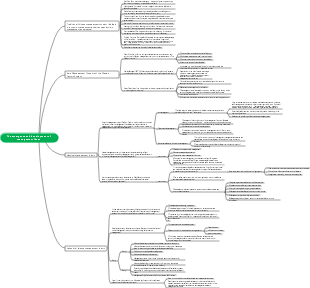
MindMap Gallery Development Trends of Modern Management Theory
This is a mind map about the development trends of modern management theory, including schools of modern management, contemporary management theories, etc.
Edited at 2023-11-13 16:23:52This is a mind map about bacteria, and its main contents include: overview, morphology, types, structure, reproduction, distribution, application, and expansion. The summary is comprehensive and meticulous, suitable as review materials.
This is a mind map about plant asexual reproduction, and its main contents include: concept, spore reproduction, vegetative reproduction, tissue culture, and buds. The summary is comprehensive and meticulous, suitable as review materials.
This is a mind map about the reproductive development of animals, and its main contents include: insects, frogs, birds, sexual reproduction, and asexual reproduction. The summary is comprehensive and meticulous, suitable as review materials.
This is a mind map about bacteria, and its main contents include: overview, morphology, types, structure, reproduction, distribution, application, and expansion. The summary is comprehensive and meticulous, suitable as review materials.
This is a mind map about plant asexual reproduction, and its main contents include: concept, spore reproduction, vegetative reproduction, tissue culture, and buds. The summary is comprehensive and meticulous, suitable as review materials.
This is a mind map about the reproductive development of animals, and its main contents include: insects, frogs, birds, sexual reproduction, and asexual reproduction. The summary is comprehensive and meticulous, suitable as review materials.
Development Trends of Modern Management Theory
schools of modern management
School of Management Science (also known as the School of Mathematics, represented by American Bofa, who wrote "Modern Production Management")
1 Rely on establishing scientific decision-making procedures and mathematical models for decision-making
2 Evaluate feasible solutions based on economic effects
3 Extensive use of electronic computers and other advanced tools for decision-making
*School of Decision Theory (Representative figure Herbert Simon of the United States, whose book "The New Science of Management Decision-making" is based on statistics and behavioral science, won the Nobel Prize in Economics in 1978)
The main points
1Management is decision-making
2 Decision-making can be divided into procedural decision-making and non-procedural decision-making.
3. Establish a decision support system
4 Decision-making is based on satisfaction
Contingency management thought (representative figure, American Lu Sansi, whose representative work is "Introduction to Management: A Contingency Science", systematically proposes contingency management theory)
It is believed that the internal elements and external environmental conditions of each organization are different, so there are no principles and methods applicable to any situation in management activities.
Management Process School (Representative figure Harold Koontz proposed the Jungle Theory of Management Theory, which takes the functions of management and the process of functioning as the research object, and believes that management is the process of completing work through others or with others)
Management is a process
There are five functions of the management process
plan
organize
Staffing
command
control
Management functions are universal
Management is flexible
Experience or case school (the founder, Peter Drucker, studies the management experience and lessons of actual management workers and the actual experience of corporate managers, mainly using a comparative method to summarize management experience)
*1 Management should focus on practical applications, not purely theoretical research
2. The task is to understand the specific purpose and mission of the organization, to energize the work and achieve the success of its employees, and to address the impact of the organization on society and its social responsibilities
3 Management methods for implementing management by objectives
strategic management theory
1 Porter's Five Forces Model (Michael Porter believes that there are five forces in the industry that determine the degree and scale of competition. The five forces collectively affect the attractiveness of the industry and the competitive strategic decisions of modern enterprises)
1 New Intruder Threat
2. Supplier’s bargaining power
3 Alternative threats
4 existing competitors
5. Buyer’s bargaining power
Competitive intensity among competitors in the same industry
new entrant
Threat determinants of entry
economies of scale
brand identity
Funding needs
Distribution channel
Absolute cost advantage
government policy
supplier
Supplier capability determinants
supplier concentration
switching cost
forward integration
Substitute input exists
Importance of supply volume to suppliers
Threat of substitutes determinants
buyer substitution preferences
relative price of substitutes
switching cost
Determinants of buyer ability
buyer concentration
purchase amount
backward integration capabilities
replacement product
price sensitivity
Low profit
competitor determinants
Industry growth (competition for market share)
fixed cost
brand identity
Numerous Competitors of Comparable Capabilities
lack of differentiation
2 Basic competitive strategy (Michael Porter is recognized as the father of competitive strategy. There are three general strategies to maintain an advantageous position in a fiercely competitive market)
1. Cost priority strategy (making the organization’s total costs lower than those of competitors, or even the lowest costs in the entire industry)
2 Differentiation strategy: including product, service, personnel, and image differentiation strategies
3 Target agglomeration strategy
Theory Z (William Ouchi's "Theory Z-How American Business Meets the Challenge of Japan") studies the relationship between people and companies, and people and work. It proposes that American companies should combine their own characteristics and learn from the management methods of Japanese companies. . Emphasizing the cultural factors of management, organizations should not only consider hard indicators such as technology and profits in terms of productivity, but also consider soft factors, such as trust, close relationships between people, etc.)

contemporary management theory
Enterprise reengineering (the core of which is the reengineering of business procedures (business processes)) was first proposed by Hammer and Ciampi. It takes business processes as the object and center of transformation, and aims at caring for customer needs and satisfaction, and fundamentally restructures existing businesses. Thinking and radical redesign, the ultimate goal is to cultivate the unique personality of the enterprise by changing the work structure and working methods, so that the enterprise can achieve a huge leap in performance)
five key stages
Reconceptualization
organizational reengineering
process reengineering
Pilot and switch
implement strategy
Four core contents
Fundamental
thoroughness
dramatic
Business Process
Learning organization (Peter Senge advocated a new theory in "The Fifth Discipline". The so-called discipline is to improve the organization's internal structure and function's ability to adapt to social and market changes through learning and training)
The first discipline: self-transcendence. It is the spiritual foundation of a learning organization
The second discipline: improving your mental model. It’s about improving cognitive patterns
Discipline Three: Build a Shared Vision. A shared vision is the source of vitality and courage for an organization
The fourth discipline: team learning. Mainly in-depth discussions
The fifth discipline: systems thinking. Observe the world from a systematic and dynamic perspective and decide on actions
Four Basic Principles of a Learning Organization
1. Can people constantly test their own experience?
2. Do people have production knowledge?
3. Can everyone share the knowledge in the organization?
4. Is learning in the organization closely related to organizational goals?
Virtual organization (enterprises focus on core capabilities and use computer technology, network technology and communication technology to carry out complementary and mutually beneficial cooperation with global enterprises. The cooperative relationship will be dissolved after the cooperation purpose is achieved)