 Wondershare EdrawMind
MindMap Gallery 8.1. Cerebral infarction
- 59
8.1. Cerebral infarction
Neurology - Detailed explanation of the knowledge framework of cerebrovascular disease and cerebral infarction. Also known as ischemic stroke, it refers to a clinical syndrome in which brain blood supply disorders caused by various reasons lead to ischemia and hypoxic necrosis of local brain tissue, and corresponding neurological deficits occur rapidly.
Edited at 2023-11-12 17:29:02
- bacteria
This is a mind map about bacteria, and its main contents include: overview, morphology, types, structure, reproduction, distribution, application, and expansion. The summary is comprehensive and meticulous, suitable as review materials.
- Plant asexual reproduction
This is a mind map about plant asexual reproduction, and its main contents include: concept, spore reproduction, vegetative reproduction, tissue culture, and buds. The summary is comprehensive and meticulous, suitable as review materials.
- Reproductive development of animals
This is a mind map about the reproductive development of animals, and its main contents include: insects, frogs, birds, sexual reproduction, and asexual reproduction. The summary is comprehensive and meticulous, suitable as review materials.
8.1. Cerebral infarction
- bacteria
This is a mind map about bacteria, and its main contents include: overview, morphology, types, structure, reproduction, distribution, application, and expansion. The summary is comprehensive and meticulous, suitable as review materials.
- Plant asexual reproduction
This is a mind map about plant asexual reproduction, and its main contents include: concept, spore reproduction, vegetative reproduction, tissue culture, and buds. The summary is comprehensive and meticulous, suitable as review materials.
- Reproductive development of animals
This is a mind map about the reproductive development of animals, and its main contents include: insects, frogs, birds, sexual reproduction, and asexual reproduction. The summary is comprehensive and meticulous, suitable as review materials.
- Recommended to you
- Outline
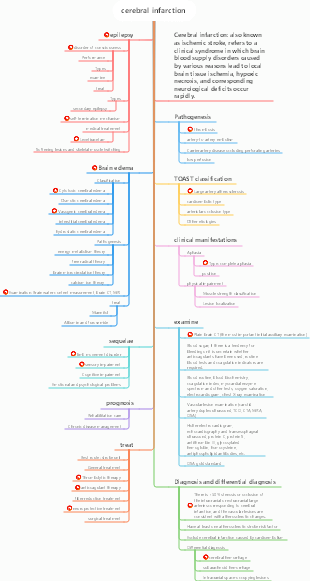
cerebral infarction
Also known as ischemic stroke, it refers to a clinical syndrome in which brain blood supply disorders caused by various reasons lead to local brain tissue ischemia, hypoxic necrosis, and corresponding neurological deficits occur rapidly.
There are three main pathophysiological types:
Cerebral thrombosis:
Acute occlusion or severe stenosis due to secondary thrombosis due to lesions in the local blood vessels themselves
Cerebral embolism:
Severe stenosis of local blood vessels due to emboli blocking the arteries
Hemodynamic mechanism:
Cerebral tissue hypoperfusion due to severe stenosis of proximal large vessels and decreased blood pressure
Cause
Blood vessel wall lesions; heart disease and hemodynamic changes; changes in blood components and hemorrheology; other causes P190
TOAST classification
Large artery atherosclerosis
cardioembolic type
arteriolar occlusion type
Other etiologies
Unexplained type
Pathology and pathophysiology
Cerebral infarction of the internal carotid artery system > Cerebral infarction of the vertebrobasilar artery system.
Pathological changes of cerebral infarction: coagulative necrosis-liquefaction-cystic cavity
Regional cerebral ischemia consists of a central necrotic area and a surrounding cerebral ischemic penumbra.
The treatment time that effectively saves brain tissue in the ischemic penumbra is called the treatment time window.
clinical manifestations
(1) General characteristics
➢ More common in middle-aged and elderly people
age
➢ Symptoms occur during quiet time or sleep
disease state
➢ Sudden onset of illness
onset of illness
➢ Some cases have prodromal symptoms of TIA
➢ Symptoms of focal neurological deficits occur
Clinical symptoms
➢Clinical manifestations depend on the size and location of the infarct
(2) Clinical characteristics of different cerebral vascular occlusions
1. Clinical manifestations of internal carotid artery (ICA) occlusion
Symptomatic occlusion - acute occlusion, inadequate collateral compensation
Monocular amaurosis fugax may occur
Symptoms of middle cerebral artery and/or anterior cerebral artery ischemia
Contralateral hemiplegia, hemi-sensory impairment, and hemianopia. Involvement of the dominant hemisphere may be accompanied by aphasia, and involvement of the non-dominant hemisphere may cause body image disorder.
When the posterior cerebral artery originates from the internal carotid artery rather than the basilar artery, it can lead to ischemia of the entire cerebral hemisphere when the internal carotid artery is occluded.
A vascular murmur can be heard when the carotid artery is severely stenotic, and disappears when the blood vessel is completely occluded.
Asymptomatic occlusion - chronic occlusion, adequate collateral compensation
There may be no clinical symptoms or signs
One-sided internal carotid artery occlusion does not cause clinical symptoms because
A normal cerebral arterial ring can quickly establish collateral circulation
2. Manifestations of middle cerebral artery (MCA) occlusion
Main trunk occlusion
Causes three hemisphere signs: contralateral hemiplegia, hemi-sensory impairment and hemianopia, gaze to the side of the lesion, complete aphasia when the dominant hemisphere is involved, body image disorder when the non-dominant hemisphere is involved, and disturbance of consciousness may occur
cortical branch occlusion
upper branch occlusion
The lesion causes hemiplegia and hemi-sensory impairment. The lower limbs are paralyzed and the upper limbs are lighter than the upper limbs. Gaze toward the side of the lesion, accompanied by Broca's aphasia (dominant hemisphere) and body image disorder (non-dominant hemisphere).
lower branch occlusion
Contralateral isotropic upper quarter visual field defect with Wernicke's aphasia (dominant hemisphere) acute confusional state (non-dominant hemisphere)
deep perforator occlusion
There was equal hemiplegia and hemimyoesthesia on the contralateral side of the lesion, and homonymous hemianopia on the contralateral side. Subcortical aphasia occurs in dominant hemisphere lesions
3. Manifestations of anterior cerebral artery (ACA) occlusion
Occlusion of the anterior main branch of the anterior communicating artery
Collateral circulation may be compensated without symptoms. When both sides originate from the same anterior cerebral artery trunk, it causes anterior and medial infarction of both cerebral hemispheres, leading to paraplegia, fecal incontinence, loss of will, motor aphasia syndrome, and frontal lobe personality changes.
Distal anterior cerebral artery occlusion after division of the anterior communicating artery
Sensory motor impairment of the contralateral lower limbs, mild paralysis of the upper limbs, and sparing of the face and hands. Loss of discrimination. Urinary incontinence, apathy, unresponsiveness, euphoria, and mutism may occur
cortical branch occlusion
Contralateral central lower limb paralysis, which may be accompanied by sensory impairment; contralateral limb transient ataxia, strong grip reflex and psychiatric symptoms
deep perforator occlusion
Leading to contralateral central facial and tongue paralysis and proximal upper limb paresis
4. Manifestations of posterior cerebral artery (PCA) occlusion
➢ Main trunk occlusion
Contralateral homonymous hemianopia and hemi-sensory impairment without hemiplegia
➢ Unilateral cortical branch occlusion
Contralateral homonymous hemianopia. Involvement of the dominant hemisphere may cause alexia (with or without agraphia), naming aphasia, agnosia, etc.
➢ Bilateral cortical branch occlusion
Complete cortical blindness, sometimes accompanied by shapeless visual hallucinations, memory impairment, prosopagnosia, etc.
➢ Occlusion of the interpeduncular branch of the origin of the posterior cerebral artery
Central mesencephalic and hypothalamic syndromes; paramedian syndrome, Weber syndrome; Claude syndrome; Benedikt syndrome
➢ Occlusion of deep perforating branch of posterior cerebral artery
Occlusion of the penetrating thalamic artery produces rubrosthalamic syndrome; occlusion of the thalamic geniculate artery produces thalamic syndrome.
5. Manifestations of vertebrobasilar artery occlusion
➢ Locked-in syndrome
Occlusion of the pontine branch of the basilar artery causes infarction of the base of the pons on both sides, with clear consciousness, no impairment in language understanding, and bilateral central paralysis.
➢ Ventrolateral pontine syndrome
Occlusion of the short circumflex branch of the basilar artery, manifesting as paralysis of the ipsilateral facial nerve and abducens nerve and contralateral hemiplegia
➢ Ventromedial pontine syndrome
Occlusion of the paracentral branch of the basilar artery, ipsilateral peripheral facial paralysis, contralateral hemiplegia, and akinesia in the same direction as the binocular lesion
➢Basilar tip syndrome
The tip of the basilar artery divides into the superior cerebellar artery and posterior cerebral artery. Occlusion causes eye movement disorders, pupillary abnormalities, arousal and behavioral disorders, and may be accompanied by memory loss, contralateral hemianopsia or cortical blindness.
➢ Dorsolateral bulbar syndrome
Due to occlusion of the branch arteries supplying the lateral medulla oblongata by the posterior inferior cerebellar artery or vertebral artery, dizziness, dysphagia, dysarthria, ataxia on the side of the lesion, Horner syndrome, and crossed sensory disturbances may occur.
(3) Common clinical types of cerebral infarction
1. Large artery atherosclerotic cerebral infarction (P195)
Atherosclerosis is the fundamental cause of this disease. Cerebral atherosclerosis is more common in arterial bifurcations.
Risk factors: increasing age, advanced age, hypertension, hyperlipidemia, DM, smoking, etc.
Pathogenesis:
1) In situ thrombosis
2) Arterial-arterial embolism
3) Rupture and bleeding within the plaque
4) Low perfusion
5) Carrier artery disease blocks perforating arteries
General characteristics: Some cases have prodromal symptoms of TIA, and focal signs usually peak more than 10 hours or 1 to 2 days after onset.
2. Cardiogenic cerebral embolism (P204)
(1) Cause
➢Non-valvular atrial fibrillation (the most common, accounting for about 50% of cardiogenic cerebral embolism)
➢Rheumatic valvular heart disease (about 10-20%), acute myocardial infarction (about 10%), abnormal emboli, infective endocarditis (about 20%), non-bacterial thrombotic endocarditis, etc.
(2) Pathology
➢More than 80% of emboli originating from the heart lead to cerebral embolism - stopping at the bifurcation of intracranial cerebral blood vessels or the narrow part of the official cavity
➢More than 80% of cardiogenic cerebral embolisms occur in the internal carotid artery system, especially the middle cerebral artery, especially the upper branches that are most susceptible to involvement.
(3) Clinical manifestation characteristics
➢The onset often occurs suddenly during activities, without prodromal symptoms, and the focal neurological signs reach their peak within seconds to minutes (Why does the onset occur so quickly? The peak appears quickly?)
➢It can occur at any age. Cerebral embolism caused by rheumatic heart disease is more common in young women.
➢The symptoms of neurological deficit are basically the same as those of large artery atherosclerotic cerebral infarction, and brain damage to multiple blood vessel supply areas may occur simultaneously.
➢Easy to relapse and bleed, and the condition fluctuates greatly
3. Small artery occlusion cerebral infarction (P207)
lacunar ischemic stroke
It refers to the lesions of small perforating arteries deep in the cerebral hemisphere or brainstem, leading to ischemic necrosis of the brain tissue supplying arteries (the diameter of the infarct is <1.5~2.0cm), resulting in an acute neurological impairment syndrome.
(1) Cause
➢ Arteriolar sclerosis is the main cause;
➢ Advanced age, hypertension, DM, smoking and family history are the main risk factors for this disease
(2) Clinical manifestation characteristics
➢ More common in middle-aged and elderly patients. The average age of first onset is about 65 years old, and the incidence gradually increases with age.
➢ More men than women
➢ Chinese people have a higher incidence rate than Caucasians
➢ More than half of the patients suffer from hypertension
➢ Usually the symptoms are mild, the signs are single, the prognosis is good, and there are generally no symptoms such as headache, increased intracranial pressure, and disturbance of consciousness.
lacunar syndrome
Pure motor hemiparesis PMH
The most common type manifests as hemiparesis of approximately the same degree on the opposite side of the face and upper and lower limbs. The lesions are mostly located in the internal capsule, corona radiata or pons
Pure sensory stroke PSS
It is more common and manifests as a loss of sensation in one side of the body, which may be accompanied by paresthesia. The lesions are mainly located in the contralateral ventroposterolateral nucleus of the thalamus
ataxic hemiparesis
Hemiparesis with cerebellar ataxia, ataxia not explained by weakness. Lesions are located in the base of the pons, internal capsule, or subcortical white matter
Dysarthria-Clumsy Hand Syndrome DCHS
Dysarthria, dysphagia, central facial and tongue paralysis, and clumsy hand movements. Lesions are located at the base of the pons, anterior limb of the internal capsule, or knee
Sensorimotor stroke SMS
Hemiplegic sensory impairment and hemiparesis were present. The lesion is located in the ventral posterior nucleus of the thalamus and adjacent to the posterior limb of the internal capsule
Auxiliary inspection
(1) Initial examination - the main purpose is to conduct emergency screening for thrombolysis indications
Plain brain CT (the most important initial auxiliary examination)
Blood sugar; if there is a tendency for bleeding or it is uncertain whether anticoagulants have been used, routine blood tests and coagulation indicators are required.
(2) Routine examination - the purpose is to rule out stroke or other causes and understand the risk factors for stroke
Plain brain CT or MRI (P199)
Vascular lesion examination (carotid artery duplex ultrasound, TCD, CTA, MRA, DSA)
Blood routine, blood biochemistry, coagulation index, myocardial enzyme spectrum and other tests, oxygen saturation, electrocardiogram, chest X-ray examination
(3) Other inspections
Holter electrocardiogram, echocardiography and transesophageal ultrasound, protein C, protein S, antithrombin III, glycosylated hemoglobin, homocysteine, antiphospholipid antibodies, etc.
DSA gold standard
Diagnosis and differential diagnosis
1. Diagnostic criteria for large artery atherosclerotic cerebral infarction (P200)
(1) Vascular imaging examination confirms that there is an intracranial or extracranial large artery stenosis >50% or occlusion corresponding to cerebral infarction, and the vascular lesions are consistent with atherosclerotic changes; or there is an intracranial or extracranial large artery stenosis >50% or Indirect evidence of occlusion, such as imaging showing that the diameter of cerebral cortex, brainstem, cerebellum or subcortical infarction is >1.5cm, clinical signs of cortical damage, or signs of brainstem or cerebellum damage.
(2) There is evidence of at least one risk factor for atherosclerotic stroke (such as advanced age, hypertension, hyperlipidemia, diabetes, smoking, etc.) or systemic atherosclerosis (such as plaque, coronary heart disease, etc.).
(3) Exclude cerebral infarction caused by cardioembolism, and there are no high or moderate risk factors for cardioembolic stroke.
2. Diagnostic basis for cardiogenic cerebral embolism (P207)
initial diagnosis:
Sudden onset, peaking in seconds to minutes, focal neurological deficits, underlying diseases originating from emboli, such as atrial fibrillation, rheumatic heart disease, etc. CT or MRI examination to rule out cerebral hemorrhage and other pathologies
Support diagnostics:
Consciousness disorder occurs at the onset of the disease, or symptoms of major neurological deficits improve rapidly in the early stages of the disease
Definite diagnosis:
Infarcts occur in multiple blood vessel supply areas at the same time, or are combined with embolism in other organs of the body. Large-artery atherosclerotic cerebral infarction, small-artery occlusive cerebral infarction, and other cerebral infarctions with clear causes have been excluded.
3. Diagnostic basis for small artery occlusion cerebral infarction (P210)
initial diagnosis:
It occurs in middle-aged and elderly people with a history of long-term risk factors such as hypertension and diabetes. It has an acute onset and symptoms of focal neurological deficits. The clinical manifestation is lacunar syndrome.
Definite diagnosis:
CT or MRI confirms that the diameter of the infarction consistent with neurological loss is <1.5~2.0cm. The infarction mainly involves the deep white matter, basal ganglia, thalamus and pons, which is consistent with small perforating artery disease in the cerebral hemisphere or deep brainstem.
Differential diagnosis
1. Cerebral hemorrhage
Cerebral infarction sometimes has similar clinical manifestations to small-scale cerebral hemorrhage, but the onset during activity, rapid disease progression, and Significantly elevated blood pressure at that time often indicates cerebral hemorrhage, and CT examination can confirm the diagnosis if hemorrhagic lesions are found.
2. Intracranial space-occupying lesions
Intracranial tumors, subdural hematomas and brain abscesses can present with stroke-like symptoms, with focal signs such as hemiplegia, and cranial When signs of increased internal pressure are not obvious, it can easily be confused with cerebral infarction.
Key points in identifying cerebral infarction and cerebral hemorrhage
treat
Goal: Save the ischemic penumbra and avoid or reduce primary brain damage - "Time is the brain"
Best route: stroke unit
(1) General processing
1. Oxygen and ventilatory support
Inhale oxygen when necessary to maintain oxygen saturation >94%.
For critically ill patients such as brainstem stroke and large infarction or those with airway involvement, airway support and assisted ventilation are required
2. Cardiac monitoring and treatment of cardiac lesions
Routine electrocardiogram examination within 24 hours after
3. Body temperature control
4. Blood pressure control
The regulation of blood pressure in acute cerebral infarction should follow the principles of individualization, prudence, and moderation.
(1) For those who are preparing for thrombolysis, their blood pressure should be controlled at systolic blood pressure <180mmHg and diastolic blood pressure <100mmHg.
(2) Within 72 hours of onset of symptoms, systolic blood pressure ≥200mmHg or diastolic blood pressure ≥110mmHg, or accompanied by acute coronary syndrome, acute heart failure, aortic dissection, preeclampsia/eclampsia and other comorbidities that require treatment, can be treated slowly Reduce blood pressure. The amplitude of blood pressure reduction should not exceed 15% within 24 hours.
(3) After stroke, the condition is stable and the sustained blood pressure is ≥140mmHg/90mmHg. A few days after the onset of illness, the antihypertensive medication before the onset of the disease is resumed or antihypertensive treatment is started.
(4) For post-stroke hypotension and hypovolemia, the causes should be actively found and dealt with, and volume expansion and blood pressure measures should be taken if necessary.
5. Blood sugar
Avoid hypoglycemia and control blood sugar level between 7.7mmol/L and 10mmol/L
6. Nutritional support