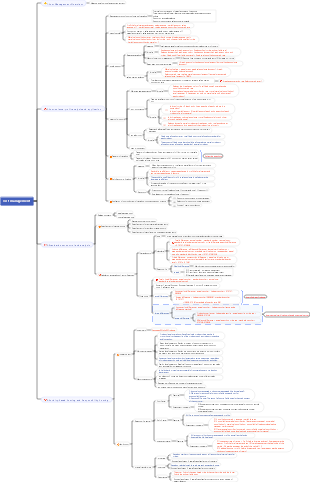
MindMap Gallery Financial analysis and evaluation
2023 Intermediate Accounting Examination, Financial Management Exam Preparation Guide. The style is simple and the content is easy to read, helping you clarify your ideas while highlighting important and difficult points. The combination of diagrams and formulas allows you to understand it clearly at a glance, achieve twice the result with half the effort, learn more efficiently, and easily obtain the intermediate certificate, come on! Continuously updating...
Edited at 2023-11-11 16:22:09This is a mind map about bacteria, and its main contents include: overview, morphology, types, structure, reproduction, distribution, application, and expansion. The summary is comprehensive and meticulous, suitable as review materials.

This is a mind map about plant asexual reproduction, and its main contents include: concept, spore reproduction, vegetative reproduction, tissue culture, and buds. The summary is comprehensive and meticulous, suitable as review materials.
This is a mind map about the reproductive development of animals, and its main contents include: insects, frogs, birds, sexual reproduction, and asexual reproduction. The summary is comprehensive and meticulous, suitable as review materials.
This is a mind map about bacteria, and its main contents include: overview, morphology, types, structure, reproduction, distribution, application, and expansion. The summary is comprehensive and meticulous, suitable as review materials.
This is a mind map about plant asexual reproduction, and its main contents include: concept, spore reproduction, vegetative reproduction, tissue culture, and buds. The summary is comprehensive and meticulous, suitable as review materials.
This is a mind map about the reproductive development of animals, and its main contents include: insects, frogs, birds, sexual reproduction, and asexual reproduction. The summary is comprehensive and meticulous, suitable as review materials.
Financial analysis and evaluation
1. Financial Analysis and Evaluation Overview
The meaning and content of financial analysis
significance
(1) Determine the financial strength of the enterprise; (2) Evaluate and assess the business performance of enterprises and reveal problems in financial activities; (3) Explore the potential of the enterprise and seek ways to improve the management level and economic benefits of the enterprise; (4) Evaluate the development trend of the enterprise.
content
financial analysis methods
comparative analysis
Fixed base dynamic ratio = analysis period amount/fixed base period amount x 100%
Period-on-month dynamic ratio = analysis period amount/previous period amount x 100%
ratio analysis
composition ratio
Composition ratio = value of a certain component/overall value x 100%. For example, the ratio of current assets to total assets
efficiency ratio
Efficiency ratio = income/expense x100%, reflecting the relationship between input and output. For example, total asset net profit rate, operating profit rate
correlation ratio
Relevant ratio = a certain indicator/relevant indicator x100%. For example, asset-liability ratio, current ratio, etc.
factor analysis
serial substitution method
meaning
Decompose the analyzed indicators and analyze their dependencies on each factor
calculate
Planned indicator: A0xB0xC0 First substitution: A1xB0xC0 - Got: (A1-A0)xB0xC0 Second substitution: A1xB1xC0 -: A1x(B1-B0)xC0 Third substitution: A1xB1xC1 - Get: A1xB1x(C1-C0)
Gap analysis
It is a simplified form of the serial substitution method, which uses the difference between the comparison value of each factor and the baseline value.
Precautions: 1. The importance of factor decomposition; 2. The order of factor substitution; 3. The seriality of sequential substitution; 4. The calculation results are hypothetical.
Limitations of financial analysis
Limitations of data sources, limitations of financial analysis methods, limitations of financial analysis indicators
Financial Evaluation
DuPont analysis, Wall scoring method, economic value added method
2. Basic financial statement analysis
Solvency analysis
Short-term solvency analysis
current ratio
Current ratio = current assets/current liabilities
quick ratio
Quick ratio = quick assets/current liabilities
Quick assets do not include: inventories, prepayments, non-current assets due within one year and other current assets
cash ratio
Cash ratio = (monetary funds trading financial assets) / current liabilities
Best reflects the company's ability to directly repay current liabilities.
xx ratio xxx assets/current liabilities
Long-term solvency analysis
Assets and liabilities
Asset-liability ratio = total liabilities/total assets
equity ratio
Equity ratio = Total liabilities/Shareholders’ income
Equity Multiplier
Equity multiplier = total assets/shareholders’ equity
Relationship between the three: Equity multiplier = 1/(1-Asset-liability ratio) = 1 Equity ratio
Interest coverage ratio
Interest coverage ratio = (net profit, expensed interest, income tax)/interest payable; Interest payable in the denominator = expensed interest capitalized interest
Other factors affecting debt solvency
Available bank loan indicators or credit lines, asset quality, contingencies and commitments
Operational Capacity Analysis
Liquid assets operating capability analysis
Inventory turnover
Inventory turnover rate = operating cost/average inventory balance
Inventory turnover days = days in the calculation period/inventory turnover rate
Accounts receivable turnover ratio
Accounts receivable turnover rate = operating income/average balance of accounts receivable
Accounts receivable turnover days = days in the calculation period/accounts receivable turnover rate
xx turnover rate = operating income/xx average balance
Current asset turnover ratio
Fixed assets operating capacity analysis
Fixed asset turnover rate
Total assets operating capacity analysis
total asset turnover ratio
Profitability Analysis
operating margin
Operating gross profit margin = operating gross profit/operating income, where operating gross profit = operating income - operating cost
operating net profit margin
Operating net profit margin = net profit/operating income x100%
Net interest rate on total assets
Net interest rate on total assets = net profit/average total assets x100%
Roe
Return on equity = net profit/average net assets =Net profit/average total assets x average total assets x average net assets =Net interest rate on total assets x equity multiplier
xx net (collected) interest rate = net profit/xx
Development capability analysis
xx growth rate
Growth amount of xx this year/xx last year
Capital value preservation and appreciation rate
Ending owner’s equity/beginning owner’s equity x 100% after deducting the impact of objective factors
cash flow analysis
Net income operating index
Net income operating index = net operating income/net profit, where net operating income = net profit - non-operating net income
cash operating index
Cash operating index = net cash flow from operating activities/cash generated from operations Cash operating index <1, indicating that the quality of earnings is not good enough
3. Financial analysis of listed companies
Special financial analysis indicators for listed companies
earnings per share
basic earnings per share
Basic earnings per share = net profit (attributable to ordinary shareholders)/number of shares, Number of shares = weighted addition at the beginning of the period - weighted decrease (time weight is taken into account when weighting)
diluted earnings per share
meaning
Dilute equity and reduce earnings per share. Potential common stock includes: convertible debentures, warrants, stock options
formula
Convertible bonds
1. Numerator adjustment - net profit attributable to ordinary shareholders, plus after-tax interest. 2. Denominator adjustment - increasing the weighted average number of common shares outstanding, the increased number of potential common shares = par value/conversion price per share x time weight
Warrants and share options
1. The molecules do not adjust. 2. Denominator adjustment - Calculate the number of additional shares of common stock that need to be issued based on the average market price of common shares, after deducting the shares repurchased with exercise proceeds.
Dividends per share
Dividends per share = total cash dividends/number of common shares outstanding at the end of the period; dividend payout rate = dividends per share/earnings per share
P/E ratio
P/E ratio = market price per share/earnings per share. The higher the P/E ratio, the greater the investment value.
price to book ratio
Price-to-book ratio = market price per share/net assets per share, net assets per share = net assets of common shares at the end of the period/number of common shares outstanding at the end of the period.
Management Discussion and Analysis
Explanation of changes in operating performance during the reporting period
Forward-looking information about the future development of the enterprise
4. Financial evaluation and assessment
Methods for comprehensive enterprise performance analysis
DuPont analysis
Return on equity = net interest rate on total assets x equity multiplier = net operating interest rate x total asset turnover rate x equity multiplier
Take the return on equity as the starting point and the net interest rate on total assets and the equity multiplier as the basis
Wall Score
Economic Value Added (EVA)
EVA = net operating profit after tax - average capital occupation x weighted average cost of capital
advantage
Taking into account the cost of all capital, it more truly reflects the value creation of the enterprise;
Achieving the unity of corporate interests, operator interests and employee interests
shortcoming
Only the value creation in the current period or the next 1-3 years can be predicted;
Unable to comprehensively evaluate operational efficiency and effectiveness;
Constant comparison of enterprises in different industries, different stages of development, different sizes, etc.;
How this is calculated is controversial.
comprehensive performance evaluation
Quantitative evaluation indicators of financial performance
Qualitative evaluation indicators for management performance
Points method for enterprise comprehensive performance evaluation