MindMap Gallery Medicine-gynecology mind map
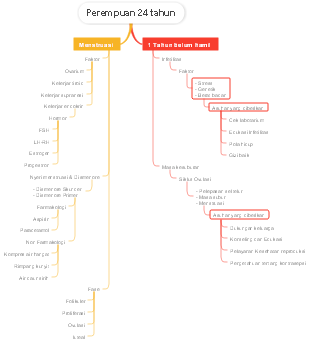
This is a mind map about medicine-gynecology, including endometrial cancer, treatment, menstruation, etc. Hope this helps! Welcome to follow and collect~~
Edited at 2023-11-05 20:47:34This is a mind map about bacteria, and its main contents include: overview, morphology, types, structure, reproduction, distribution, application, and expansion. The summary is comprehensive and meticulous, suitable as review materials.

This is a mind map about plant asexual reproduction, and its main contents include: concept, spore reproduction, vegetative reproduction, tissue culture, and buds. The summary is comprehensive and meticulous, suitable as review materials.
This is a mind map about the reproductive development of animals, and its main contents include: insects, frogs, birds, sexual reproduction, and asexual reproduction. The summary is comprehensive and meticulous, suitable as review materials.
This is a mind map about bacteria, and its main contents include: overview, morphology, types, structure, reproduction, distribution, application, and expansion. The summary is comprehensive and meticulous, suitable as review materials.
This is a mind map about plant asexual reproduction, and its main contents include: concept, spore reproduction, vegetative reproduction, tissue culture, and buds. The summary is comprehensive and meticulous, suitable as review materials.
This is a mind map about the reproductive development of animals, and its main contents include: insects, frogs, birds, sexual reproduction, and asexual reproduction. The summary is comprehensive and meticulous, suitable as review materials.
The rejuvenated Aunt Li
menstruation
physiological process
Normal menstrual volume: 20ml to 60ml. If it exceeds 80ml, it is called menorrhagia
Reason for irregularity
Endocrine disorders
mood swings Irregular work, rest and diet taking birth control pills catch a cold excessive exercise Gynecological diseases
organic disease
Uterine fibroids endometrial polyps endometrial hyperplasia endometriosis
vaginal bleeding
adolescence Irregular menstrual cycle Sexual intercourse related issues vaginal inflammation Childbearing age (20-39 years old) endometriosis Uterine fibroids Infect Postmenopausal (40 years and older) endometrial hyperplasia endometrial cancer Dry and weak tissue Pregnancy early pregnancy bleeding Abnormal position of the placenta or placental abruption
Abnormal discharge
puberty Inflammation during adolescence hygiene habits Childbearing age (20-39 years old) Infection – Trichomonas or bacterial hygiene habits Postmenopausal (40 years and older) endometrial cancer Dry and weak tissue Pregnancy Infect Placental abruption or abnormal placenta accreta
Return of menstruation: Women will have menstrual bleeding again a few days after menstruation, usually one to two days, and the amount will not be too much. Postmenopausal bleeding - perimenopause
other
Blood routine
1. White blood cell count (WBC) [Normal reference range] Adults (4.0~10.0)×109/L; Newborns (15.0~20.0)×109/L 2. Red blood cell count (RBC) [Normal reference range] Newborn: (6.0~7.0)×1012/L Infant: (5.2~7.0)×1012/L Children: (4.2~5.2)×1012/L Adult male: (4.0~5.5)×1012/L L Adult female: (3.5~5.0)×1012/L 3. Platelet count [Normal reference range] (100~300)×109/L
Coagulation
Seven items of coagulation Prothrombin time (PT): 10-14 seconds Activated partial thromboplastin time (APTT): 20-40 seconds Thrombin time (TT):11-14 seconds Fibrinogen (FIB): 2-4g/L Fibrin(ogen) degradation product (FDP): 0-5mg/L (0-5ug/ml) D-Dimer: 0-0.55mg/L FEU (people under 60 years old) Antithrombin III (AT-III): (activity): 80%-120%
liver function
Alanine aminotransferase (ALT): 7-40 U/L (unit/L) Aspartate aminotransferase (AST): 13-35U/L (unit/L) Total bilirubin (TBIL): 0-23 μmol/L (micromol/L) Direct bilirubin (DBIL): 0-8μmol/L (1-4mg/L) Indirect bilirubin (IBIL): 1.0-14μmol/L
kidney function
Blood tests mainly assess the glomerular filtration rate. The indicators examined are creatinine, urea nitrogen, and uric acid.
Hemostatic drugs
Classification 1. Drugs that inhibit the fibrinolytic system (tranexamic acid) 2. Drugs that promote the function of the coagulation system (vitamin K) 3. Drugs that constrict blood vessels (pituitrin) 4. Drugs that reduce capillary permeability (ethylamine) 5. Others: Topically applied hemostatic drugs (Yunnan Baiyao)
Infertility
Sexual intercourse without contraception for at least 12 months without pregnancy is called infertility in women, and infertility in men.
Cause: Female: Pelvic factors Ovulation disorder Male: Abnormal semen. Abnormal semen caused by congenital or acquired reasons. Male sexual dysfunction refers to abnormalities of organic or psychological reasons Other factors such as immune
Diagnosis: Male: History collection Physical examination semen analysis Other auxiliary examinations female: Medical history collection physical examination full body examination Infertility related auxiliary examinations
Treatment: (1) Correction of organic pelvic lesions (2) Induction of ovulation (3) Treatment of unexplained infertility (4) Assisted reproductive technology
NMR
principle
treat
Operation
Indications ·The lesion is limited to the uterine body ·Suspected/existing tumor infiltration in the cervix ·Lesions extending beyond the uterus ·The standard surgical procedure is extrafascial total hysterectomy plus bilateral adnexectomy ·Pelvic and para-aortic lymph node dissection - high-risk patients
hysterectomy
Way - transvaginal ——Laparoscopic surgery ——Traditional open hysterectomy
Classification Partial hysterectomy (young premenopausal) Subtotal hysterectomy (cervix-sparing surgery) Subextensive hysterectomy (stage IA1, and cervical cancer stage IA2, endometrial cancer stage Il) Extensive hysterectomy (cervical cancer stage IB~IIA, endometrial cancer stage II) Extended radical hysterectomy drugs (applicable to patients with cervical cancer who have experienced small central recurrence of cervical cancer after radiotherapy) Ultra-extensive hysterectomy (for patients with centrally recurrent cervical cancer, or for patients with tumor invasion involving the distal ureter or bladder) Total hysterectomy - intrafascial total hysterectomy ——Extrafascial total hysterectomy
salpingo-oophorectomy
Pelvic lymph node dissection Para-aortic lymph node dissection
Definition: A general term for a type of surgery that involves extensive resection of pelvic malignant tumors and simultaneous removal of pelvic lymph nodes.
abdominal pelvic lymph node dissection Laparoscopic pelvic lymph node dissection extraperitoneal pelvic lymphadenectomy Intra-abdominal pelvic lymphadenectomy
Adjuvant treatment options
Chemotherapy: Paclitaxel (inhibits mitosis of cancer cells and triggers apoptosis)/carboplatin (interferes with DNA synthesis)/Trastuzumab (inhibits cell growth and promotes apoptosis of tumor cells)
Radiotherapy: Vaginal brachytherapy External radiotherapy
Fertility preserving treatment options
There is a strong desire for fertility and no contraindications to pregnancy. The histological type was endometrioid adenocarcinoma. The tissue differentiation type is highly differentiated. The lesions were limited to the endometrium, with no myometrial infiltration, no extrauterine spread, and no lymph node involvement. There are no contraindications related to treatment drugs (applicable to those taking progesterone treatment). Patients are fully informed and able to comply with treatment and follow-up visits
① Use progesterone to enhance antagonism and induce tumor regression; ② Reduce endogenous estrogen production and antagonize estrogen receptors to weaken estrogen effects before performing hysterectomy after childbirth.
Follow-up
Within 2 to 3 years after the end of treatment, reexamination should be done every 3 to 6 months, then every six months, and once a year after 5 years.
Content: (1) Ask about symptoms (2) Physical examination (3) Vaginal cytology examination is not recommended under special circumstances (4) CA125 and HE4 detection. (5) Imaging examination
endometrial cancer
clinical manifestations
①Irregular vaginal bleeding before and after menopause (generally no contact bleeding) ②Vaginal discharge ③Intermittent pain caused by late-stage irregular uterine contractions ④Others: swelling and pain in lower limbs, hydroureter, kidney atrophy; Symptoms of systemic failure such as anemia, weight loss, fever, and cachexia.
Cause
obesity hypertension Diabetes (the “endometrial triad”) Menstrual disorders Early menarche and late menopause Maternity Polycystic Ovary Syndrome Ovarian Cancer atypical endometrial hyperplasia exogenous estrogen
Obesity: Enhances the effects of estrogen Insulin-like growth factor action inflammatory factors Adipokine – increases leptin production and decreases adiponectin production
Hypertension: Pituitary gland dysfunction
diabetes: Hyperglycemia - damage to respiratory enzyme system, reactive oxygen species promote microangiogenesis Insulin-like growth factor action Interaction with obesity
pathology
General type
Diffuse type The lesions may involve all or most of the intima. There is a discernible boundary with normal endometrium, while benign endometrial hyperplasia is softer and has a smooth surface. Malignant polypoid protrusions are large, hard, and brittle, with superficial ulcers on the surface. In the late stages of the disease, ulcers and necrosis occur, involving the entire endometrium.
Limited Less common. The surface cancer is not large in scope, but it invades the muscle layer deeply, causing the uterine body to enlarge or become necrotic, infected, and form uterine wall ulcers, or even perforation. In the later stage, there is also surrounding erosion or metastasis.
polyp type Endometrial cancer occurs in the uterine horns and is common after menopause
microscopy
(1) Adenocarcinoma: accounting for about 80% to 90%. Under the microscope, the endometrial glands were increased, varied in size, and arranged disorderly, showing an obvious back-to-back phenomenon. The nuclei were large, pleomorphic, and deeply stained, with less cytoplasm, more mitotic phases, and less stroma with inflammatory cell infiltration.
(2) Adenokeratocarcinoma: Adenocarcinoma contains clusters of mature and well-differentiated benign squamous epithelium, with intercellular bridges and keratinized images or the formation of keratinized beads.
(3) Squamous adenocarcinoma: Cancer tissue contains two components: adenocarcinoma and squamous carcinoma.
(4) Clear cell carcinoma: The tumor has a tubular structure, sparse cytoplasm, large nuclei protruding into the cavity, and collagen fibers in the stroma.
Grading
FIGO Phase (2023)
Development process: irregular vaginal bleeding → leucorrhea with foul odor → abdominal pain → abdominal mass → distant metastasis with different symptoms in different parts → bladder and colon
Transfer: direct spread Lymphatic metastasis: pelvic infundibular ligament, parametrium, and presacral lymph nodes, draining into intra-iliac, extra-iliac, common iliac, presacral, and para-aortic lymph nodes respectively. Hematogenous metastasis (uncommon)
TNM staging system
Ann Arbor staging - lymphoma - I, II, III, IV
Dukes staging – colorectal cancer
Diagnostic/Gynecological Examination
TCT examination
clinical examination Early general gynecological examinations often reveal nothing. The uterus is not large, the cervix is smooth, and there are no abnormalities in the appendages. In the advanced stages of the disease, the uterus is larger than the corresponding age
B-ultrasound examination The size, location, and degree of myometrial invasion of endometrial cancer in the uterine cavity, and whether the tumor penetrates the uterine serosa or involves the cervical canal
hysteroscopy Observe the location, size and boundaries of the cancer, whether it is localized or diffuse, whether it is exophytic or endophytic, and whether the cervical canal is involved; perform a biopsy on suspicious lesions
retroperitoneal lymphography It can determine whether there is metastasis of pelvic and para-aortic lymph nodes
CT and magnetic resonance imaging Accurately describe the size and scope of the tumor, and determine the metastasis of uterine tumors to surrounding connective tissues, pelvic and para-aortic lymph nodes, pelvic wall, and peritoneal metastases, etc.
The gold standard: endometrial biopsy