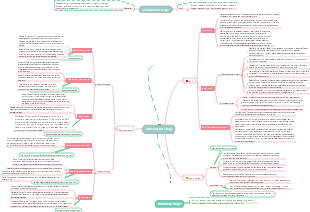
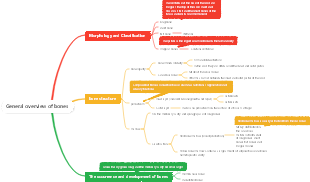
Bone classification: There are 206 bones in adults.
Long bones: humerus, femur, metacarpals, phalanges
Distributed in the limbs, it can be divided into two ends of the body. There is a medullary cavity inside to accommodate the bone marrow.
Short bones: carpal bones, tarsal bones
Flat bones: skull (frontal bones, parietal bones, occipital bones), ribs, scapula, sternum
Irregular bones: vertebrae
Trunk bones (24 vertebrae, one base bone, one coccyx and 12 pairs of ribs)
vertebra
Vertebral body: The back of the vertebral body is slightly depressed, and together with the vertebral arch, it forms the vertebral foramen. Each vertebral foramen passes through to form the spinal canal that contains the spinal cord.
Vertebral arch: arcuate bony plate, the narrowed part closely connected to the vertebral body is called pedicle. The upper and lower edges of the root have notches respectively. The upper and lower notches of adjacent vertebrae together form an intervertebral foramen, through which spinal nerves and blood vessels pass. The vertebral pedicles on both sides expand posteriorly and medially and are called vertebral laminae. The vertebral pedicle emits 7 processes: 1 spinous process, 1 pair of transverse processes, and 2 pairs of articular processes
Sternum (located in the middle of the front wall of the chest, convex and concave, and can be divided from top to bottom)
Ribs (composed of ribs and costal cartilage, 12 pairs in total)
True ribs: The front ends of the 1st to 7th pairs of ribs are directly connected to the sternum
False ribs: The 8th to 10th pairs of ribs are not directly connected to the sternum. The front ends of the ribs are connected to the upper costal cartilage to form a costal arch.
Floating ribs: The front ends of the 11th to 12th ribs are free in the abdominal wall muscle layer
Skull (composed of 23 flat and irregular bones)
Brain skull (8 pieces)
Paired: Temporal and parietal bones
Unpaired: frontal bones, ethmoid bones, sphenoid bones, occipital bones
Facial skull (15 pieces)
Pairs: maxillary bones, palatine bones, zygomatic bones, lacrimal bones and inferior nasal bones
Unpaired: vomer, mandible and hyoid
appendicular bones
Upper limb bones
Upper limb bones: including the clavicle and scapula. Most clavicle fractures occur at the junction of the middle and outer thirds.
The scapula is between the 2nd and 7th ribs, and the lower angle is flat against the 7th rib or the 7th intercostal space, which is the mark for counting ribs.
free upper limb bones
Humerus: Typical long bone
Forearm bones: including radius and ulna (inner ulna and outer radius)
Hand bones: carpal bones, metacarpal bones and phalanges
Lower limb bones
Lower limb bone (hip bone): Irregular in shape. The upper part is flat and wide, the middle part is narrow and thick, there is a deep socket facing downward and outward called the acetabulum, and the lower part has a large hole called the obturator.
The left and right hip bones, sacrum, and coccyx form the pelvic bone. The hip bone is composed of the ilium, pubis and ischium. The three bones meet at the acetabulum and are completely fused by the age of 16.
free lower limb bones
Femur: The longest and strongest long bone in the human body
Patella: the largest sesamoid bone in the human body
Tibia: located on the inside of the lower leg
Fibula: Located outside and behind the tibia. The upper end is slightly expanded and is called the fibular head. The lower end of the head is narrowed and is called the fibular neck. The lower end is expanded to form the lateral malleolus.
Foot bones: including tarsals, phalanges, and metatarsals
The anterior and lower part of the temporal fossa is thin, and is weakest where the frontal, parietal, temporal, and sphenoidal bones meet. The small annular area that forms the "H"-shaped suture is called the pterion, and the forelimb of the middle meningeal artery passes through it.
Main characteristics of each part of the vertebrae
Cervical vertebra: There is a transverse process hole at the root of the small transverse process of the vertebral body.
Atlas (first cervical vertebra): annular, without vertebrae, spinous processes, and articular processes
Axis (second cervical vertebra): The odontoid process extends upward from the vertebral body
Carina vertebra (seventh cervical vertebra): The spinous process is particularly long, the end is not bifurcated, and is easy to touch in living objects. It is often used as a symbol for counting the number of vertebrae.
Thoracic vertebrae: The spinous processes are longer and inclined backward and downward in an imbricated arrangement.
Lumbar vertebrae: The vertebral body is thick, the cone foramen is oval or triangular, the spinous process is wide and short, plate-shaped, extending horizontally to the rear. The gaps between each spinous process are wide, and lumbar puncture can be performed clinically here.
Sacrum: formed by the fusion of 5 sacral vertebrae, slightly curved in the shape of an inverted triangle
Coccyx: formed by the fusion of 3 to 4 degenerated coccygeal vertebrae
The connection between the manubrium of the sternum and the body of the sternum is slightly convex forward, which is called the sternal angle. The two sides are flat against the second rib, which is an important sign for counting ribs.
bone structure
Bone quality: compact bone, spongy bone
Periosteum: Except for the articular surface, the surface of fresh bone is covered with periosteum
Bone marrow (filled in the medullary cavity and cancellous space)
Red bone marrow: The bone marrow of fetuses and young children is red bone marrow (has hematopoietic and immune functions)
Yellow bone marrow: After the age of five, the red bone marrow in the backbone of long bones is gradually replaced by adipose tissue (loss of hematopoietic ability)
 Wondershare EdrawMind