MindMap Gallery Chapter 2 Leadership Behavior
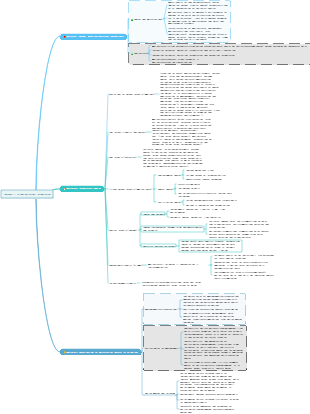
Chapter 2 Leadership Behavior: Leadership refers to a person who has the ability to influence groups and influence others to achieve organizational goals. Leadership has two basic characteristics: the ability to influence, to direct and to inspire. The influence of leadership mainly comes from formal appointments in the organization. Come and learn to be an intermediate economist with me!
Edited at 2023-10-24 20:56:46This is a mind map about bacteria, and its main contents include: overview, morphology, types, structure, reproduction, distribution, application, and expansion. The summary is comprehensive and meticulous, suitable as review materials.

This is a mind map about plant asexual reproduction, and its main contents include: concept, spore reproduction, vegetative reproduction, tissue culture, and buds. The summary is comprehensive and meticulous, suitable as review materials.
This is a mind map about the reproductive development of animals, and its main contents include: insects, frogs, birds, sexual reproduction, and asexual reproduction. The summary is comprehensive and meticulous, suitable as review materials.
This is a mind map about bacteria, and its main contents include: overview, morphology, types, structure, reproduction, distribution, application, and expansion. The summary is comprehensive and meticulous, suitable as review materials.
This is a mind map about plant asexual reproduction, and its main contents include: concept, spore reproduction, vegetative reproduction, tissue culture, and buds. The summary is comprehensive and meticulous, suitable as review materials.
This is a mind map about the reproductive development of animals, and its main contents include: insects, frogs, birds, sexual reproduction, and asexual reproduction. The summary is comprehensive and meticulous, suitable as review materials.
Chapter 2 Leadership Behavior
Section 1 Leadership Theory
A leader refers to a person who has the ability to influence groups and influence others to accomplish organizational goals. Leadership has two basic characteristics: the ability to influence, to direct and to inspire. The leader's influence mainly comes from the formal appointment of the organization
leadership theory
trait theory
Leaders have certain inherent qualities, and these qualities are innate. Only those who are born with certain qualities can become leaders.
Gibber believes that excellent leadership must possess the following characteristics: ① Strong (Putin) ②Be smart but not too smart (Wang Xifeng) ③Extrovert and dominant (Trump) ④Have good adaptability (Deng Xiaoping) ⑤Confidence (Chairman Mao)
Stoogdier has further expanded the range of traits to include: ① Have a sense of responsibility for the work completed ②Be enthusiastic and persevere in the pursuit of goals ③Be adventurous and innovative when solving problems ④Be brave enough to practice ⑤Confidence ⑥Able to handle interpersonal tension well and tolerate setbacks, etc.
Drawbacks of Trait Theory (1) Ignoring the needs of subordinates (2) Failure to indicate the relative importance of each trait (3) Ignoring situational factors (4) Failure to distinguish between causes and effects (the relationship between traits and performance)
Transactional and transformational leadership theory (Burns)
transactional leadership
Features: 1. Rewards: Commitment to provide rewards for effort, reward for high performance, and appreciate achievement 2. Error management (positive type): Observe and look for deviations from standards and take corrective action 3. Error management (passive): only intervene when standards are not met 4. Laissez-faire: giving up responsibility and avoiding decision-making
Research results: Transactional style is a relative mediocre management
transformational leadership
Characteristics: 1. Charm: Provide vision for the mission, instill pride, gain respect and trust 2. Motivation: Continuously high expectations, encouraging efforts, using simple means to express important intentions 3. Intelligent stimulation: Improve wisdom, solve problems rationally and cautiously 4. Personalized care: Give personal care and treat employees’ training and suggestions in a personalized manner
Research results: Transformational leadership creates superior organizational performance in innovation and change
Charismatic Leadership Theory (Robert House)
1. Characteristics of leaders Leaders are confident and trustful of their followers, have high expectations for their followers, have idealistic visions, and use a personalized style. Leaders motivate followers to produce performance above expectations and a strong sense of belonging.
2. Characteristics of followers Followers identify with the leader and his mission, have high loyalty and confidence in the leader, imitate his values and behaviors, and gain self-esteem from the relationship with the leader. The effects of charismatic leadership are further enhanced when followers display high levels of self-awareness and self-management.
3. Charm itself is an attribution phenomenon that changes with the situation. Leadership traits that prompt charisma attributions include: self-confidence, impression management skills, social sensitivity, and empathy. In addition to studying the characteristics of the leader himself, one must also consider the situation in which the leader finds himself, as well as the nature of the task.
Path-goal theory (Robert House)
Motivational effect: It combines the realization of performance with the satisfaction of employee needs; providing necessary coaching, guidance, support and rewards to achieve effective work performance
Four leadership behaviors: 1. Directive leadership: Make employees clear others' expectations of him, standards for successful performance, and work procedures (externally controlled subordinates) 2. Supportive leadership: Establish a comfortable working environment, be friendly and caring, and care about the needs of subordinates (Subordinates with structured work) 3. Participative leadership: Actively solicit and adopt employees’ opinions (Subordinates with internal control) 4. Achievement-oriented leadership: Set challenging goals and encourage subordinates to show their best (those with strong ability and experience) subordinate)
Different leadership behaviors are appropriate for different environmental factors and personal characteristics
Contingency Theory (Feedler)
It is believed that the level of team performance depends on the matching of leadership style and situational factors, and the leadership style is divided into work orientation and relationship orientation.
Situational factors are divided into three dimensions: superior-subordinate relationship, work structure, and authority. Memory tips: For those with a high relationship orientation, the situational dimension will be high, low, and low, high, and for high. For those with a high work orientation, the situational dimension will be three lows (bad relationship between superiors and subordinates, low work structure, and small authority).
Leader-Member Exchange Theory/LMX Theory (George Glenn and colleagues)
It is believed that in the early stages of establishing relationships and roles between leaders and subordinates in a team, subordinates are divided into "insiders" and "outsiders"
The exchange process is a reciprocal process that changes the subordinate's self-concept and also changes the leader's self-schema.
Section 2 Leadership Styles and Skills
Douglas McGregor's classic Theory X and Theory Y: Theory X: a management style that represents traditional authority. Theory Y: Represents a heuristic, humanistic management style
Early research on leadership
1. Lewin’s model of democracy and autocracy: leadership styles are divided into three basic types: autocratic, democratic and laissez-faire. Children under laissez-faire leaders develop the most aggressive behaviors. 2. Stoogdier’s research: Personality and situation are both factors that determine leadership
Ohio and Michigan model
Caring for people: It means that leaders pay attention to interpersonal relationships, respect and care for the suggestions and emotions of subordinates, and are more willing to establish working relationships of mutual trust. Leaders with a high interpersonal orientation help subordinates solve personal problems, are friendly and approachable, and treat every subordinate fairly. Care about the life, health, status and satisfaction of subordinates
Work management: refers to the behavioral activities that leaders engage in when defining or determining the roles of themselves and their subordinates in order to achieve goals, including organizational work tasks, work relationships, and work goals.
Ohio pattern
Employee orientation: Leaders focus on interpersonal relationships, proactively understand and actively meet employee needs
Production orientation: Leaders emphasize work technology and task progress, and care about the achievement of work goals
michigan model
Management Grid (Black and Merton) and Life Cycle Theory (Paul Hersey and Blanchard)
The management grid theory draws leadership styles into two-dimensional coordinates
The abscissa: caring about tasks; the ordinate: caring about people
Coordinate position representation
(1,1) - Governance by inaction: neither caring about people nor tasks
(1,9) - Country Club: Cares a lot about people, but not enough about the mission
(5,5) - Moderate type: strive for balance and maintain a certain degree of satisfaction
(9,1) - Task leadership style: attaching importance to work tasks but being indifferent to people
(9,9) - The most ideal leadership style: attaches great importance to work tasks and also cares about employees
Life cycle theory is an extension of the management grid theory, proposed by management psychologists Paul Hersey and Blanchard. Life cycle theory believes that an important factor affecting a leader's style choice is the maturity of subordinates. Maturity includes the following two aspects:
Job Maturity: Knowledge and Skill Level---Competencies.
Psychological maturity: willingness or motivation to do work---willingness
Life cycle theory combines the two dimensions of work orientation and relationship orientation to derive four leadership styles
Directive style: high work, low relationship. immature state
Sales style: high work, high relationship. initial mature state
Participative: low effort, high relationships. relatively mature state
Delegating style: low work, low relationship. high maturity state
Leadership Skills: Successful leadership relies on appropriate behaviours, skills and actions. Three Key Skills of Leadership
Technical skills: A person's knowledge of a type of program or technology knowledge and ability. What's involved is something
Interpersonal Skills: The ability to work effectively with others and build teamwork. It's people who care
Conceptual skills: The ability to think in terms of models, frameworks, and broad connections. It affects opinions and thoughts
Section 3 Leadership Decision-making
Decision-making process
Simon's decision-making process: intellectual activity stage, design activity stage, selection activity stage
Mintzberg's decision-making process: identification stage, development stage, selection stage
decision model
rational model
According to the rational model, decision makers are completely rational in every respect. maximization principle. Decision makers have the following characteristics: (1) From the perspective of goals, the decision-making is completely rational. (2) There is a complete and consistent preference system that enables decision makers to choose among different alternatives. (3) Decision makers can know all alternatives. (4) There is no limit on computational complexity, and the best alternative can be selected through calculation. (5) There is no difficulty in calculating probability.
bounded rationality model
Characteristics of decision makers: 1) When choosing a plan, try to satisfy yourself, or look for satisfactory results. (2) The world perceived by decision makers is a simplified model of the real world. (3) Due to the adoption of the satisfaction principle rather than the maximization principle, decision makers do not need to know all possible options when making choices. (4) Use relatively simple empirical heuristic principles, business tips and habits to make decisions. Note: The difference between bounded rationality models and rational models is mainly reflected in degree rather than qualitative differences.
social model
People have a tendency to stick with bad decisions, which is called "increased investment." Reasons for "increase in investment": (1) Project characteristics, such as extending the investment return period and dealing with temporary problems. (2) Psychological determinants, such as errors in decision-making information processing. (3) Social pressure, there is peer pressure and the need to maintain one's own face. (4) Determining factors of the organization, such as failure of the organizational communication system, destruction of the political system, and resistance to change, etc.
decision making style
Two dimensions of decision-making style
Value orientation: refers to whether the decision-maker is concerned with the task and technology itself or with human and social factors.
Ambiguity tolerance: refers to the measured degree of structure and control a decision maker needs (low ambiguity tolerance) and the ability to work in an uncertain environment (high ambiguity tolerance)
Four Decision-Making Styles (Memory Tip: Congratulations to the Government)
Guidance type Guidance type (Z): task and technology orientation. Lower blur tolerance
Analytical Decision Making (F): Task and Technical Orientation. Higher blur tolerance
Conceptual type (G): Concern for people and society. Higher blur tolerance
Behavioral type (X): Concern for people and society. Lower blur tolerance