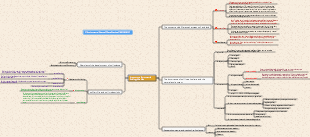
MindMap Gallery soil water
Soil water, available soil water: The water retained in the soil between the field water capacity (1-2 million Pa) and the permanent wilting coefficient (1.5 million Pa). Soil water with a soil water suction greater than 1.5 million Pa is ineffective water for plants.
Edited at 2023-10-21 10:50:26This is a mind map about bacteria, and its main contents include: overview, morphology, types, structure, reproduction, distribution, application, and expansion. The summary is comprehensive and meticulous, suitable as review materials.

This is a mind map about plant asexual reproduction, and its main contents include: concept, spore reproduction, vegetative reproduction, tissue culture, and buds. The summary is comprehensive and meticulous, suitable as review materials.
This is a mind map about the reproductive development of animals, and its main contents include: insects, frogs, birds, sexual reproduction, and asexual reproduction. The summary is comprehensive and meticulous, suitable as review materials.
This is a mind map about bacteria, and its main contents include: overview, morphology, types, structure, reproduction, distribution, application, and expansion. The summary is comprehensive and meticulous, suitable as review materials.
This is a mind map about plant asexual reproduction, and its main contents include: concept, spore reproduction, vegetative reproduction, tissue culture, and buds. The summary is comprehensive and meticulous, suitable as review materials.
This is a mind map about the reproductive development of animals, and its main contents include: insects, frogs, birds, sexual reproduction, and asexual reproduction. The summary is comprehensive and meticulous, suitable as review materials.
Soil water mind map
Classification of soil water types
soil moisture type
Hygroscopic water Soil absorbs water. The water retained by dry soil by absorbing water vapor from the air is called hygroscopic water.
Maximum moisture absorption: the amount of water vapor that dry soil can absorb in an atmosphere that is nearly saturated with water vapor and condense into liquid water on the surface of soil particles.
Film water: Water adsorbed on the surface of soil particles forms a water film. This part of water is called soil film water.
The soil water content when the soil film water reaches the maximum value is called the maximum molecular water holding capacity of the soil.
Capillary water: The moisture existing in the capillary pores of soil is called capillary water, including capillary suspended water and capillary rising water.
Capillary suspended water is water maintained in the capillary pores of the upper soil with the help of capillary force. It is not connected to the capillary water rising from the groundwater and seems to be suspended in the upper soil, so it is called capillary suspended water.
Capillary water breakage When the soil moisture content decreases to a certain level, the continuous state of water suspended in the thicker capillaries breaks, and the evaporation rate decreases significantly. The soil water content at this time is called the capillary water breakage. Approximately equivalent to about 75% of the soil's water holding capacity
Field water capacity: The soil moisture content when capillary suspended water reaches its maximum value is called field water capacity. It is usually used as the highest indicator of irrigation water quota. In terms of quantity, it includes hygroscopic water, membranous water and capillary suspended water. The size of field water capacity is mainly affected by texture, organic matter content, structure, tightness, etc.
Capillary water holding capacity The soil moisture content at which capillary water rises to the maximum
The relative height that capillary water can rise from the groundwater level to the capillary water is called the capillary water rise height.
Gravity water Gravity water is water that temporarily exists in soil macropores (ventilation pores) and is related to the leaching loss of soil nutrients.
Soil saturated water content: the water content when all pores of the soil are filled with water, also called the total soil water holding capacity
Note: The above-mentioned values of various forms of water are different for different textures of soil.
Determination of soil water content
How to express soil moisture content
energy state of soil water
Water and soil potential and its sub-potentials
Matric potential (m) negative value, maximum = 0 when the soil is saturated. The higher the soil moisture content, the higher the matric potential.
Pressure potential ( p ) is positive. There is pressure potential only when the soil is saturated with water. In unsaturated soil, the pressure potential is 0. The deeper the saturated soil layer, the higher the pressure potential.
Solute potential (S) is negative. The higher the soil solute concentration, the lower the solute potential. The solute potential only affects the movement of water in semipermeable membranes.
Gravity potential (g) refers to the change in soil and water potential caused by gravity. The gravity potential exists at any time. It is positive when it is higher than the reference surface, and negative otherwise. The gravity potential is 0 at the reference surface.
The absolute positive value of soil water suction. Soil water suction refers to the energy state of soil water when it is subjected to a certain suction. It is referred to as suction, but it does not refer to the suction of soil to water. The suction generally mentioned refers to the matrix suction, and its value Equal to vm, but with opposite sign
Quantitative determination of soil water potential
Standard unit of soil and water potential: Pa 1 Pa =0.0102 cm water column 1 atm =1033 cm water column = 1.0133 bar 1 bar =0.9896 atm =1020 cm water 1 bar =100000 Pa
Soil moisture characteristic curve
Refers to the relationship curve between soil moisture content and soil water suction. At present, it is not possible to theoretically deduce the small relationship between soil moisture content and soil water suction or matric potential. It can only be obtained experimentally.
curve
Cause of hysteresis
In the soil moisture characteristic curve, the matric potential increases quickly (soil water suction decreases) when it first begins to absorb water, while the water content increases slowly, that is, it lags. The soil dehydration process is opposite. As the matric potential decreases (soil water suction increases), water in large pores cannot be discharged due to the bottleneck effect of small pores. It is not until the matric potential reaches the level corresponding to the small pores that the soil pores begin to drain normally. The soil moisture characteristic curve shows that when dehydration first begins, the matric potential rises (soil water suction decreases) quickly and the water content decreases slowly.
use·
First, it can be used to convert between soil water suction S and moisture content 0 Secondly, the soil moisture characteristic curve can indirectly reflect the distribution of soil pore size. Third, the moisture characteristic curve can be used to analyze the water holding capacity of soils with different textures and the availability of soil moisture. Fourth, when applying mathematical physics methods to quantitatively analyze water movement in soil, the moisture characteristic curve is an indispensable and important parameter.
movement of soil water
saturated flow
Saturated flow hydraulic conductivity
concept
When all pores in the soil are filled with water, the speed at which water moves to the lower layers of the soil or laterally
Features
Characteristics of saturated hydraulic conductivity ① The saturation rate is a constant ② It is the MAX of soil hydraulic conductivity ③ It mainly depends on the texture and structure of the soil. Sandy soil > Loamy soil > Clay
Factors affecting saturated hydraulic conductivity
Texture water flux is proportional to the fourth power of pore radius. Structural soil crust has a significant impact on soil saturated hydraulic conductivity. Organic matter content. Clay mineral types
unsaturated flow
Unsaturated hydraulic conductivity
dy / dx is the total water potential gradient. Unsaturated hydraulic conductivity is a function of soil matric potential.
the difference
The mathematical expression of soil flow under unsaturated conditions is similar to that under saturated conditions. The difference between the two is The total water potential gradient under saturated conditions can be expressed in a differential form, while under non-sum conditions the differential form can be used: Soil hydraulic conductivity Ks under saturated conditions is a constant for a specific soil, while unsaturated hydraulic conductivity is a function of soil water content or matric potential (ym)
Water vapor movement
The movement of soil gaseous water is manifested by two phenomena: water vapor diffusion and water vapor condensation. The driving force of water vapor diffusion movement is the water vapor pressure gradient.
Infiltration and redistribution to soil surface evaporation
Republish
After the soil water infiltration process is completed, the water moves downward in the soil and is redistributed under the influence of gravity and suction gradients. Redistribution of soil water is unsaturation of soil water
soil water infiltration
Generally refers to the process of water entering the soil vertically downward from the soil surface, but it does not exclude the process of water entering the soil laterally or even upward in furrow irrigation.
Influencing factors
One is the water supply rate, and the other is the infiltration capacity of the soil.
initial penetration rate
Water flow rate at the onset of infiltration relative to soil background moisture
stable infiltration rate
Stable infiltration rate is the rate when water flow is stable after infiltration, which is equal to or close to saturated hydraulic conductivity
Evaporation from soil surface
The process by which soil water vapor enters the atmosphere. When the soil water supply is sufficient, the maximum possible evaporation intensity determined by the evaporation capacity of the atmosphere is called the potential evaporation intensity.
The evaporation process on the soil surface is divided into three stages.
1. The stage when the evaporation intensity of the topsoil remains stable.
– The evaporation intensity in the stable evaporation stage is mainly determined by the evaporation capacity of the atmosphere, which can be approximated by the evaporation intensity E0 of the water surface. The lower limit of moisture content at this stage is generally considered to be equivalent to the moisture content of capillary water breakage, or 50-70% of field water capacity.
2. Stages in which the evaporation intensity of topsoil changes with moisture content
– The evaporation rate is sharply reduced, which is beneficial to the maintenance of soil moisture
3. Water vapor diffusion stage
– The water transport capacity of the soil is extremely weak and cannot replenish the water lost by evaporation from the top soil, forming a dry soil layer on the soil surface. At this stage, the evaporation surface is not on the surface, but inside the soil. The evaporation intensity is mainly controlled by the ability of water vapor diffusion in the dry soil layer and depends on the thickness of the dry soil layer. Generally speaking, its rate of change is very slow and Stablize.
Soil moisture conservation measures are most effective during the first stage of evaporation; the second stage is less effective.
Water evaporation from salt soil: – There is a lot of salt accumulation in summer; – The evaporation force is weak and there is less salt accumulation; – The salt moves to higher places and the salt spots expand.
Field soil moisture balance
Regulation in the soil
Effective water
Available soil water: The water retained in the soil between the field water capacity (1-2 million Pa) and the permanent wilting coefficient (1.5 million Pa). Soil water with a soil water suction greater than 1.5 million Pa is ineffective water for plants.
wilting coefficient
The wilting coefficient, also known as the wilting coefficient and the wilting point, is one of the important soil moisture constants. The wilting coefficient varies depending on the soil. The wilting coefficient of clay soil is higher than that of sandy soil. Refers to the soil moisture content when the leaves of crops growing on moist soil wilt after a long-term drought due to insufficient water absorption to compensate for transpiration consumption.
Plants absorb water
Plant water absorption: – active and passive water absorption. Passive water absorption is the main method, and its driving force is the water potential gradient from plant leaves to stems to roots to soil. Active water absorption generally does not exceed 10% of the plant's water capacity
way
– Rational extraction, – distribution and management; – Reduce water transmission losses; – Improve irrigation efficiency. Soil water regulation
control
Soil water control measures mainly include soil water conservation and regulation
1. Farming measures: autumn plowing, cultivating and suppression, etc.
2. Ground covering film covering and straw covering
3. Irrigation measures: sprinkler irrigation, drip irrigation, seepage irrigation
21 Huanke 2 Wang Zhanhua 210825030237