MindMap Gallery Alkaloids physical and chemical properties, extraction and separation, structural identification
This is a mind map about the physical and chemical properties, extraction and separation, and structural identification of alkaloids. Most alkaloids are crystalline solids, optically active, and have a certain melting point.
Edited at 2024-01-16 20:39:42This is a mind map about bacteria, and its main contents include: overview, morphology, types, structure, reproduction, distribution, application, and expansion. The summary is comprehensive and meticulous, suitable as review materials.

This is a mind map about plant asexual reproduction, and its main contents include: concept, spore reproduction, vegetative reproduction, tissue culture, and buds. The summary is comprehensive and meticulous, suitable as review materials.
This is a mind map about the reproductive development of animals, and its main contents include: insects, frogs, birds, sexual reproduction, and asexual reproduction. The summary is comprehensive and meticulous, suitable as review materials.
This is a mind map about bacteria, and its main contents include: overview, morphology, types, structure, reproduction, distribution, application, and expansion. The summary is comprehensive and meticulous, suitable as review materials.
This is a mind map about plant asexual reproduction, and its main contents include: concept, spore reproduction, vegetative reproduction, tissue culture, and buds. The summary is comprehensive and meticulous, suitable as review materials.
This is a mind map about the reproductive development of animals, and its main contents include: insects, frogs, birds, sexual reproduction, and asexual reproduction. The summary is comprehensive and meticulous, suitable as review materials.
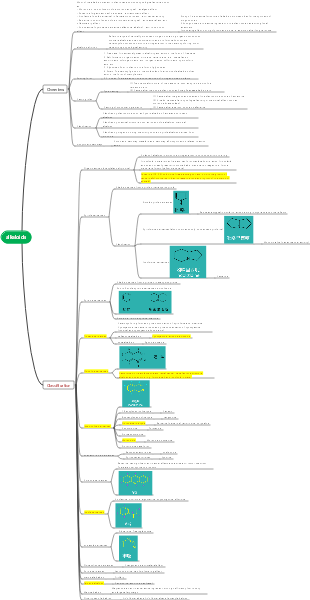
alkaloids
Physical and chemical properties
General properties
Form: mostly crystalline solid, rarely powder; has melting point. A few are liquid at room temperature (most of them do not contain oxygen, and if they contain an ester bond)
Color: mostly colorless or white, a few are colored
Berberine: yellow, tetrahydroberberine: colorless; hematine: yellow, colorless after salt formation
Taste: mostly bitter
Volatility: Most are non-volatile, a few are volatile
Optical rotation: mostly left-handed optical rotation. • Some produce metarotation phenomenon. • Such as: Nicotine Neutral solution - left optical rotation. Acidic solution - right optical rotation • Most L-isomers exhibit significant physiological activity.
solubility
Free base: A small number of phenolic bases, which are insoluble in alkaline water for various reasons. For example, demethyltetrandrine is insoluble in alkaline water due to steric hindrance and the ability to form intermolecular hydrogen bonds. Non-phenolic alkaloids are insoluble in alkaline water, so they are in the chloroform layer during extraction.
Salt-forming Alk: • Mostly soluble in water, insoluble or poorly soluble in organic solvents. Hydrophilic alkaloids usually refer to quaternary ammonium alkaloids and alkaloids with N→O coordination bonds • Oxylate salts tend to be more water-soluble. • Poor solubility with salt water formed by macromolecular organic acids • Good solubility with small molecular organic acids or inorganic acids to form salt water
alkaline
Source of alkalinity
How to express the strength of alkalinity
The larger the pKa, the smaller the degree of ionization of the conjugate acid, and the stronger the binding ability of nitrogen atoms to H, that is, the stronger the alkalinity.
Factors affecting the strength of alkalinity (specific examples on PPT!)
Hybridization method
sp3>sp2>sp1
Quaternary ammonium (such as berberine) > secondary amine > primary amine > tertiary amine > aromatic amine > amide; guanidino > quaternary ammonium base > aliphatic (hetero) amine > aromatic (hetero) amine > amide
Electronic effect: The density of the electron cloud increases, and the stronger the ability to accept protons, the stronger the alkalinity.
Induction effect: connecting a power supply group increases the alkalinity
Induction effect: If there are electron-withdrawing groups (such as phenyl, hydroxyl, carbonyl, ester group, ether bond, acyl group, double bond) near the nitrogen atom, the alkalinity will be weakened
Cocaine and topicocaine
Conjugation effect: When the lone electron pair of the nitrogen atom is in the p-π conjugated system, the alkalinity is weakened. Common p-π conjugation effects mainly include aniline type, enamine type and amide type. Guanidine>amidine>imidazole>pyridine>pyrrole, indole
Induction-field effect: reduced alkalinity
Steric effect: steric hindrance
Tertiary amine molecules - reduced alkalinity But such as: matrine - enhance alkalinity Generally speaking, when the induction effect and the steric effect exist at the same time, the steric effect has a greater impact on alkalinity; when the induction effect and the conjugation effect exist at the same time, the conjugation effect has a greater impact on the alkalinity.
intramolecular hydrogen bonding
If stable intramolecular hydrogen bonds can be formed, the alkalinity can be enhanced. (Means that the protons accepted during salt formation can form stable intramolecular hydrogen bonds)
Pseudoephedrine is more alkaline than ephedrine
Intramolecular tautomerism: aza ketal, protonation to form quaternary ammonium base
Conditions for tautomerism: ① Ring tertiary amine molecule has double bonds at the α and β positions of the nitrogen atom; ②Cyclic tertiary amine molecule has -OH at the α position of the nitrogen atom; ③N located at the bridgehead of the fused ring cannot be isomerized
Salt formation (Alk salt formation mechanism)
When alkaloids form salts with acids, for protonation, when secondary amine and tertiary amine alkaloids form salts, the protons are mostly bonded to nitrogen atoms. In quaternary ammonium bases, azaacetals, enamines, and alkaloids with cross-ring effects involving nitrogen atoms, protonation often does not occur at the nitrogen atom.
Salt formation of quaternary ammonium bases
Salt formation of nitrogen-containing heteroacetal Alk
Salt formation of Alk with enamine structure
Alk protonation is mostly on β-C, not nitrogen atoms
The N atom at the bridgehead of the fused ring cannot form a salt in the form of an imine
Neostrychnine, Amarinine
Salt formation of Alk involving cross-ring effects of nitrogen atoms
When the lone electron pair of the N atom is spatially close to the ketone group, a cross-ring effect occurs.
Involves the oxidation of nitrogen atoms
Oxidation to imines and their salts
N-dealkylation (remove N-methyl, N-ethyl, etc.)
amidation
Formation of azaacetal
precipitation reaction
use: • Identification – test tube, TLC or PPC chromogen; • Extraction Separation – Checks for complete extraction.
Conventional extraction method (excluding interference from water-soluble components)
Precipitation reagent
Metal salts • Iodine-potassium iodide (Wagner) KI-I2 tan precipitate • Potassium bismuth iodide (Dragendoff) BiI3×KI reddish brown precipitate • Potassium mercury iodide (Mayer reagent) HgI2×2KI off-white precipitate; if excess reagent is added, the precipitate will be dissolved again • Gold chloride (3%) (Suric chloride) HAuCl4 yellow crystalline precipitate
Acids - silicotungstic acid (Bertrand reagent) SiO2×12WO3 milky white
Phenolic acids - picric acid (Hager's reagent) 2,4,6-trinitrophenol yellow
Double salt—Ammoniumreineckate chromium ammonium thiocyanate reagent, produced Into insoluble double salt purple red
Reaction principle: generate more molecular double salts and complex salts
Precipitation reaction conditions
(1) It is usually carried out in the state of salt formation of alkaloids in acidic aqueous solution; (if it is under alkaline conditions, the reagent itself will precipitate) (2) When in dilute alcohol or fat-soluble solution, the water content is >50%; (when the alcohol content is >50%, the precipitate can be dissolved) (3) It is not easy to add large amounts of precipitation reagents. (For example: excess potassium mercury iodide can dissolve the precipitate produced)
Judgment of results
(1) More than three precipitation reagents need to be used for each Alk during identification: precipitation reagents have different sensitivities to various Alks. (2) Directly carry out precipitation reaction on the acid extract of traditional Chinese medicine, then Positive result - cannot determine the presence of Alk A negative result indicates that there is no presence of Alk (3) Amino acids, proteins, polysaccharides, tannins, etc. Precipitation reagents - precipitation
color reaction
Labat reaction • 5% gallic acid in alcohol • It has a methylenedioxy structure and is emerald green.
Vitali reaction • Fuming nitric acid and caustic alcohol solutions • The presence of benzyl hydrogen in the structure indicates a positive reaction • Deep purple-dark red-final color disappears
Extraction and Separation
extract
Acid water extraction method (ion exchange resin method, precipitation method), cold extraction method (percolation method, cold soak method)
Acid water - 0.1% ~ 1% H2SO4, HCl, HOAc, etc. Alkaloids and their salts are easily soluble in methanol, ethanol, etc., so methanol or ethanol is often used as the extraction solvent, and extraction is performed by reflux, dipping or percolation methods. Most free alkaloids are lipophilic, so they can be extracted with lipophilic organic solvents such as chloroform, dichloromethane, toluene, etc.
Acid water extraction has many disadvantages, so here are some solutions:
Ion exchange resin method: cation exchange resin
Precipitation
Acid extraction and alkali precipitation method: suitable for weakly alkaline alkaloids
Salting out method: suitable for medium weak base
Ley's ammonium salt precipitation method NH4[Cr(NH3)2(SCN)4]: suitable for quaternary ammonium bases
Alcohol solvent extraction method
Water-immiscible organic solvent extraction method
If the alkaloid salts and free alkaloids contained in traditional Chinese medicine are extracted, the solvent that should be used is methanol/ethanol; the separation of matrine and oxymatrine from total alkaloids of Sophora flavescens is based on the different solubility of the two in ether. ; In alkaline water from which fat-soluble alkaloids have been removed, n-butanol should be used to extract water-soluble alkaloids directly from the alkaline water.
separation
Separation based on the solubility of Alk and its salts • (1) Known ingredients - check the literature to select the crystallization solvent • (2) Unknown components - chromatographic method for solvent selection
Alk has different alkalinity - pH gradient extraction method
Methods to determine pH value: Buffer paper chromatography (small Rf value means high alkalinity), use pKa value to determine pH value (pH=pKa 2). When mixing alkaloid acid aqueous solutions and extracting and separating them using the pH gradient method, the pH of the solution should gradually increase from low to high. When separating alkaloids from chloroform by pH gradient extraction, you can extract from 8-3 buffer sequentially (from high to low pH)
Determine the ease of separation - number of extractions
chromatography • (1) Adsorbent: Alumina is commonly used in column chromatography (silica gel is occasionally used); • (2) Developing agent: Free Alk is often eluted with solvents such as benzene, ether, and chloroform; • (3) Judgment of compound polarity: ① Similar structure: more double bonds and more oxygen-containing functional groups - the polarity is high ②In oxygen-containing functional groups:
Extraction and separation examples: vinblastine and vincristine
Structure Identification
Chromatography: Determine physical and chemical constants (such as melting point), compare with data reported in the literature, and compare Make thin layers of the standard and measure the physical and chemical data of its derivatives. • 1. Thin layer chromatography • 2. Paper chromatography
genealogy
UV - reflects the conjugated system contained in the molecule; IR——Use characteristic absorption peaks to identify the main functional groups in the structure; NMR - various techniques to determine the structure of the map; MS - Based on the literature, combined with the mass spectral characteristics of the main alkaloid types for analysis.
General rules for alkaloid MS
Difficult to cleave or resulting in characteristic ions resulting from cleavage of substituents or side chains
Features: M or M -1 are mostly base peaks or strong peaks. Characteristic ions resulting from framework fragmentation are generally not observed. Mainly includes two categories: ①The overall or main structure of the molecules composed of the aromatic system; such as quinolines, acridones, etc. ②Alkaloids with multiple ring systems and tight molecular structures; such as matrines, colchicines, etc.
The main cleavage is dominated by nitrogen atoms
• The main cleavage method is α-cleavage centered on nitrogen atoms, and it mostly involves the cleavage of the skeleton. • Characteristics: Most of the base peaks or strong peaks are nitrogen-containing groups or parts. • Main types of alkaloids: cinchonines, steroidal alkaloids, etc.
Characteristic ions mainly produced by RDA fragmentation
• Features: After cleavage, a pair of strong complementary ions are produced, from which the nature and number of substituents on the ring can be determined. • Mainly include: tetrahydroprotoberberines, non-N-alkyl-substituted aporphyrins, etc. • Tetrahydroprotoberberine type alkaloids are mainly cleaved from the C ring and undergo reverse Diels Alder reaction (RDA reaction). For example: the cleavage process of cyclanoline is expressed as follows:
Characteristic ions are mainly produced by the cleavage of benzyl groups.
• Features: Same as 3. That is, a pair of strong complementary ions is produced after fragmentation • Such as: benzyl tetrahydroisoquinolines, bisbenzyl tetrahydroisoquinolines, etc. • For example: 1-benzyl-tetrahydroisoquinoline alkaloids in the isoquinoline type easily lose the benzyl group during the cracking process, resulting in strong spectral lines dominated by tetrahydroisoquinoline fragments