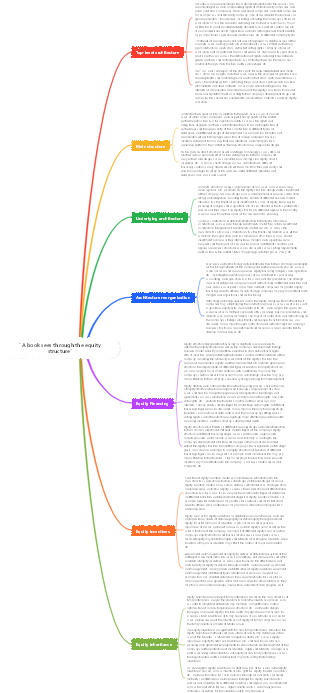
MindMap Gallery Top-level design and equity incentives
This is a mind map about top-level design and equity incentives, including the company's control rights design, equity layout, equity incentives, equity cooperation, etc.
Edited at 2024-01-15 09:48:12This is a mind map about bacteria, and its main contents include: overview, morphology, types, structure, reproduction, distribution, application, and expansion. The summary is comprehensive and meticulous, suitable as review materials.

This is a mind map about plant asexual reproduction, and its main contents include: concept, spore reproduction, vegetative reproduction, tissue culture, and buds. The summary is comprehensive and meticulous, suitable as review materials.
This is a mind map about the reproductive development of animals, and its main contents include: insects, frogs, birds, sexual reproduction, and asexual reproduction. The summary is comprehensive and meticulous, suitable as review materials.
This is a mind map about bacteria, and its main contents include: overview, morphology, types, structure, reproduction, distribution, application, and expansion. The summary is comprehensive and meticulous, suitable as review materials.
This is a mind map about plant asexual reproduction, and its main contents include: concept, spore reproduction, vegetative reproduction, tissue culture, and buds. The summary is comprehensive and meticulous, suitable as review materials.
This is a mind map about the reproductive development of animals, and its main contents include: insects, frogs, birds, sexual reproduction, and asexual reproduction. The summary is comprehensive and meticulous, suitable as review materials.
Top-level design and equity incentives Liang Hui
Company control design
Partner mechanism design
What makes a good team?
There must be a leader
strategy execution
The founding team must not exceed 3 people
There must be a leader. Two cows: the boss and the second child.
worship
trust
Standardize
like
Keep an equity pool
Personality compatibility
Partners enter
Principle: Who creates value, who distributes benefits
Financial resources driven-physical capital model 80%
People-driven-human capital model 20%
How to confirm founder’s worth
Initial (100 shares per capita) Convener (increase by 5) Entrepreneurship point and execution (increase by 5) First step (increase by 5-25) CEO (increase by 5) Full-time (increase by 200) Credibility (increase by 50-500) Industry characteristics
Technology investment requires dedicated project investment
Partner adjustment mechanism
Cash in installments
Realize part of the equity
A 70% B 30% implementation of each half
Subtopic 2
Subtopic 3
internal motivation
Stablize
Equity incentives
unstable
Pay in installments
Absolute value Number of shares
unanimous agreement
Use architecture and try not to use protocols
Partners: Percent Discreet
Exit mechanism for partners
If you withdraw your shares, you won’t get your money back, and you won’t lose even if you lose.
lock-in period
Based on the actual situation of each industry
Valuation
to price
Investment 6-month fixed annualized rate
Reference investors: one-third, one-fifth
Book net assets
Of course quit
Loss of shareholders, death and reaching retirement age, revoking of business license, bankruptcy, cancellation of shareholder qualifications, inability to perform duties, termination of contract due to fault
Exit
Resigning voluntarily, handling equity without permission, violating company rules, dereliction of duty, committing fraud, causing significant losses to the company, prohibiting competition, breaking the law, failing job assessments, damaging the company's reputation or interests
Exit at expiration
Buyback method
Confirm and agree
One-time repurchase of the shares held and payment of 5-year dividends according to the previous year's dividend standard
The company repurchases 20% of the shares each time, and repurchases them year by year over five years. Shareholders are also entitled to enjoy dividend distribution based on the company's net profit of the previous year and the amount of equity held by each repurchase.
governance structure
Four keys: 1. Shareholding ratio of founding shareholders 2. Voting system of shareholders’ meeting, board of directors and board of supervisors 3. Nomination of chairman and general manager 4. Institutional arrangements for founding shareholders to repurchase shares held by investor shareholders or management shareholders
Design of the company’s registered capital
1. Bigger is not always better 2. Be wary of investment in non-monetary assets with unrealistic values 3. Investors’ capital premium is not equal to capital increase paid in
Design of company articles of association
1. Proportion of voting rights 2. Proportion of dividends 3. Capital contribution proportion, actual funds or installments, 4. Inheritance 5. Equity transfer 6. Shareholder withdrawal 7. Investment, guarantee 8. Shareholders’ meeting power 9. Chairman Gua Xing and director emergence Method 10. Powers of Chairman and Executive Director 11. Powers of General Manager 12. Capital increase ratio of legal representative: 100 X=10%
Equity core solves the relationship between six types of people
Founders: Addressing Control
Percentage of shares
Team in the same department: Solve business problems and provide effective motivation
Number of shares
Investors: Financing, Value
Upstream and downstream: stakeholders to a community of shared future
Virtual shares: debt replacement employee incentives: year-end bonus incentives
Peers: Can mergers and acquisitions be possible?
public shares
Secondary market
Who has the final say?
nine life lines
1. Absolute control line: 67% 2. Relative control line: 51% 3. Safety control line: 34% 4. Listed company tender offer line 30% 5. Major horizontal competition warning line: 20% 6. Temporary meeting rights: 10 % 7. Major equity change warning line 5% 8. Temporary proposal right: 3% 9. Subrogation right 1%
Three levels of control
shareholders meeting
Absolute controlling interest
veto power
Board of Directors
Right to nominate seats
AB shares: A shares have one vote, one share has one vote, and B shares have one vote. The right to re-elect the chairman of the board.
Management
Personnel management rights
Seven ways to divide shares without dividing rights
limited partnership
Boss: GP
Employee Incentive Equity Crowdfunding LP
pyramid architecture
persons acting in concert
proxy voting rights
preferred stock
AB shares
Company Articles of Association Design
Equity layout
The core of equity design: value
Equity Design: Two-wheel drive
Value: The value of the first-level platform is mainly
overall company value
Making money: Second-level platform business value is the main focus
Industrial chain integration
capital story
Where to put the future?
The origin of the brand story
regional expansion
technological innovation
Manufacturing retail
Small company, big group
Policy promotion
New Field
New product
Equity structure
Analysis on the value of feeding horses in separate troughs Long-termism
Where is the future?
Where are the people?
Where are the assets?
Where is the profit?
natural person direct structure
The risk is relatively high
limited partnership structure
Holding company structure
hybrid architecture
Overseas equity structure
Contractual architecture
Five-tier architecture
pyramid structure
Equity layout target structure chart
See picture
Corporate WeChat screenshot_16618471455002.png
Equity incentives
The nature of equity incentives
Responsibility system rather than profit sharing system
Principles of Equity Incentives
Begin with the end in mind
Misunderstandings about Equity Incentives
Shareholding system does not mean contracting system. Shareholding reform does not mean sharing money and not requiring small shareholders but small bosses.
Short term: dividends Medium term: appreciation Long term: value
Business goals: average of the first two years*0.9, exceeding 10 million segments, exceeding 50 million in increments
Equity incentive methods
Choice of equity model: five models
The total shares shall not exceed 5% and 30% of the transaction amount, and the price shall be fair.
Real shares
Agreed exit mechanism
stock futures
External partners: dividends and increments
options
Both parties require an agreement, an agreement
dry stocks
Cash type
Appreciation rights
(Business growth: 70% profit growth 30% 1) 17%
adjustment mechanism
trading enterprise
innovative enterprise
The Five Elements of Determining a Person
historical contribution
Identity characteristics
degree of correlation
Hard to replace
Difficulty in supervision
adjustment mechanism
Project Partner
business partner
Managing Partner
permanent partner
Five elements of timing
strategic planning period
Employee psychological expectations
Nature of the work
Industry characteristics
laws and regulations
adjustment mechanism
Assessment period Subject period Window period Lock-in period Exercise period Conversion to real shares Realization period
Accelerate or lengthen the excitation cycle
Five elements of pricing
net profit
Stablize
gross profit
Net assets
Unstable*2 times
revenue
High round increase *3 times
Investors and stock prices
Profit* multiple Fair price: 8-12 times Employees: 5-6 times Set strategy once every 3 years and change it once
adjustment mechanism
Share price
pay deposit
Five elements of quantification
Total amount This amount Individual amount
Equity structure
A certain ratio of incentives divided into three rounds
Number of people motivating
5% at the grassroots level, 20% at the middle level, 80% at the top level
incentive cost
0.8-1.5 times the annual salary of senior executives
Incentive intensity
Cake-cutting method: Job level: 38% step difference Job value: Core center support 10% Company age: 1.0-1.3
laws and regulations
adjustment mechanism
Performance rolling-performance trigger
With 10% of the total share capital, excess: 10% increase for every 2 times the number of shares
Incentives to spend money Incentives to not spend money Incentives to get money
Four levels of dynamic management of equity
Equity Transfer Agreement
Equity distribution is fair: static
Equity Incentives: Dynamic
dynamic meaning
When designing: supporting linkage
After Implementation: Dynamic Optimization
Equity operations: buying and selling
share
performance management
organizational structure
Payroll management
Capital operation
governance structure
Corporate Strategy
Corporate Strategy
Basic business to make money
Virtual shares
Development business future
Equity opening
Opportunistic business projects
cooperate
Strategic three-way innovation
Upgraded
layered design
Fission type
Business Analysis Cross-Holdings
Cross-border
Venture capital mechanism
internal
Corporate Governance
shareholders meeting
Partner meeting
Board of Directors
strategy committee
The Audit Committee
Nomination Committee
Remuneration and Appraisal Committee
Equity Committee
Capital operation
Never listed
Mainly virtual stocks
Three new board
options
Planned IPO
Real shares with restrictions
Be acquired
Real shares/appreciation rights
Listed
Restricted stock/options/employee stock enhancement plan
Organization
Create chamfer structure
Execution type => Pull type
Establish business unit organization
Headquarters
Salary design
Salary level
Overlay type Substitution type
performance appraisal
The weight accounts for 40%
Take the three items with the highest equity in the monthly performance evaluation as the evaluation criteria, and make statistics at the end of each monthly evaluation.
The weight of stock reporting is 20%
Organize shareholder reports on the 10th of the next month of each quarter and provide mutual evaluation and scoring
Values weight 30%
Organize shareholder self-evaluation and mutual evaluation on the 20th of the next month of each quarter
Shareholder proposals weight 10%
Discuss on the 15th of the next month of each quarter and give each other scores.
Equity cooperation
Things to pay attention to in equity cooperation
funds
return profit points
Exit method
Value-added space
1. The ultimate goal of partner learning is to make the cake bigger and then divide the cake 2. Build a team, set strategies, and lead the team
Long lasting
minute increments
Select people
Share responsibilities