MindMap Gallery early algebra,algebra and integers
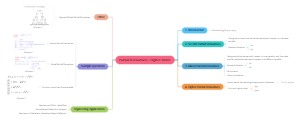
This mind map presents a well-organized illustration of the evolution of algebra, starting from its initial concepts and progressively delving into the role that integers play in algebra. Each section is meticulously dissected and elaborated on across multiple levels, aiming to provide learners with a clear and logically structured overview of the algebraic knowledge system, aiding them in grasping the essence and developmental trajectory of algebra more effectively.
Edited at 2024-08-02 18:34:11Early Algebra, Algebra and Integers

Early Algebra Foundational principles introduced at the elementary level to build algebraic thinking.
Pattern Recognition(counting and patterns) Recognizing and predicting patterns in numbers and shapes. Example: Identifying sequences like 2, 4, 6, 8, ...
Properties of Operations Understanding commutative, associative, and distributive properties. Example: (a + b = b + a)
Simple Equations Solving basic equations with single variables. Example: (x + 5 = 10); find (x).
Functional Thinking Understanding relationships between quantities. Example: Mapping input values to output values in function tables.
Variable and Expressions Introduction to using symbols(letters) to represent numbers Example (x+3=7)
Songs, Rhymes, and Games Activities that involve repetition and patterns help develop algebraic thinking skills even before formal education begins.
Algebra Advanced study of mathematical symbols and rules for manipulating them
Linear Equations Equations of the first degree (no exponents). Example: (2x + 3 = 7); solve for (x).
Quadratic Equations Equations involving squaring terms. Example: (x^2 - 4x + 4 = 0)
Solving multiple equations with multiple variables. Example: (x + y = 6) (2x - y = 3).
Polynomials Expressions with multiple terms. Example: (3x^2 + 2x - 5)
Inequalities Understanding and solving greater than/less than equations. Example: (x + 3 > 5); find the range of (x)..
Progression from Early Algebra How concepts evolve from simple introductions to complex manipulations
Conceptual Understanding Building on basic concepts to understand deeper properties and operations. Example: Moving from simple addition to algebraic addition of like terms.
Symbolic Representation From using boxes or simple symbols to formal algebraic notation. Example: Interpreting and using (x) and (y) instead of boxes or counters
Problem Solving From simple word problems to complex algebraic problems. Example: Translating real-world problems into algebraic equations.
Abstract Thinking Transitioning from concrete numbers to abstract reasoning. Example: Understanding that (x) can represent any number in an equation.
Role of Integers how integers fit within early algebra and algebra
Number Line Integers' representation on a number line helps in understanding positive and negative values.
Operations with Integers(operations and relationship) Addition, subtraction, multiplication, and division involving integers. Example: (-3 + 5 = 2)
Applications in Equations(algebraic expressions) Using integers in solving algebraic equations. Example: Solving (x - 4 = -2); (x = 2)
Properties and Rules Comprehending the properties and rules specific to integers. Example: Rules for adding and multiplying negative numbers.
Range and Real-life context understanding integers in context, such as temperature and financial transactions Example:Elevation above/below sea level
Links Between Early Algebra, Algebra and Integers Integration and mutual reinforcement of concepts.
Concept Introduction Introducing integers within early algebraic concepts. Example: Understanding negative numbers when learning simple equations.
Visual Aids Using number lines and counters to represent integers. Example: Using counters for positive/negative values to solve equations.
Stepping Stones Using early algebra to pave the way for learning algebraic operations with integers. Example: Transitioning from addition of natural numbers to addition involving negative integers.
Consistent Rules Applying consistent rules across early algebra and algebra for operations with integers. Example: Applying the rule of combining like terms in both integer and algebraic contexts.
Practical Examples Real-life integration of integer operations in algebra problems. Example: Solving problems involving debts and credits.
Early Algebra, Algebra and Integers
Early Algebra Foundational principles introduced at the elementary level to build algebraic thinking.
Pattern Recognition(counting and patterns) Recognizing and predicting patterns in numbers and shapes. Example: Identifying sequences like 2, 4, 6, 8, ...
Properties of Operations Understanding commutative, associative, and distributive properties. Example: (a + b = b + a)
Simple Equations Solving basic equations with single variables. Example: (x + 5 = 10); find (x).
Functional Thinking Understanding relationships between quantities. Example: Mapping input values to output values in function tables.
Variable and Expressions Introduction to using symbols(letters) to represent numbers Example (x+3=7)
Songs, Rhymes, and Games Activities that involve repetition and patterns help develop algebraic thinking skills even before formal education begins.
Algebra Advanced study of mathematical symbols and rules for manipulating them
Linear Equations Equations of the first degree (no exponents). Example: (2x + 3 = 7); solve for (x).
Quadratic Equations Equations involving squaring terms. Example: (x^2 - 4x + 4 = 0)
Solving multiple equations with multiple variables. Example: (x + y = 6) (2x - y = 3).
Polynomials Expressions with multiple terms. Example: (3x^2 + 2x - 5)
Inequalities Understanding and solving greater than/less than equations. Example: (x + 3 > 5); find the range of (x)..
Progression from Early Algebra How concepts evolve from simple introductions to complex manipulations
Conceptual Understanding Building on basic concepts to understand deeper properties and operations. Example: Moving from simple addition to algebraic addition of like terms.
Symbolic Representation From using boxes or simple symbols to formal algebraic notation. Example: Interpreting and using (x) and (y) instead of boxes or counters
Problem Solving From simple word problems to complex algebraic problems. Example: Translating real-world problems into algebraic equations.
Abstract Thinking Transitioning from concrete numbers to abstract reasoning. Example: Understanding that (x) can represent any number in an equation.
Role of Integers how integers fit within early algebra and algebra
Number Line Integers' representation on a number line helps in understanding positive and negative values.
Operations with Integers(operations and relationship) Addition, subtraction, multiplication, and division involving integers. Example: (-3 + 5 = 2)
Applications in Equations(algebraic expressions) Using integers in solving algebraic equations. Example: Solving (x - 4 = -2); (x = 2)
Properties and Rules Comprehending the properties and rules specific to integers. Example: Rules for adding and multiplying negative numbers.
Range and Real-life context understanding integers in context, such as temperature and financial transactions Example:Elevation above/below sea level
Links Between Early Algebra, Algebra and Integers Integration and mutual reinforcement of concepts.
Concept Introduction Introducing integers within early algebraic concepts. Example: Understanding negative numbers when learning simple equations.
Visual Aids Using number lines and counters to represent integers. Example: Using counters for positive/negative values to solve equations.
Stepping Stones Using early algebra to pave the way for learning algebraic operations with integers. Example: Transitioning from addition of natural numbers to addition involving negative integers.
Consistent Rules Applying consistent rules across early algebra and algebra for operations with integers. Example: Applying the rule of combining like terms in both integer and algebraic contexts.
Practical Examples Real-life integration of integer operations in algebra problems. Example: Solving problems involving debts and credits.