 Wondershare EdrawMind
MindMap Gallery Attitude and moral character learning
- 19
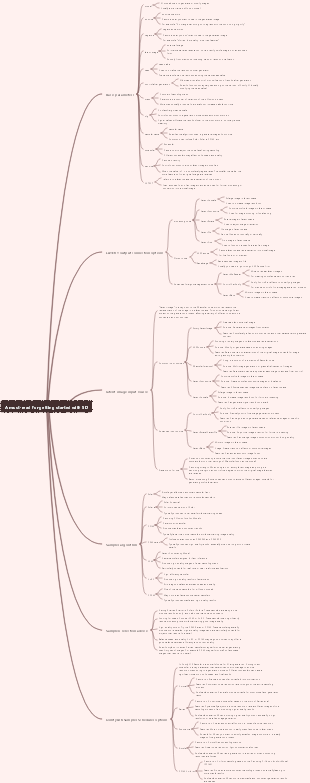
Attitude and moral character learning
Teacher recruitment, educational psychology, attitude and moral study, this mind map will help you familiarize yourself with the key points of knowledge and enhance your memory. Students in need can save it.
Edited at 2024-11-26 10:06:23
- Reproductive system
This template shows the structure and function of the reproductive system in the form of a mind map. It introduces the various components of the internal and external genitals, and sorts out the knowledge clearly to help you become familiar with the key points of knowledge.
- Interpretation and summary of relationship field e-book
This is a mind map about the interpretation and summary of the relationship field e-book, Main content: Overview of the essence interpretation and overview of the relationship field e-book. "Relationship field" refers to the complex interpersonal network in which an individual influences others through specific behaviors and attitudes.
- Accounting books and accounting records
This is a mind map about accounting books and accounting records. The main contents include: the focus of this chapter, reflecting the business results process of the enterprise, the loan and credit accounting method, and the original book of the person.
Attitude and moral character learning
- Reproductive system
This template shows the structure and function of the reproductive system in the form of a mind map. It introduces the various components of the internal and external genitals, and sorts out the knowledge clearly to help you become familiar with the key points of knowledge.
- Interpretation and summary of relationship field e-book
This is a mind map about the interpretation and summary of the relationship field e-book, Main content: Overview of the essence interpretation and overview of the relationship field e-book. "Relationship field" refers to the complex interpersonal network in which an individual influences others through specific behaviors and attitudes.
- Accounting books and accounting records
This is a mind map about accounting books and accounting records. The main contents include: the focus of this chapter, reflecting the business results process of the enterprise, the loan and credit accounting method, and the original book of the person.
- Recommended to you
- Outline


Attitude and moral character learning
Attitude formation and change
concept of attitude
An internal state of readiness or response tendency formed through learning that affects personal behavioral choices
Attitude is a state of internal readiness rather than the actual reaction itself
Students with good grades internally intend to exclude and avoid students with poor grades, but this idea does not necessarily translate into explicit behavioral responses.
Attitudes are different from abilities, although both are internal response tendencies. Ability determines whether an individual successfully completes certain tasks, and attitude determines whether an individual is willing to complete certain tasks.
The behavior of caring for public property is not determined by ability, but by attitude.
Attitude is the result of learning, not innate. Attitudes are formed and changed through the interaction between individuals and the environment. Once formed, attitudes are relatively stable and not easy to change within a certain period of time.
structure of attitude
Emotional (A) component
The emotion or emotional experience that accompanies the cognitive component of attitude is the core component of attitude. It is mainly manifested as a person's understanding and understanding of an object, approval and opposition. When the attitude changes, the emotion will also change accordingly.
Emotional experiences such as liking or disliking, hating or not hating Huawei products
Emotional experiences such as the sense of satisfaction that students get when they get good grades, the excitement and sense of accomplishment after solving a difficult problem, etc.
Behavioral (B) component
Refers to the intention or intention to prepare for a certain response to an object, which is expressed as a state of readiness before actual action (not the action itself, but the state of readiness before taking action). Attitudes and behavioral tendencies are often inferred based on emotional components.
Be prepared to buy tutoring books or spend a lot of time studying in order to get good grades
Cognitive (C) component
Refers to the concept or belief with evaluative significance that an individual has towards the attitude object.
For example, the evaluation of the price, quality, performance and other attributes of Huawei products is a concept.
If students believe that good academic performance can bring honor, it is a belief
attitude formation process
attitude acquisition theory
learning theory
classical conditioning theory
Repeated, systematic associations between an attitude object (a conditioned stimulus) and something that elicits a positive or negative emotion (an unconditioned stimulus) can produce a positive or negative attitude toward that object
Students often associate English learning with enjoyable experiences and develop a positive attitude toward English learning.
Nazis are often associated with terrorist crimes. People hate Nazis because they are associated with terrorist crimes, which creates a negative attitude towards Nazis.
reinforcement theory
When an individual's behavior is praised by others, it is reinforced, resulting in a positive emotional experience and a positive attitude towards the behavior; on the contrary, punishment will cause the individual to have a negative emotional experience and show a negative attitude
After students are praised for their behavior, they develop a positive attitude toward their behavior; students who confront teachers in class always have unpleasant consequences, namely punishment. negative attitude
social learning theory
People often learn social attitudes and behaviors by observing the attitudes and behaviors of role models, and many attitudes are learned by imitating the attitudes of others.
Adolescents’ political attitudes may come from observing the attitudes of others and thus receiving vicarious reinforcement
cognitive theory
cognitive balance theory
Proposed by Hyde in 1958, this theory holds that people tend to maintain consistency by balancing each other's attitudes with their attitudes toward something. When an imbalance occurs, people tend to change it into a balanced state
Also known as the "P-O-X" theory, P represents the cognitive subject, O is another person who is connected with P, and X is another arbitrary object that P is connected with O. The theory assumes that the balance state between the three is stable.
What is considered is that a person will combine each other's attitudes towards people and objects within his or her own cognitive structure. Hyde emphasizes that a person's attitude towards a certain cognitive object is often affected by other people's influence on the object, that is, he attaches great importance to interpersonal relationships. The influence of relationships on attitudes
cognitive dissonance theory
In 1957 Festinger proposed
When an individual realizes that there is a contradiction between his different attitudes or between his attitudes and behaviors, it will lead to psychological discomfort and pressure, prompting the person to try to eliminate the existing imbalance and thus eliminate the discomfort.
Cognitive dissonance is a prerequisite for attitude change
Although cognitive dissonance provides conditions for attitude change, it does not necessarily lead to attitude change. Therefore, it is necessary to seize the opportunity of cognitive dissonance in time and take effective measures: such as reducing the importance or number of dissonant cognitions, improving coordination The importance or number of cognitions, changing the cognitive elements, etc. promote attitude changes.
Ways to Promote Attitude Change
conditioned response method
Use the principles of classical conditioned responses and operant conditioned responses to promote attitude changes
With the help of classical conditioned responses, moral requirements such as "helping others" and "loving the collective" can be linked to teachers' approval and parents' love, so that students can form a positive attitude towards these moral requirements; based on the theory of operant conditioning, teachers usually The available methods are to reinforce or punish students' behavior appropriately.
When students show a positive attitude toward an object, give students appropriate rewards to increase the likelihood that the positive attitude will appear again. When a student shows a negative attitude toward a certain object, give the student a certain amount of punishment to reduce the possibility of the negative attitude appearing again.
Provide role models
Social learning is accomplished through observation and imitation. As a component of social learning, attitude can also be acquired through observation and imitation of role models. Role models play a very important role in the observational learning process
Notice
The role models chosen should be similar to the students and have appeal and credibility
Consider the role model's age, gender, social background and other characteristics to be as similar as possible to the students to avoid feeling unattainable or out of reach.
Present role models who are respected, have higher status, are capable and attractive, so that students can have emotional resonance and be motivated to learn from others.
Multiple demonstration methods should be combined
Teachers need to repeatedly set an example and provide guidance
Encourage students when they demonstrate required behavior
Persuasion
More common methods used by teachers to change students' attitudes
In the process of persuasion, teachers should provide students with certain evidence or information to support or change students' attitudes.
For example, for lower grade students with limited understanding ability, when the students have no opposing views, when the task of persuasion is to solve an urgent problem, the teacher can only present positive views; for upper grade students with strong understanding ability, when the students originally have When the task of persuasion is to cultivate students' long-term stable attitudes, teachers should put forward both positive and negative views.
Persuasion must not only convince people with reason, but also move people with emotion.
Students’ original attitudes should be considered when persuading
Ways to Strengthen Attitudes
internal
First, we must strengthen our knowledge and understanding of the newly acquired attitude objects.
Second, we must reduce or eliminate factors that promote attitude cognitive dissonance.
external
Newly acquired attitudes must be continuously strengthened to enhance the subject's internal preparation tendency for objective trends.
The formation and cultivation of moral character
concept of moral character
The abbreviation of moral character is the stable psychological tendencies and characteristics displayed by individuals when regulating their behavior according to certain social moral principles. Character reflects the moral outlook of an individual, is the reflection of social morality on the individual, and is the core part of personality with moral evaluation significance.
Morality vs Attitude
Similarities
The basic issues involved in moral character and attitude are of the same nature
For example, a student has the character of respecting the elderly. The character mentioned here also refers to the student's internal readiness or tendency to make behavioral choices when meeting the elderly. It is also called the attitude of respecting the elderly.
Differences
A broader range of attitudes
Attitudes include attitudes toward society, the collective, labor, life, study, others, and oneself
Morality involves only that part of the stable attitude of social moral norms
Low degree of attitude internalization
Only attitudes in which values are internalized to the highest level can be called moral character
Morality vs Morality
Morality
Morality is a social phenomenon and the sum of behavioral norms. Its effectiveness lies in coordinating the relationship between people, people and nature, and people and themselves.
Issues such as the nature and development of morality are the objects of ethics research
Morality
Morality is the reflection of social morality on an individual. It is the stable psychological tendency and characteristics that an individual displays when regulating his or her behavior according to certain social moral principles.
The formation and change of moral character are the research objects of educational psychology
Morality is not innate, but is acquired in a certain social and educational environment. It undergoes a complex process of continuous internalization of external norms and norms and the externalization of internal concepts.
Morality VS personality, character
Morality
Character is the core part of personality that has moral evaluation significance
character
Character is an individual’s stable attitude towards reality and the habitual behavior that is adapted to it in the course of life.
There are both non-moral evaluation aspects of character (introversion and extroversion, optimism, activeness, and taciturnity, etc.), and there are moral evaluation aspects (such as being honest and brave in your attitude toward people and things, etc.), which are recognized by people as good. Quality, while hypocrisy, prejudice, selfishness, etc. are bad characters)
structure of moral character
theories of moral development
Piaget's stage theory of moral development
Two levels of moral development: from heteronomy to autonomy
Children before the age of 10 are basically at the heteronomous level, and their judgments of moral behavior are mainly based on external standards set by others; after the age of 10, children are basically at the self-discipline level, and their judgments are mainly based on internal standards recognized by themselves.
Piaget believed that children's moral development from heteronomy to autonomy depends on two aspects.
One is the maturation of children's own cognition, the development of logical abilities, and the weakening of self-centered attention tendencies.
The second is the social experience children gain, establishing real social interactions and social cooperation relationships among peers, and realizing their equal status.
Children's development from heteronomy to self-discipline is reflected in four aspects: attitude towards rules, judgment on behavioral responsibility, understanding of the concept of justice and judgment on the fairness of punishment.
From simple rules to real rules
Young children implement the rules according to their own imagination. Older children gradually realize that they are obliged to follow the rules. Only then do the rules become binding on the children's actions.
From objective responsibility to subjective responsibility
Young children judge the severity of a behavior based on the objective loss consequences caused by the behavior, that is, they pay more attention to the objective responsibility of the behavior; older children judge the behavior based on the intention of the actor, that is, they pay more attention to the subjective responsibility of the behavior.
From the justice of obedience to the justice of equality and fairness
From expiatory punishment to retributive punishment
Young children believe that it is natural for them to be punished if they make a mistake. The content of the mistake may have nothing to do with the nature of the punishment. Punishment is to atone for the crime. Older children realize that there is no need to impose forced punishment from the outside when making a mistake. The content of the mistake has nothing to do with the nature of the punishment. closely related, effective punishment should be retributive punishment
Stages of Moral Development--1930 "Children's Moral Judgment"
Egocentric Stage/Pre-Moral Stage (2-5 years old)
Children cannot distinguish themselves from the external environment, but regard the external environment as an extension of themselves. They always implement rules according to their own ideas. Rules or adult requirements are not binding on them.
For example, in a game, they can ignore the rules and suddenly announce their success and applaud.
Authoritative Stage/Heteronomous Stage (6-8 years old)
It shows absolute obedience to authority and respect and obedience to the rules themselves.
Lower grade students often say "This is what the teacher said" and like to complain to the teacher, etc.
Reversibility stage/self-discipline stage (9-10 years old)
Children no longer view rules as unchangeable, but as mutually agreed upon and changeable among peers. Recognize the social relationship between peers, respect each other, and judge the quality of behavior by whether it is fair or not
Before the rules, there is a reversible relationship between companions. I ask you to abide by it, and I must abide by it too.
Fair stage (11-12 years old)
Children's moral concepts tend to be fair, make appropriate decisions based on each person's specific situation, make judgments based on care and sympathy, and have a sense of justice.
Kohlberg's stage theory of moral development
The founder of modern moral cognitive development theory: Kohlberg-dilemma story method
Three levels and six stages
pre-conventional level
Moral concepts are purely external
punishment obedience orientation
Whether a behavior is good or bad is judged based on the consequences of the behavior. The seriousness of the wrongful behavior is entirely based on the severity of the behavior after the behavior, that is, the degree of punishment or damage suffered. They do not yet have a true concept of norms by following the orders of an authoritative mission in order to avoid punishment. Children do not participate in an action because they realize that the action is bad.
The stage of simple interestism
Children follow norms to obtain rewards or to satisfy personal needs. If the actor ultimately benefits, he considers it "right" to serve others, and the seriousness of the wrongdoing is now partly judged based on the actor's intention.
custom level
Children obey the norms established by parents, peers, and social groups in order to receive rewards and praise or to maintain social order.
"Good boy" stage
Moral behavior in the minds of children is behavior that pleases others, helps others, or is appreciated by others. Behaviors are evaluated based on the intention of the actor.
"He behaved well" "He is a good person"
Comply with the law
Individuals accept and follow social norms and social customs in order to avoid censure from legal authority. Judgment that behavior is good or moral because it conforms to the norms that maintain social order, and believes that social rules cannot be changed and only need to be obeyed. Acceptance and compliance are not due to fear of punishment, but the belief that norms and laws maintain social order
post-conventional level
The principles of behavior are not limited to obeying a special authority or person, but sharing responsibilities with others. This stage has developed beyond the constraints of real morality and has reached the state of complete self-discipline (self-control).
social contract orientation
Moral reasoning is flexible, and behavior that reflects the wishes of the majority of people or the greatest social welfare is moral behavior. Only standards that are generated in accordance with democratic procedures and must be fair and impartial are acceptable. Laws that are imposed on others or are harmful to the rights and interests of the majority of people are considered unfair and should be rejected and changed. That is, rules can be changed
universal ethical orientation
A person at the highest stage judges what is right or wrong based on the moral principles chosen by his own conscience. It has abstract moral principles based on respect for individuals and believes that it is right for individuals to always act in accordance with their own chosen moral principles.
Enlightenment
The development of children's moral judgment is mostly at the first level before the age of 10; more than half of them are at the second level before and after the age of 13, and only a few enter the third level; 30% of children above 16 years old enter the third level.
The order of children's moral development is fixed, which is related to children's thinking development, but specific to each person, the time may be sooner or later, which is related to cultural background and communication.
To promote children's moral development, they must be constantly exposed to moral environments and moral dilemmas to facilitate discussion and practice of moral reasoning.
General conditions for the formation of moral character
external conditions
family parenting style
The family upbringing style is democratic, trustful and tolerant, which is conducive to the formation and development of children's good moral character; on the contrary, it is easy to produce bad and hostile behaviors.
peer group
Trying to align one's words and actions with those of the peer group in order to gain acceptance and approval from the peer group
social atmosphere
internal conditions
cognitive dissonance
Research by Feitingsig and others shows that humans have a need to maintain balance and consistency, that is, they strive to maintain the consistency of their own opinions or beliefs to maintain psychological balance. Cognitive dissonance is the prerequisite for attitude change.
For example, when new things are inconsistent with one's original experience, or one's own views are inconsistent with other people's or society's views, there will be unpleasant or tense feelings in the heart, and individuals will try to achieve new goals by changing their views or beliefs. balance
Attitude stereotype
Due to past experiences, individuals may have certain inner tendencies such as affirmation or denial, tendency or avoidance, likes or dislikes towards the people or things they face. This kind of prior psychological preparation and disposition often dominates people's expectations and evaluations of things, which in turn affects whether and how much relevant information is accepted.
Conditions that affect students' attitude learning set include whether forming or changing attitudes affects adaptation in all aspects, the comparison between the degree of reinforcement obtained by attitude learning and the severity of punishment or loss suffered by non-learning, etc.
Helping students form a positive attitude or psychological preparation towards teachers and the collective is the prerequisite for students to receive the best education.
moral cognition
The formation and change of moral character depends on the level of understanding and mastery of the existing moral principles and norms in the individual's mind, as well as the existing level of moral judgment. To change or improve an individual's moral level, one must consider his ability to accept it and follow the principles of first discipline before self-discipline and step by step.
When students' moral judgment ability is in the third stage of its development, it is best to explain to them the principles of the fourth stage; when teachers implement moral education, they should not only pay attention to the form of moral education for moral preaching, but should combine the students' Practical life and personal experience, understanding with reason
Cultivation of moral character
Conditions for transforming moral knowledge into moral beliefs
Educators practice what they preach
The best example of what an educator means when teaching ethics to students is his or her actions. Educators practice what they preach and make students realize that it pays to act ethically
Gain moral experience in moral practice
Students can deepen their understanding of ethical norms and their significance through ethical practice. Seeing with your own eyes the positive consequences that your moral behavior brings to others or the collective can not only gain a vivid moral emotional experience, but also make you more confident in the correctness of moral norms because your moral understanding has been repeatedly confirmed by moral practice. This is morality. The establishment of beliefs lays an empirical foundation
Cultivate students’ moral judgment skills
Combining specific moral situations and comparing with the requirements of moral principles to evaluate and reflect on one's own and others' behavior is conducive to the generalization and integration of moral experience, thereby enhancing the dominance of moral concepts on one's future behavior.
Get social feedback
Students' behavior in the group often receives praise and criticism from public opinion and rewards and punishments from educators. On the one hand, this kind of social feedback motivates students to act according to moral principles, and on the other hand, it continuously conveys information to students about the value of moral behavior. When a student sees himself earning the respect of the class for his altruistic actions, he becomes convinced of the need to enforce ethical rules. In order to form ethical beliefs, consistency in social feedback is important.
For example, for the same behavior of students, social feedback information is inconsistent, the views injected into the school are inconsistent with the views of parents, and the views of teachers are inconsistent with the views of some students, it will cause difficulties in confirming students' moral understanding.
The formation and cultivation of moral emotions
Integrate moral awareness with emotional experience
Moral beliefs are the crystallization of moral cognition and moral emotions. Only the combination of correct moral concepts and strong emotional experience can form correct moral beliefs. The formation and change of students' moral beliefs are inseparable from emotional experience. Emotional experience is the direction of moral knowledge. The mediator and bridge for the transformation of moral beliefs
Guide students to put their moral understanding into action
Only by taking action can we further improve our sense of moral experience.
To cultivate students' love for labor and respect for the success of others' labor, this can only be achieved by allowing students to personally participate in certain crafts and production labor; to cultivate students' willingness to help others, only by providing help to others within their ability and seeing that Only when you realize the effect of your actions can you achieve success.
Use excellent literary and artistic works to arouse emotional resonance among students
Educators should make full use of excellent literary and artistic works, such as stories, novels, dramas, film and television works, etc., to arouse students' emotional resonance
Guide students to make correct evaluations of moral situations
Moral evaluation is a mental activity. It is a process of applying existing moral knowledge to analyze and judge the good and evil of moral actions that have taken place. Regular use of moral evaluation can help students consolidate and expand their moral experience and deepen their understanding of moral significance. understand
Pay attention to the emotional influence of teachers
Teachers' moral emotions have a great influence on students, so teachers should adjust their moral emotions, release correct and positive positive moral emotions, and be good at controlling and regulating their own emotions to edify and infect students and influence them subtly. students, allowing students to form good moral emotions
The formation and cultivation of moral will
Develop strong moral convictions
Moral belief is a firm moral viewpoint, a moral concept that firmly believes in the correctness of moral norms and is accompanied by emotional color and motivation. It is the organic unity of profound moral understanding, strong moral emotions and tenacious moral will. It is necessary to cultivate students to be firm moral beliefs, providing conceptual support for the exercise of their moral will
Encourage students to use outstanding figures as role models for their own moral will
Encourage students to use outstanding figures in history, reality, and literary and artistic works as examples of their own moral will, and form the intention to train their will.
Create moderately difficult situations to hone moral will
Along with moral actions, teachers should consciously train students and create moderately difficult situations so that students can hone their moral will in practical activities to overcome difficulties. Difficult situations should not be too difficult, otherwise students will not be able to bear them
Guide students to exercise their will through self-education
Guide students to self-evaluate their volitional actions through self-education, guide students to develop the ability of self-control, and maintain good behavior without outside supervision; guide students to learn to eliminate internal and external interference and persist in volitional actions; Guide students to use self-guarantee, self-monitoring, and self-strengthening methods to exercise their will
Formation and cultivation of moral behavior habits
Increase desire to practice consciously
The cultivation of moral behavior habits is inseparable from the internal drive of individual students. Therefore, educators should enhance students' desire to consciously and proactively practice on their own, and guide students to seek rents on their own and take advantage of opportunities to practice and exercise.
Provide situations for repeated practice
Good moral behavior is formed through repeated practice and repetition. It is necessary to use situations that allow students to practice and practice repeatedly to form moral behavior habits under the premise of clarifying the meaning of the behavior.
Use aphorisms to urge students to persist in practice
In the process of cultivating students' behavioral habits, some students cannot persist. At this time, famous people's aphorisms can play a very important role. Therefore, educators should appropriately organize students to learn aphorisms about moral behavior and habits so that students can remind themselves. keep practicing
Pay attention to overcoming bad behaviors and habits
The path of juvenile delinquency generally begins with bad behavior. Whether it is historical or current, a large number of facts tell people that in order for teenagers to grow up healthily, they must actively prevent bad behavior, overcome bad behavior, and correct bad behavior.
Use behavior modification to eliminate bad behavior
Psychologists believe that behavioral therapy can quickly eliminate bad behaviors, and behavior modification methods are simple and easy to implement.
Example-driven method, imaginary aversion therapy, desensitization therapy, shock therapy/full therapy, etc.