MindMap Gallery Agile development process
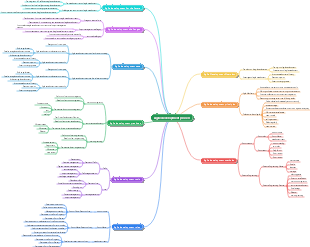
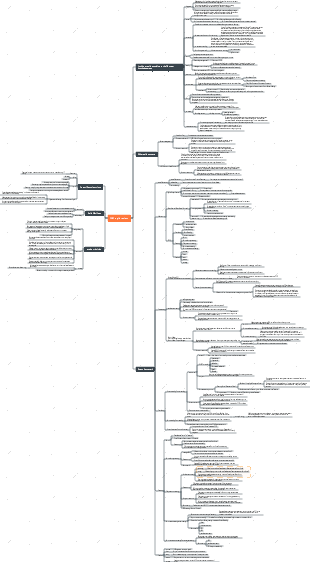
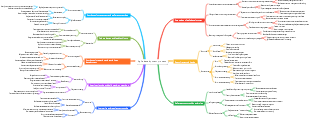
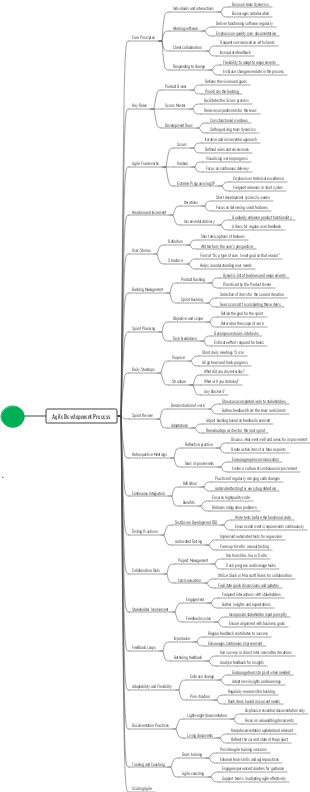
This is a mind map about the agile development process. Agile development puts the role of people at the core, and believes that the collaboration, communication and creativity of team members are the key to project success.
Edited at 2025-03-05 09:43:17Rumi: 10 dimensions of spiritual awakening. When you stop looking for yourself, you will find the entire universe because what you are looking for is also looking for you. Anything you do persevere every day can open a door to the depths of your spirit. In silence, I slipped into the secret realm, and I enjoyed everything to observe the magic around me, and didn't make any noise. Why do you like to crawl when you are born with wings? The soul has its own ears and can hear things that the mind cannot understand. Seek inward for the answer to everything, everything in the universe is in you. Lovers do not end up meeting somewhere, and there is no parting in this world. A wound is where light enters your heart.
Chronic heart failure is not just a problem of the speed of heart rate! It is caused by the decrease in myocardial contraction and diastolic function, which leads to insufficient cardiac output, which in turn causes congestion in the pulmonary circulation and congestion in the systemic circulation. From causes, inducement to compensation mechanisms, the pathophysiological processes of heart failure are complex and diverse. By controlling edema, reducing the heart's front and afterload, improving cardiac comfort function, and preventing and treating basic causes, we can effectively respond to this challenge. Only by understanding the mechanisms and clinical manifestations of heart failure and mastering prevention and treatment strategies can we better protect heart health.
Ischemia-reperfusion injury is a phenomenon that cellular function and metabolic disorders and structural damage will worsen after organs or tissues restore blood supply. Its main mechanisms include increased free radical generation, calcium overload, and the role of microvascular and leukocytes. The heart and brain are common damaged organs, manifested as changes in myocardial metabolism and ultrastructural changes, decreased cardiac function, etc. Prevention and control measures include removing free radicals, reducing calcium overload, improving metabolism and controlling reperfusion conditions, such as low sodium, low temperature, low pressure, etc. Understanding these mechanisms can help develop effective treatment options and alleviate ischemic injury.
Rumi: 10 dimensions of spiritual awakening. When you stop looking for yourself, you will find the entire universe because what you are looking for is also looking for you. Anything you do persevere every day can open a door to the depths of your spirit. In silence, I slipped into the secret realm, and I enjoyed everything to observe the magic around me, and didn't make any noise. Why do you like to crawl when you are born with wings? The soul has its own ears and can hear things that the mind cannot understand. Seek inward for the answer to everything, everything in the universe is in you. Lovers do not end up meeting somewhere, and there is no parting in this world. A wound is where light enters your heart.
Chronic heart failure is not just a problem of the speed of heart rate! It is caused by the decrease in myocardial contraction and diastolic function, which leads to insufficient cardiac output, which in turn causes congestion in the pulmonary circulation and congestion in the systemic circulation. From causes, inducement to compensation mechanisms, the pathophysiological processes of heart failure are complex and diverse. By controlling edema, reducing the heart's front and afterload, improving cardiac comfort function, and preventing and treating basic causes, we can effectively respond to this challenge. Only by understanding the mechanisms and clinical manifestations of heart failure and mastering prevention and treatment strategies can we better protect heart health.
Ischemia-reperfusion injury is a phenomenon that cellular function and metabolic disorders and structural damage will worsen after organs or tissues restore blood supply. Its main mechanisms include increased free radical generation, calcium overload, and the role of microvascular and leukocytes. The heart and brain are common damaged organs, manifested as changes in myocardial metabolism and ultrastructural changes, decreased cardiac function, etc. Prevention and control measures include removing free radicals, reducing calcium overload, improving metabolism and controlling reperfusion conditions, such as low sodium, low temperature, low pressure, etc. Understanding these mechanisms can help develop effective treatment options and alleviate ischemic injury.
Agile development process
Agile development overview
Definition and Features of Agile Development
Emphasize people-oriented
Agile development puts the role of people at the core, believing that team members’ collaboration, communication and creativity are key to project success.
Flexible response to changes in demand
Agile development encourages rapid adaptation to changes, respond to changes in demand through short-cycle iterations, and ensures that the product is closer to the actual needs of users.
History and development of agile development
Origin and background
Origins and Background: The history of agile development can be traced back to the late 1990s, when the software development industry faced rapid changing market demand and growing project complexity. The traditional waterfall development model has been criticized for its rigid and slow response speed. In this context, a group of software development experts gathered together to seek a more flexible and rapidly adapted to changes. In 2001, these experts held a gathering at the Snowbird Ski Resort in Utah to jointly draft the Agile Software Development Manifesto, marking the official birth of an agile development method. The declaration highlights individuals and interactions above processes and tools, workable software above detailed documentation, customer cooperation above contract negotiations, and response changes above compliance with plans. The emergence of agile development has provided a new, more efficient and adaptable development model for the software industry.
The evolution of modern agile methods
In 2001, a group of software development experts gathered together to put forward the Agile Manifesto and 12 core values, marking the birth of modern Agile methods. These manifestos and values advocate that individual interaction is better than process tools, workable software is better than detailed documents, customer cooperation is more important than contract negotiation, and response changes are higher than following plans, laying the cornerstone for agile development and leading software development to transform from a waterfall model to a flexible iteration agile model.
On this basis, agile methods and frameworks such as Scrum, extreme programming (XP), and Kanban have flourished, enriching the diversity of agile practices. Scrum emphasizes short-cycle iteration and continuous feedback to promote rapid response and adjustment; XP focuses on testing-driven development, continuous integration and other practices to ensure code quality and efficiency. The continuous emergence and evolution of these frameworks and methods have made agile development more specific and operational, greatly promoting its popularity and application in the field of software development. They not only improve development efficiency and flexibility, but also strengthen team collaboration and customer participation, jointly shaping a new look of modern software development.
Principles of agile development
Individuals and interactions are more important than processes and tools
Pay attention to teamwork
In agile development, communication and collaboration among team members are key to project success. Through daily communication and cooperation, the team can quickly respond to changes and solve problems together.
Flexible adjustment of workflow
Agile development encourages teams to continuously optimize and adjust workflows based on project progress and actual conditions. This flexibility helps to increase efficiency and ensures that the team is always on the right track.
Software that works more than detailed documentation
Focus on actual results
In agile development, teams should focus on delivering workable software, ensuring functionality and value creation, rather than over-investing in document production.
Simplify documentation writing
The principle of agile development advocates simplifying documents to ensure that the writing of documents is both efficient and necessary, and avoid delaying product development progress due to cumbersome documents.
Agile development team role
Product Manager
Responsible for demand analysis and planning
Product managers need to have a deep understanding of user needs, develop product roadmaps, and ensure that the development team clearly defines goals and priorities.
Communication with the marketing and development team
The product manager acts as a bridge to ensure that market strategies and product functions are synchronized, while coordinating the development team to promote project progress.
Development Team
Responsible for designing and implementing functions
Responsible for conception, planning and actually developing and implementing the required functions to ensure that the system or product has the expected operability and practicality.
Continuous integration and testing
Continuous integration promotes frequent merger of code and automated testing, ensures software quality and accelerates the iteration process.
Agile development process stage
Planning phase
Determine product vision and goals
Clarify the future development direction of the product and establish specific and measurable goals to guide product development and market positioning.
Develop an iteration plan
Formulate a detailed and executable iterative development plan, clarify the goals and tasks of each stage, and ensure that the project progresses steadily.
Iterative development stage
Daily station meeting synchronous progress
Team members hold brief meetings every morning to report on the completion of their respective tasks, discuss problems encountered, and plan the work priorities of the day.
Coding and code review
Once the developer has finished coding, it ensures code quality through code review, promotes knowledge sharing, and prevents potential flaws and errors through code review.
Agile development tools and technologies
Jira and Confluence
Task tracking and knowledge management
Jira manages project progress, Confluence stores and shares documents, both of which help agile development and knowledge management.
Teamwork and document sharing
Confluence and Jira combine to help team collaboration, share discussions conveniently, update information in real time, and maintain a project knowledge base together.
Continuous integration and continuous deployment
Automated construction and testing
Automated construction and testing are an indispensable link in agile development. It quickly completes the compilation, packaging and various tests of code through preset scripts to ensure the efficiency of the development process and the stability of the software quality.
Quick feedback and deployment
Quick feedback and deployment allow development teams to instantly understand the results of product construction and testing. Through continuous integration and deployment tools, code changes can be quickly pushed to the production environment and shortened the release cycle.
Agile development metrics and improvements
Agile metrics
Story point estimation and speed tracking
Story point assessment and continuous speed monitoring and tracking
Code quality and defect rate
The higher the code quality, the lower the defect rate.
Continuous improvement method
Review meetings and problem identification
Review the content of the meeting and carefully identify existing problems.
Introducing new tools and practices
Introduce innovative tools and put them into practice to improve work efficiency and quality, promote project progress and team effectiveness.