MindMap Gallery The construction path of Zong Baihua's aesthetic thought
This is a mind map about The construction path of Zong Baihua's aesthetic thought, Main content: artistic conception aesthetics, comparative aesthetics between Chinese and Western, walking aesthetics, artistic conception aesthetics, comparative aesthetics between Chinese and Western, walking aesthetics.
Edited at 2025-02-17 20:04:28This is a mind map about the annual work plan of the three pillars of human resources. The main contents include: strategic human resources planning, talent recruitment and allocation, employee performance management, employee training and development, employee relationships and communication, employee welfare and care, human resources information system construction, regulatory compliance and risk management, and organizational culture construction.
This is a mind map for the diagnosis and treatment of acute cerebral hemorrhage in patients with hemodialysis. The annual incidence of acute cerebral hemorrhage in patients with hemodialysis is (3.0~10.3)/1000, and the main cause is hypertension. Compared with non-dialysis patients, the most common bleeding site is the basal ganglia area, accounting for 50% to 80%; but the bleeding volume is large and the prognosis is poor, and the mortality rate is 27% to 83%. Especially for patients with hematoma >50ml, hematoma enlarged or ventricular hemorrhage on the second day after onset, the prognosis is very poor.
The logic is clear and the content is rich, covering many aspects of the information technology field. Provides a clear framework and guidance for learning and improving information technology capabilities.
This is a mind map about the annual work plan of the three pillars of human resources. The main contents include: strategic human resources planning, talent recruitment and allocation, employee performance management, employee training and development, employee relationships and communication, employee welfare and care, human resources information system construction, regulatory compliance and risk management, and organizational culture construction.
This is a mind map for the diagnosis and treatment of acute cerebral hemorrhage in patients with hemodialysis. The annual incidence of acute cerebral hemorrhage in patients with hemodialysis is (3.0~10.3)/1000, and the main cause is hypertension. Compared with non-dialysis patients, the most common bleeding site is the basal ganglia area, accounting for 50% to 80%; but the bleeding volume is large and the prognosis is poor, and the mortality rate is 27% to 83%. Especially for patients with hematoma >50ml, hematoma enlarged or ventricular hemorrhage on the second day after onset, the prognosis is very poor.
The logic is clear and the content is rich, covering many aspects of the information technology field. Provides a clear framework and guidance for learning and improving information technology capabilities.
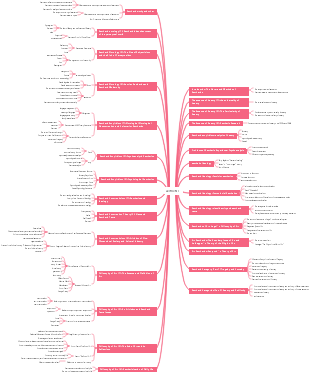
The construction path of Zong Baihua's aesthetic thought
Walking aesthetics
1. What is walking? (Reflected by China and the West)
1. West: Xiaoyao School
2. China: Zhuangzi
"Etiquette, music, travel" It is the cultural foundation of Chinese art
2. Where to find beauty?
Clear the taste of
1. Subject: To achieve emptiness and keep quiet——(etheless and fulfilling)
2. Object: taste (man, nature, society)
Comparative aesthetics Chinese and Western comparison
1. Why do we need to compare Chinese and Western countries?
2. Comparative thoughts in "Aesthetic Walk"
1. Difference
1) Differences in the “relationship between poetry and painting” between China and the West
2) Differences in Chinese and Western observation methods (spatial consciousness)
2. Contact: Chinese and Western art exchange
Grotto temple art represented by "Dunhuang Mogao Grottoes"
Artistic aesthetics
1. What is artistic conception? What are its characteristics? (Dao, dance, blank)
2. Why is the highest pursuit of Chinese art in artistic conception?
3. The artistic conception (category) in "Aesthetic Walk"
1) Tao: "The Book of Changes" Yin and Yang, virtual and real, first-born lotus and wrong colored gold
2) Dance: Vivid - lines (painting), audio (music), and the beauty of flying (garden)
3) Blank: plan to be black as white, opera set, leave blank, borrow scenery
4. The reflection of artistic conception in the three major painting subjects
1) Figure painting: vivid charm (lines)
2) Flower and bird painting: naive and natural (lines)
3) Landscape painting: Both temperaments are strong (brush and ink are far away)
Walking aesthetics
1. What is walking? (Reflected by China and the West)
1. The West
Xiaoyao Sect
2. China
Zhuangzi
2. Where to find beauty?
Clear the taste of
1. Subject: to achieve emptiness and keep quiet——(etheless and fulfilling); 2. Object: taste (man, nature, society)
Comparative aesthetics Chinese and Western comparison
1. Why do we need to compare Chinese and Western countries?
Revealing the aesthetic differences in different cultural contexts
Through the comparison between China and the West, we can discover unique aesthetic concepts and artistic expressions in their respective cultures, thereby revealing the aesthetic differences in different cultural backgrounds.
Promote the exchange and integration of cross-cultural aesthetic theories
The comparison of Chinese and Western aesthetics will help promote theoretical exchanges between different cultures, promote mutual reference and integration of aesthetic ideas, and form a more inclusive global aesthetic perspective.
Explore the relationship between universality and particularity of aesthetics
By comparing Chinese and Western aesthetics, we can explore the relationship between the universality and particularity of aesthetics, and understand the universal aesthetic principles in different cultures and the aesthetic characteristics under specific cultures.
Deepen the understanding of their respective cultural aesthetic traditions
The comparison between China and the West can not only deepen our understanding of Western aesthetic traditions, but also help us to have a deeper understanding of the historical context and cultural characteristics of Chinese aesthetics.
Provide reference for the internationalization of aesthetic theory
Comparative research on Chinese and Western aesthetics provides valuable reference for the internationalization of aesthetic theory and helps to build a more comprehensive and diverse global aesthetic theory system.
Enriching the perspective and methods of aesthetic research
Through the comparison of Chinese and Western aesthetics, researchers can adopt a variety of perspectives and methods to enrich the content of aesthetic research and broaden the depth and breadth of research.
2. Comparative thoughts in "Aesthetic Walk"
1. Difference
1) The difference in the "relationship between poetry and painting" between China and the West; 2) The difference in the way of viewing (spatial consciousness) between China and the West
2. Contact: Chinese and Western art exchange
Grotto temple art represented by "Dunhuang Mogao Grottoes"
Artistic aesthetics
1. What is artistic conception? What are its characteristics? (Dao, dance, blank)
Artistic conception is the highest state of artistic expression.
Artistic conception is the profound and implicit aesthetic ideal pursued in artistic creation. It transcends intuitive images and touches the depths of the viewer's heart.
It combines emotions and scenery to form a unique image.
The artistic conception creates images beyond reality through the combination of the artist's emotions and natural or living scenery, giving the viewer infinite imagination.
The artistic conception reflects the philosophical thought of "Tao".
The artistic conception is deeply embedded in the traditional Chinese philosophy of "Tao", emphasizing the harmonious unity of nature and the universe, and pursuing the state of unity between man and nature.
The artistic conception pursues the dynamic beauty of "dance".
The beauty of artistic conception is not only static, but also pursues dynamic flow like a dance, and shows the vitality of life through unpredictable images.
Artistic conception is good at using "blanks" to create imagination space.
In artistic creation, artistic conception often uses the method of leaving blank space to give viewers a broad imagination space and make the work infinite meaning.
The artistic conception has subtle and profound aesthetic characteristics.
The beauty of artistic conception is not directly revealed, but guides the viewer into a richer spiritual world through implicit techniques and profound connotations.
2. Why is the highest pursuit of Chinese art in artistic conception?
The artistic conception reflects the aesthetic ideals of Chinese culture.
The aesthetics of artistic conception originates from traditional Chinese culture, emphasizing that "the intention comes first" and conveys far-reaching aesthetic interests and spiritual pursuits through artistic works.
It embodies the philosophical concept of unity between man and nature.
The creation and appreciation of artistic conception are deeply embedded in the philosophical thought of the unity of man and nature, and pursue the harmonious unity of man and nature and the universe.
The artistic conception can transcend concreteness and achieve spiritual communication.
The beauty of artistic conception is not limited to the description of images. It guides the viewer into a deeper spiritual experience and emotional resonance through suggestion and association.
It is the core of artistic forms such as Chinese painting and poetry.
Traditional art forms such as Chinese painting and poetry all have the highest goal of creating artistic conception, and show far-reaching meaning through simple brush and ink and speech.
The pursuit of artistic conception promotes innovation in artistic expression techniques.
In order to express a richer artistic conception, artists have continuously explored new artistic techniques, which has promoted the diversity and expressiveness of Chinese art forms.
Artistic aesthetics emphasizes the harmonious unity of the subject and the object.
Artistic aesthetics believes that artistic creation is not only the expression of subjective emotions, but also the fusion of the object world and subjective spirit, and the pursuit of balance and harmony between the two.
3. The artistic conception (category) in "Aesthetic Walk"
1)
"The Book of Changes" Yin and Yang, virtual and real, first-born lotus and wrong colored gold
2) Dance
Vivid - lines (painting), audio (music), beauty of flying (garden)
3) Blank
Plan for white as black, opera set, leave blank space, borrow scenery
4. The reflection of artistic conception in the three major painting subjects
1) Character painting
Vivid spirit (lines)
2) Flower and bird painting
Innocence and naturalness (lines)
3) Landscape painting
All temperaments are strong (brush and ink are far away)