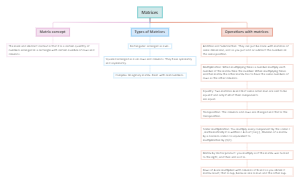
**Mind Map: Motion (Class 9 CBSE)**
**1. Describing Motion**
- **Reference Point**
- Object used to determine motion.
- **Types of Motion**
- Linear, Circular, Rotational, Oscillatory.
- **Scalar & Vector Quantities**
- *Scalars*: Distance, Speed (magnitude only).
- *Vectors*: Displacement, Velocity, Acceleration (magnitude + direction).
- **Distance vs. Displacement**
- *Distance*: Total path length (scalar).
- *Displacement*: Straight-line + direction (vector).
**2. Rate of Motion**
- **Speed**
- *Formula*: \( \text{Speed} = \frac{\text{Distance}}{\text{Time}} \).
- Average vs. Instantaneous Speed.
- **Velocity**
- *Formula*: \( \text{Velocity} = \frac{\text{Displacement}}{\text{Time}} \).
- Average vs. Instantaneous Velocity.
- **Uniform & Non-Uniform Motion**
- Constant vs. variable speed.
**3. Acceleration**
- **Definition & Formula**
- \( a = \frac{v - u}{t} \) (Change in velocity/time).
- **Types**
- Uniform, Non-uniform, Deceleration (negative).
**4. Graphical Representation**
- **Distance-Time Graph**
- Horizontal line: Object stationary.
- **Velocity-Time Graph**
- Area under graph = Displacement.
- **Deriving Equations**
- Three equations derived from velocity-time graphs.
**5. Equations of Motion**
- **1st Equation**: \( v = u + at \).
- **2nd Equation**: \( s = ut + \frac{1}{2}at^2 \).
- **3rd Equation**: \( v^2 = u^2 + 2as \).
- *Applications*: Solving numerical problems.
**6. Uniform Circular Motion**
- Constant speed but changing direction.
- Accelerated motion (centripetal acceleration).
**7. Relative Motion**
- Motion perception depends on observer’s frame (e.g., train passengers vs. platform observers).
**8. Units & Measurements**
- **SI Units**:
- Distance (m), Time (s), Speed (m/s), Acceleration (m/s²).
- **Conversions**:
- \( 1 \, \text{km/h} = \frac{5}{18} \, \text{m/s} \).
**9. Numerical Problems**
- Real-life applications (e.g., braking distance, projectile motion).
- Use color coding for Scalars (blue) vs. Vectors (red).
- Highlight formulas in boxes.
- Include mini-graphs (distance-time and velocity-time) under graphical representation.
This structured mind map ensures comprehensive coverage of the chapter, aligning with the CBSE curriculum and aiding in visual learning. 🌟
 Wondershare EdrawMind