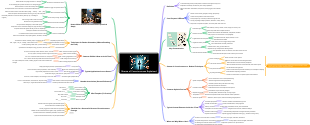
MindMap Gallery Stream of Consciousness Explained
Discover the captivating world of Stream of Consciousness, a narrative technique that immerses readers in the raw, unfiltered thoughts of characters. This approach prioritizes immediacy and emotional depth, allowing thoughts to flow freely without conventional structure. Key characteristics include associative links, fragmented sentences, and an interior focus, all while minimizing authorial intervention. Explore its relationship with related techniques like interior monologue and psychological realism, and understand common forms such as first-person present tense and punctuation-light passages. This technique shines in character-driven scenes, revealing inner conflicts and thematic explorations of identity and consciousness, while posing challenges like reader confusion. Delve into the nuances of thought in motion and experience literature in a profoundly intimate way.
Edited at 2026-03-20 01:43:18Discover the fascinating world of integrals, a fundamental concept in calculus that encapsulates the idea of accumulation. This overview explores the core idea behind integrals, distinguishing between definite and indefinite integrals, and illustrating their applications in real-life scenarios like calculating distance, mass, and costs. We delve into the fundamental theorem of calculus, which bridges the gap between accumulation and differentiation. Key properties such as additivity and linearity are highlighted, alongside practical computation methodsboth analytical and numerical. Finally, we address common misconceptions to deepen your understanding. Join us on this journey to appreciate the power of integrals in mathematics and beyond!
Discover the fascinating world of probability, where uncertainty meets mathematical precision. This introduction explores key concepts, starting with definitions and interpretations of probabilityclassical, frequentist, and Bayesian. We delve into fundamental laws, including Kolmogorov's axioms, and essential properties like conditional probability and independence. Learn about the law of total probability and Bayes' theorem, which are crucial for updating beliefs based on new evidence. Finally, connect probability to random variables and distributions, highlighting their significance in real-world applications. Join us on this journey to understand how probability shapes our understanding of chance and decision-making.
Discover the fascinating world of Group Theory, where the elegance of symmetry meets algebraic structures. This branch of mathematics explores how groups model actions that maintain structural integrity, aiming to classify and analyze symmetries across various fields. A group, defined by specific operations and properties, encapsulates transformations that preserve shapes, equations, and more. Key concepts include finite and infinite groups, abelian versus non-abelian structures, and fundamental examples like integers and permutation groups. Group Theory also delves into internal structures like subgroups, normal subgroups, and homomorphisms, providing essential tools for understanding complex symmetry systems. Join us in exploring how this theory formalizes and describes symmetry in both abstract and tangible ways.
Discover the fascinating world of integrals, a fundamental concept in calculus that encapsulates the idea of accumulation. This overview explores the core idea behind integrals, distinguishing between definite and indefinite integrals, and illustrating their applications in real-life scenarios like calculating distance, mass, and costs. We delve into the fundamental theorem of calculus, which bridges the gap between accumulation and differentiation. Key properties such as additivity and linearity are highlighted, alongside practical computation methodsboth analytical and numerical. Finally, we address common misconceptions to deepen your understanding. Join us on this journey to appreciate the power of integrals in mathematics and beyond!
Discover the fascinating world of probability, where uncertainty meets mathematical precision. This introduction explores key concepts, starting with definitions and interpretations of probabilityclassical, frequentist, and Bayesian. We delve into fundamental laws, including Kolmogorov's axioms, and essential properties like conditional probability and independence. Learn about the law of total probability and Bayes' theorem, which are crucial for updating beliefs based on new evidence. Finally, connect probability to random variables and distributions, highlighting their significance in real-world applications. Join us on this journey to understand how probability shapes our understanding of chance and decision-making.
Discover the fascinating world of Group Theory, where the elegance of symmetry meets algebraic structures. This branch of mathematics explores how groups model actions that maintain structural integrity, aiming to classify and analyze symmetries across various fields. A group, defined by specific operations and properties, encapsulates transformations that preserve shapes, equations, and more. Key concepts include finite and infinite groups, abelian versus non-abelian structures, and fundamental examples like integers and permutation groups. Group Theory also delves into internal structures like subgroups, normal subgroups, and homomorphisms, providing essential tools for understanding complex symmetry systems. Join us in exploring how this theory formalizes and describes symmetry in both abstract and tangible ways.
Stream of Consciousness (Narrative Technique)
Definition
A narrative technique that presents a character’s thoughts as they occur
Emphasizes immediacy, subjectivity, and mental association over orderly logic
Often minimizes the narrator’s filtering or explanation
Purpose & Effects
Creates intimacy with a character’s inner life
Mimics real cognition: jumps, loops, distractions, intrusive memories
Conveys emotion and psychological depth more directly than summary
Can destabilize “objective” reality by foregrounding perception
Core Characteristics
Associative flow
Ideas linked by sound, image, memory, or emotion rather than plot logic
Sudden topic shifts triggered by sensory cues
Fragmentation
Incomplete sentences, interruptions, ellipses, trailing thoughts
Contradictions and revisions mid-thought
Interior focus
Internal perceptions, self-talk, impressions, impulses
Private logic and personal symbolism
Reduced authorial mediation
Less explanation, fewer transitions, minimal signposting
Reader infers context from cues
Variable structure
Can range from lightly interior to highly experimental
May mix with conventional narration and dialogue
Stream of Consciousness vs. Related Techniques
Interior monologue
Direct presentation of thoughts, often in first person
More syntactically coherent than full stream-of-consciousness in many cases
Free indirect discourse
Third-person narration colored by a character’s voice and judgments
Blends narrator grammar with character perspective
Psychological realism
Broader category portraying mental life
Stream of consciousness is one intensified method within it
Summary of thoughts
Narrator paraphrases thinking in orderly form
Less immersive than direct thought flow
Stream of consciousness maximizes immediacy and association; related modes vary by grammatical distance and degree of narrative filtering.
Common Forms & Variations
First-person present tense
Heightens immediacy (“I see… I think… now…”)
Third-person with deep focalization
Close third person that stays inside one mind
Punctuation-light or punctuation-free passages
Accelerates pace and mimics unfiltered flow
Rhythmic, lyrical prose
Repetition, motifs, and sound patterns reflecting mental cadence
Hybrid structures
Alternates between external action and internal cascade
Uses paragraphs or line breaks to shape mental “waves”
Typical Content Elements
Sensory impressions
Smells, textures, sounds that trigger memories
Micro-observations
Tiny details noticed and reinterpreted instantly
Memory intrusions
Flashbacks without formal transitions
Anticipation and anxiety loops
Repetitive worries, rehearsed conversations
Self-correction
“No, that’s not it—” style revisions
Private associations
Personal symbols, recurring images, idiosyncratic metaphors
Stylistic Tools
Syntax choices
Run-on sentences to simulate momentum
Sentence fragments for quick impressions
Parentheticals and dashes for interruptions
Diction and voice
Colloquial phrasing, idiolect, slang, or formal registers depending on character
Repetition of key words reflecting fixation
Sound and rhythm
Alliteration, internal rhyme, cadence matching emotion
Motifs and anchors
Recurrent objects/phrases grounding the reader
Leitmotifs signaling themes or trauma
Time manipulation
Present moment expands; years collapse into a phrase
Nonlinear chronology shaped by memory and association
How It Captures “Inner Thought in Flow”
Trigger → association chain
External stimulus (e.g., smell) sparks memory, then emotion, then judgment
Simultaneity
Multiple thought layers: observation + evaluation + worry + desire
Attention drift
Focus shifts from task to unrelated idea and back
Emotional logic
Feelings guide transitions more than rational sequencing
Subtext made explicit
Unspoken fears, desires, and biases surface directly
When to Use It
Character-driven scenes
Moments of decision, conflict, guilt, longing, attraction, grief
High-stakes psychological states
Panic, obsession, dissociation, mania, shock
Theme exploration
Identity, memory, time, consciousness, alienation
Intimacy or unreliability
Reveals contradictions and self-deception
Risks & Challenges
Reader confusion
Lack of context or unclear referents
Monotony or self-indulgence
Excessive length without variation or stakes
Weak narrative traction
Internal flow replaces forward movement if not balanced
Voice inconsistency
Character’s language may accidentally resemble author’s
Accessibility
Dense passages may alienate some readers without anchors
Techniques for Clarity Without Losing Flow
Provide subtle grounding cues
Occasional concrete details: location, physical action, time of day
Use recurring anchors
A sound, object, or goal repeatedly returns to center
Modulate intensity
Alternate stream passages with clearer narration or dialogue
Keep cause-and-effect emotional continuity
Even if logic jumps, emotional progression should track
Control pronouns and references
Ensure “he/she/that” has a recoverable meaning
Strategic paragraphing
Break at shifts in stimulus, memory, or emotional turn
Crafting a Stream-of-Consciousness Passage (Process)
Step 1: Choose the viewpoint mind
Define current emotional state, preoccupation, and fear/desire
Step 2: Establish the immediate scene
One or two sensory anchors (sound, smell, light) to root the flow
Step 3: Identify triggers
Select 2–4 stimuli likely to spark associations
Step 4: Build association chains
Stimulus → memory → judgment → bodily sensation → new stimulus
Step 5: Shape rhythm and punctuation
Faster pace: fewer stops, more dashes/fragments
Slower introspection: longer sentences, reflective clauses
Step 6: Weave in external action
Small actions (walking, stirring coffee) to keep orientation
Step 7: End with a pivot
A return to the present, a decision, a revelation, or a stark image
Indicators of Effective Use
Distinct, believable voice
Thoughts sound like this character, not generic narration
Emotional authenticity
The flow reveals vulnerability, conflict, or desire meaningfully
Coherent undercurrent
A thematic or emotional thread ties digressions together
Reader can reassemble context
Enough cues to infer what’s happening and why it matters
Typical Signs It Needs Revision
Disorientation without payoff
Confusion doesn’t resolve into insight or tension
Repetition without development
Same worry repeats without escalation or reframing
Lack of stakes
Thoughts float without a driving need or pressure
Uniform texture
No variation in sentence length, cadence, or intensity
Common Contexts in Literature (General)
Modernist experimentation
Emphasis on consciousness, perception, fragmented reality
Contemporary literary fiction
Psychological immediacy and voice-driven narration
Genre applications
Thrillers: panic spirals
Romance: intimate attraction and doubt
Horror: intrusive thoughts and dread loops
Quick Checklist for Writers
Whose mind are we in, and what do they want right now?
What sensory anchors keep the reader oriented?
What triggers drive the associative leaps?
Where does the emotional arc shift or deepen?
How do rhythm and punctuation reflect mental state?
What concrete moment ends or reframes the flow?