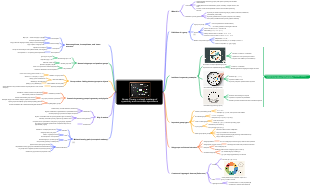
MindMap Gallery What is Group Theory
Discover the fascinating world of Group Theory, where the elegance of symmetry meets algebraic structures. This branch of mathematics explores how groups model actions that maintain structural integrity, aiming to classify and analyze symmetries across various fields. A group, defined by specific operations and properties, encapsulates transformations that preserve shapes, equations, and more. Key concepts include finite and infinite groups, abelian versus non-abelian structures, and fundamental examples like integers and permutation groups. Group Theory also delves into internal structures like subgroups, normal subgroups, and homomorphisms, providing essential tools for understanding complex symmetry systems. Join us in exploring how this theory formalizes and describes symmetry in both abstract and tangible ways.
Edited at 2026-03-20 03:02:07Explore the fascinating world of limits, a fundamental concept in calculus that underpins derivatives and integrals. This overview delves into the core idea of limits, emphasizing how they describe the value a function approaches as the input nears a certain point. Learn about intuitive understandings through approaches versus equals, and the formal ε–δ definition that rigorously defines limits. Discover various types of limits, including one-sided and limits at infinity, and when limits exist or fail. Uncover key properties, their relationship to continuity, and techniques for evaluating limits. Join us in mastering the foundational concepts that shape mathematical analysis!

Explore the fundamental concepts of work and power, essential for understanding energy dynamics in physics. This overview covers core definitions, including work as energy transfer and power as the rate of work done. Delve into the work-energy relation, examining the work-kinetic energy theorem and the distinctions between conservative and nonconservative forces. Learn how to calculate work under various conditions, from constant forces to variable forces and multiple interactions. The mechanical energy framework explains energy conservation principles, while power calculations provide insight into energy transfer rates. Utilize graphical tools and diagrams to visualize these concepts, avoiding common pitfalls in understanding work and its implications.
Discover the fascinating world of isotopes, the variants of chemical elements that share the same number of protons but differ in neutrons, leading to unique properties. This overview covers the core definitions and atomic structure basics of isotopes, including their notation and abundance. Learn about examples like hydrogen, carbon, and oxygen, and differentiate between stable isotopes and radioisotopes. Understand the significance of isotopic variation, its origins in stellar processes and fractionation, and how we measure isotopes using advanced techniques like mass spectrometry. Join us in exploring the critical role isotopes play in science and nature.
Explore the fascinating world of limits, a fundamental concept in calculus that underpins derivatives and integrals. This overview delves into the core idea of limits, emphasizing how they describe the value a function approaches as the input nears a certain point. Learn about intuitive understandings through approaches versus equals, and the formal ε–δ definition that rigorously defines limits. Discover various types of limits, including one-sided and limits at infinity, and when limits exist or fail. Uncover key properties, their relationship to continuity, and techniques for evaluating limits. Join us in mastering the foundational concepts that shape mathematical analysis!
Explore the fundamental concepts of work and power, essential for understanding energy dynamics in physics. This overview covers core definitions, including work as energy transfer and power as the rate of work done. Delve into the work-energy relation, examining the work-kinetic energy theorem and the distinctions between conservative and nonconservative forces. Learn how to calculate work under various conditions, from constant forces to variable forces and multiple interactions. The mechanical energy framework explains energy conservation principles, while power calculations provide insight into energy transfer rates. Utilize graphical tools and diagrams to visualize these concepts, avoiding common pitfalls in understanding work and its implications.
Discover the fascinating world of isotopes, the variants of chemical elements that share the same number of protons but differ in neutrons, leading to unique properties. This overview covers the core definitions and atomic structure basics of isotopes, including their notation and abundance. Learn about examples like hydrogen, carbon, and oxygen, and differentiate between stable isotopes and radioisotopes. Understand the significance of isotopic variation, its origins in stellar processes and fractionation, and how we measure isotopes using advanced techniques like mass spectrometry. Join us in exploring the critical role isotopes play in science and nature.
What is Group Theory
Core Idea
Study of symmetry via algebraic structures called groups
A group models actions that can be done and undone while preserving structure
Central goal: classify and analyze symmetry systems in mathematics, science, and engineering
What Is a Group (Definition)
A set G with a binary operation * such that
Closure
For all a,b in G, a*b in G
Associativity
(a*b)*c = a*(b*c) for all a,b,c in G
Identity element
There exists e in G with e*a = a*e = a for all a in G
Inverses
For each a in G, there exists a^{-1} with a*a^{-1} = a^{-1}*a = e
Notation
Multiplicative: ab, identity e
Additive (common in abelian groups): a+b, identity 0, inverse -a
Symmetry Systems (Why Groups Capture Symmetry)
Symmetry as transformations
A symmetry is a transformation that preserves some object or structure
Examples of preserved structure
Geometric shape (distances/angles)
Algebraic equations
Graph connectivity
Physical laws or configurations
Composition as the group operation
Doing symmetry A then B equals composed symmetry B ∘ A
Identity symmetry: do nothing
Inverse symmetry: undo
Symmetry group
The set of all symmetries of an object forms a group under composition
Key Types of Groups
Finite vs infinite
Finite: limited number of symmetries (e.g., polygon rotations)
Infinite: unbounded symmetries (e.g., integer translations)
Abelian (commutative) vs non-abelian
Abelian: ab=ba (e.g., Z under addition)
Non-abelian: order matters (e.g., many rotation groups in 3D)
Discrete vs continuous (Lie groups)
Discrete: separated elements (e.g., permutations)
Continuous: smoothly varying symmetries (e.g., rotations by any angle)
Groups are often categorized by size (finite/infinite), commutativity (abelian/non-abelian), and whether elements vary in steps or smoothly (discrete/continuous).
Fundamental Examples (Building Intuition)
Integers (Z, +)
Identity: 0
Inverse: -n
Models translation symmetry along a line in integer steps
Modular arithmetic (Z_n, +)
Clock arithmetic
Models rotational symmetry by n equal steps
Nonzero reals (R^×, ·)
Scaling symmetries (dilations) on a line
Permutation groups S_n
Elements are permutations of n objects
Operation: composition of permutations
Captures symmetries of labeled configurations and combinatorial structures
Classic Symmetry Groups in Geometry
Cyclic group C_n
Symmetries: rotations of a regular n-gon
Structure: generated by one rotation
Dihedral group D_n
Symmetries: rotations + reflections of a regular n-gon
Non-abelian for n ≥ 3
Presentation idea
Rotation r with r^n=e
Reflection s with s^2=e
Relation srs = r^{-1}
Rotation groups
SO(2): all planar rotations (continuous)
SO(3): all 3D rotations (continuous, non-abelian)
Euclidean symmetry groups
Translations, rotations, reflections, glide reflections
Wallpaper groups: 17 types of planar repeating pattern symmetries
How Group Theory Describes Symmetry Formally
Group actions
A group G acts on a set X by transformations of X
Connects abstract group elements to concrete symmetries
Orbits and stabilizers
Orbit of x: all points reachable by applying group elements
Stabilizer of x: symmetries that keep x fixed
Orbit–stabilizer principle (finite case)
|G| = |Orbit(x)| · |Stabilizer(x)|
Isomorphism (same symmetry structure)
Two groups are isomorphic if they are structurally identical
Means two different-looking symmetry systems can be the same group
Generators and relations
Many groups described by a small set of basic symmetries (generators)
Relations encode constraints (e.g., rotate n times gives identity)
Internal Structure (Tools for Understanding Groups)
Subgroups
Smaller symmetry sets within a symmetry system
Example: rotations form a subgroup of dihedral symmetries
Normal subgroups and quotient groups
Normal subgroup: compatible with forming symmetry modulo symmetry
Quotient group: compresses a group by identifying elements differing by a normal subgroup
Useful for simplifying complex symmetry systems
Homomorphisms
Structure-preserving maps between groups
Kernel measures symmetries that become invisible under a map
Conjugacy
Elements related by g a g^{-1} represent the same type of symmetry in different positions
Conjugacy classes often correspond to symmetry types (e.g., reflections)
Classification Highlights (Big Theorems and Milestones)
Lagrange’s theorem (finite groups)
The order of a subgroup divides the order of the group
Strong constraint on possible symmetry counts
Cyclic and abelian group classification (finite abelian groups)
Finite abelian groups decompose into products of cyclic groups
Simple groups and composition series
Simple groups: no nontrivial normal subgroups (building blocks)
Classification of finite simple groups (major achievement)
Why It Matters (Applications)
Physics
Conservation laws from symmetries (via group/Lie symmetry ideas)
Particle physics uses groups like SU(2), SU(3)
Crystallography uses discrete symmetry groups
Chemistry
Molecular symmetry groups predict spectra and bonding patterns
Computer science
Permutation groups in algorithms and complexity
Error-correcting codes and cryptography use algebraic group structures
Robotics and graphics
Rotation/rigid motion groups SO(3), SE(3) for orientation and motion
Mathematics
Number theory (Galois groups), geometry, topology, combinatorics
Common Misconceptions
Group does not mean a collection with no structure
Must satisfy the four axioms
Symmetry is not only visual
Includes invariance of equations, operations, and abstract structures
Not all symmetry groups are commutative
Many important symmetry systems are non-abelian (order matters)
Quick Concept Checklist
Identify the object/structure
Define transformations that preserve it
Check closure under composition
Find identity and inverses
Determine whether the group is finite/infinite, abelian/non-abelian
Look for generators, subgroups, and group actions