MindMap Gallery Allianz Market Segmentation, Targeting and Positioning Analysis
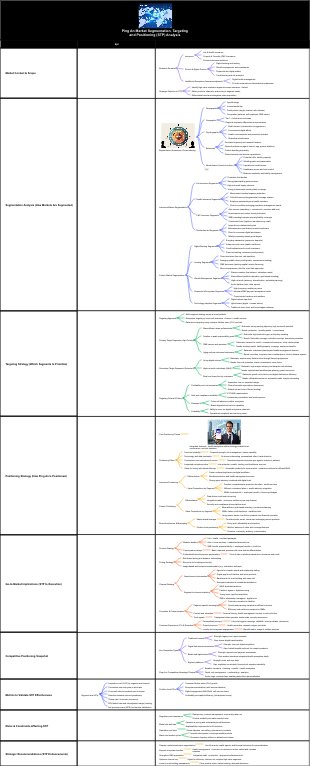
Discover the strategic insights behind Allianz's approach to market segmentation, targeting, and positioning. This analysis aims to identify key customer segments across Life, Property & Casualty (P&C), and Asset Management, prioritizing those based on attractiveness and business fit. The framework covers demographic, geographic, psychographic, behavioral, needs-based, and value-based segmentation, leveraging both internal and external data analytics. The focus includes retail and commercial customers across various channels, with an in-depth look at core customer needs in Life & Health segments, ranging from young adults to high-net-worth individuals. Join us to explore how Allianz tailors its offerings to meet diverse customer demands effectively.
Edited at 2026-03-25 14:47:16Mappa mentale per il piano di inserimento dei nuovi dipendenti nella prima settimana. Strutturata per giorni: Giorno 1 – benvenuto, configurazione strumenti, presentazione team. Secondo giorno – formazione su policy aziendali e obiettivi del ruolo. Terzo giorno – affiancamento e primi task guidati. Il quarto giorno – riunioni con dipartimenti chiave e feedback intermedio. Il quinto giorno – revisione settimanale, definizione obiettivi a breve termine e integrazione culturale.

Mappa mentale per l’analisi della formazione francese ai Mondiali 2026. Punti chiave: attacco stellare guidato da Mbappé, con triplice minaccia (profondità, taglio, sponda). Criticità: centrocampo poco creativo – la costruzione offensiva dipende dagli attaccanti che arretrano. Difesa solida (Upamecano, Saliba, Koundé). Portiere Maignan. Variabili: gestione infortuni e condizione fisica dei big. Ideale per scout, giornalisti e tifosi.
Mappa mentale per il piano di inserimento dei nuovi dipendenti nella prima settimana. Strutturata per giorni: Giorno 1 – benvenuto, configurazione strumenti, presentazione team. Secondo giorno – formazione su policy aziendali e obiettivi del ruolo. Terzo giorno – affiancamento e primi task guidati. Il quarto giorno – riunioni con dipartimenti chiave e feedback intermedio. Il quinto giorno – revisione settimanale, definizione obiettivi a breve termine e integrazione culturale.
Mappa mentale per l’analisi della formazione francese ai Mondiali 2026. Punti chiave: attacco stellare guidato da Mbappé, con triplice minaccia (profondità, taglio, sponda). Criticità: centrocampo poco creativo – la costruzione offensiva dipende dagli attaccanti che arretrano. Difesa solida (Upamecano, Saliba, Koundé). Portiere Maignan. Variabili: gestione infortuni e condizione fisica dei big. Ideale per scout, giornalisti e tifosi.
Allianz Market Segmentation, Targeting and Positioning (STP) Analysis
Purpose & Scope
Objectives
Identify key customer segments across Life, P&C, and Asset Management
Prioritize target segments based on attractiveness and fit
Define positioning by segment and line of business
Business Lines Covered
Life & Health Insurance
Property & Casualty (P&C) Insurance
Asset Management (e.g., AllianzGI, PIMCO)
Markets & Channels Considered
Retail and commercial customers
Digital/direct, agents/brokers, bancassurance, affinity/partners, employer-sponsored
Segmentation Framework (How Allianz Can Segment)
Segmentation Dimensions
Demographic: age/life stage, income/wealth, family status, occupation
Geographic: country/region, urban/rural, catastrophe exposure zones
Psychographic: risk attitude, financial confidence, sustainability values, lifestyle
Behavioral: product usage, claims behavior, renewal propensity, channel preference
Needs-based: protection gaps, health needs, retirement goals, liquidity needs
Value-based: CLV, profitability, cross-sell potential
Firmographic (Commercial): industry, company size, revenue, international footprint, risk complexity
Risk-based (Insurance-specific): underwriting risk, fraud risk, catastrophe risk, credit risk (where applicable)
Segment by who they are, where they are, how they behave, what they need, what they’re worth, and what risks they carry
Data & Analytics Enablers
Internal data: policy, claims, renewals, service interactions, portfolio performance
External data: credit/financial indicators, geospatial risk, macroeconomic indicators
Modeling approaches
Clustering (K-means/HC), propensity models, lifetime value models
Churn prediction, next-best-action, uplift modeling
Governance
Privacy/compliance, fairness/anti-discrimination, model risk management
Market Segmentation Analysis: Life & Health
Core Customer Needs in Life & Health
Income protection and family security
Mortality and longevity risk management
Retirement accumulation and decumulation
Health protection and critical illness coverage (market-dependent)
Key Retail Segments (Illustrative)
Young adults / Early career (18–30)
Needs: affordable protection, starter savings, simple digital onboarding
Typical products: term life, accident cover, entry-level savings plans
Key drivers: price sensitivity, convenience, trust, flexibility
Family builders (30–45)
Needs: higher protection, mortgage/education protection, health add-ons
Typical products: term life, riders (CI/disability), family health solutions
Key drivers: adequate sum assured, bundling, service reliability
Mid-career accumulators (40–55)
Needs: retirement planning, wealth accumulation, tax-efficient structures
Typical products: annuity savings, unit-linked/participating products (by market)
Key drivers: investment performance, advice quality, transparency
Pre-retirees (55–65)
Needs: capital preservation, retirement income planning, healthcare costs
Typical products: deferred annuities, guaranteed income options, long-term care (where available)
Key drivers: guarantees, solvency strength, clarity on payouts
Retirees (65+)
Needs: stable income, estate planning, health and long-term care financing
Typical products: immediate annuities, pension solutions, legacy-oriented life products
Key drivers: claims/service excellence, payout reliability, simplicity
High-net-worth (HNW) / Affluent
Needs: wealth transfer, bespoke risk solutions, capital-efficient structuring
Typical products: universal life/whole life (market-specific), private placement (where permitted)
Key drivers: customization, privacy, advisory ecosystem, brand prestige
Underinsured / Protection-gap segment
Needs: basic coverage at accessible prices, simplified underwriting
Typical products: simplified-issue term, micro/low-ticket policies (market-dependent)
Key drivers: accessibility, trust, clear value proposition
Group / Employer Segments
SMEs
Needs: affordable employee benefits, simple administration
Typical solutions: group life, disability, health benefits (depending on market)
Large corporates / Multinationals
Needs: global benefits consistency, risk pooling, strong service SLAs
Typical solutions: international group programs, pension solutions, captive/financing options
Life & Health Targeting Considerations
Segment attractiveness: premium growth potential, persistency, margin, regulatory stability
Allianz fit: distribution strength, underwriting capability, product breadth, brand trust
Risk & capital intensity: guarantee exposure, longevity risk, interest-rate sensitivity
Market Segmentation Analysis: Property & Casualty (P&C)
Core Customer Needs in P&C
Asset protection (home, auto, valuables)
Liability protection (personal and commercial)
Business continuity and risk management
Fast claims settlement and catastrophe resilience
Retail P&C Segments
Digital-first urban customers
Needs: easy purchase, transparent pricing, app-based servicing
Typical products: auto, renters/home, travel, gadget insurance
Key drivers: UX, speed, personalization, self-service claims
Value-seeking mass market
Needs: competitive pricing, basic coverage, predictable premiums
Typical products: standard motor/home bundles
Key drivers: price, discounts, straightforward coverage
Families with multiple assets
Needs: bundled coverage, higher limits, reliable claims
Typical products: multi-policy bundles (home+auto+liability), umbrella coverage
Key drivers: convenience, claims reputation, advisor support
Mobility-focused customers
Needs: flexible usage-based cover, short-term insurance
Typical products: telematics/UBI motor, pay-per-mile, shared mobility cover
Key drivers: fair pricing, behavior-based rewards, safety features
High-value property owners / Affluent
Needs: high limits, bespoke underwriting, premium service
Typical products: high-net-worth home, collectibles, extended liability
Key drivers: expertise, discretion, superior claims handling
Catastrophe-exposed households
Needs: adequate cat coverage, mitigation support, rapid recovery
Typical products: home with nat-cat endorsements, parametric add-ons (where available)
Key drivers: coverage clarity, resilience services, reinsurance-backed capacity
Commercial P&C Segments (Firmographic & Risk Complexity)
Micro businesses / Sole proprietors
Needs: simple packaged policies, digital onboarding
Typical products: BOP-like packages, general liability, commercial auto
SMEs (core commercial segment)
Needs: broad coverage, risk advice, manageable premiums
Typical products: property, liability, workers’ comp (market-specific), cyber basics
Mid-market enterprises
Needs: tailored programs, higher limits, claims/risk engineering
Typical products: multiline programs, business interruption, cyber, D&O
Large corporates / Global accounts
Needs: complex risk transfer, multinational servicing, captive solutions
Typical products: global property/liability, specialty lines, structured solutions
Industry vertical segments (examples)
Manufacturing: property/BI, equipment breakdown, product liability
Construction: liability, surety (where offered), project-based cover
Retail/Wholesale: property, liability, supply chain interruption
Technology/Professional services: cyber, E&O, D&O
Transportation/Logistics: fleet, cargo, liability, telematics
Energy/Infrastructure: high-limit property, environmental liability, engineering risks
P&C Targeting Considerations
Portfolio strategy: balance retail scale with profitable niches and specialty lines
Underwriting profitability: combined ratio targets, risk selection, pricing discipline
Catastrophe management: risk accumulation control, zoning, reinsurance optimization
Claims & service differentiation: rapid settlement, digital claims, fraud control
Market Segmentation Analysis: Asset Management
Core Investor Needs
Long-term growth, capital preservation, income generation
Liability-driven investing (LDI) and duration matching
Diversification and downside risk control
ESG/sustainable investing integration
Primary Client Segments
Retail investors (direct or intermediated)
Mass market: low fees, simple diversified funds, education
Affluent/HNW: portfolio construction, tax-aware strategies, alternatives access
Typical solutions: mutual funds/ETFs, multi-asset, target-date (where applicable)
Institutional investors
Pension funds: LDI, funded status management, governance support
Insurance companies: asset-liability matching, capital-efficient portfolios
Sovereign wealth funds / central banks: scale, risk control, transparent mandates
Endowments/foundations: growth + spending rules, alternatives, diversification
Family offices: bespoke mandates, alternative investments, reporting
Distribution/intermediary segments
Private banks and wealth managers
Financial advisors/IFAs
Platforms and online brokers
Strategy/Preference Segments (Cross-cutting)
Passive / index-oriented
Active equity/fixed income seekers
Multi-asset allocators
Alternatives (real estate, infrastructure, private credit, hedge strategies)
Income-focused (dividend, credit, multi-asset income)
ESG / impact-oriented investors
Asset Management Targeting Considerations
AUM growth vs margin trade-offs
Performance track record and consistency
Distribution access and shelf placement
Product scalability and operational complexity
Regulatory constraints and suitability rules
Cross-LOB Segment Opportunities (Integrated Customer View)
Life stage-based cross-sell paths
Early career: P&C renters/auto → Life term → AM starter funds
Family builders: P&C bundle + Life protection + education savings/AM
Mid-career: Life retirement products + AM discretionary portfolios + P&C umbrella
Pre-retiree/retiree: annuities/pension + capital preservation AM + home/health-related protection
Business ecosystem paths
SMEs: commercial P&C + employee benefits (group life/health) + treasury/investment solutions
Large corporates: global P&C + global benefits + institutional AM mandates
Shared segment differentiators
Trust/financial strength and brand reliability
Claims/service excellence and digital convenience
Advice-led solutions for complex needs
Targeting Strategy (Who Allianz Should Prioritize)
Targeting Approaches
Undifferentiated (mass): broad retail P&C lines in mature markets with strong distribution
Differentiated (multi-segment): distinct propositions for digital retail, families, SMEs, affluent
Concentrated (niche/specialty): specialty commercial lines, HNW, institutional mandates
Micro-targeting (analytics-driven): propensity-based offers, next-best-product, event-triggered marketing
Target Segment Selection Criteria
Market attractiveness: size, growth, competitive intensity, price elasticity
Profit pool potential: margins, claims frequency/severity, fee rates (AM), persistency (Life)
Strategic fit: capabilities, brand, distribution, underwriting and investment expertise
Risk and capital impact: cat exposure, guarantee risk, liquidity requirements
Channel feasibility: acquisition cost, partner access, advisor coverage, digital readiness
Regulatory and reputational considerations conduct risk, suitability, ESG claims integrity
Illustrative Priority Targets by LOB
Life & Health: families, mid-career accumulators, pre-retirees, group benefits (SMEs/large employers where competitive)
P&C: multi-product households, SMEs and mid-market, specialty/high-limit segments with underwriting edge
Asset Management: institutional LDI/credit/alternatives, affluent via wealth channels, insurance balance-sheet mandates leveraging ALM expertise
Positioning Strategy (How Allianz Should Be Perceived)
Core Brand Positioning Themes (Enterprise-level)
Financial strength and reliability
Protection expertise with superior claims performance
Customer-centric service and digital convenience
Global scale with local relevance
Responsible and sustainable stewardship (ESG)
Positioning for Life & Health
Value proposition pillars
Secure your family and future with trusted long-term protection
Transparent retirement planning and dependable payouts
Flexible products and advice support across life stages
Proof points: solvency strength, long-term track record, service quality metrics
Messaging by segment
Young adults: simple, affordable, digital-first protection
Families: comprehensive protection bundles, rapid service, clarity
Pre-retirees: guaranteed income options, retirement expertise
Affluent: bespoke planning, legacy solutions, dedicated advisors
Positioning for P&C
Value proposition pillars
Fast, fair, and dependable claims—protection when it matters
Risk prevention and resilience services (especially for commercial/cat)
Convenient multi-policy bundles and personalized pricing (where appropriate)
Proof points: claims turnaround performance, network partnerships, risk engineering capability
Messaging by segment
Digital-first: app-led service, instant quotes, simple claims
Families: bundle savings + trusted claims + coverage breadth
SMEs: one-stop risk solution + advisory + business continuity support
HNW: bespoke coverage + premium claims concierge
Positioning for Asset Management
Value proposition pillars
Disciplined investment expertise with robust risk management
Outcome-oriented solutions (income, retirement, liability matching)
Sustainable investing credibility with measurable frameworks
Proof points: long-term performance record, institutional risk processes, reporting transparency
Messaging by segment
Institutional: governance support, risk-controlled mandates, scale and customization
Affluent: multi-asset solutions, downside management, ESG options
Retail: simple diversified products, education, competitive fees
Channel & Go-to-Market Implications
Distribution Channel Roles
Agents/advisors: best for complex needs (life planning, HNW, SME risk advice)
Brokers: strong in commercial P&C and specialty lines
Bancassurance: effective for life savings, protection, and affluent acquisition
Direct/digital: efficient for standard retail P&C and simple life products
Partnerships/affinity: embedded insurance, mobility, retail platforms, employer ecosystems
Customer Journey Design by Segment
Awareness: segment-specific content, calculators, ESG disclosures
Consideration: personalized quotes, needs analysis, advisor consultation options
Purchase: frictionless onboarding, eKYC, simplified underwriting where suitable
Service & retention: proactive renewals, policy management apps, loyalty bundles
Claims/benefits moment: rapid settlement, transparent communication, empathetic service
Pricing & Product Packaging
Bundling strategy: household bundles, SME packages, retirement + investment bundles
Personalization: usage-based insurance, modular riders, portfolio customization
Value-added services: risk prevention, cyber hygiene tools, wellness programs, financial coaching
Competitive Context & Differentiation
Key competitor types by LOB
Life & Health: local incumbents, bancassurance-led players, digital insurers
P&C: direct price leaders, regional carriers, specialty underwriters
Asset Management: global asset managers, passive giants, alternative specialists
Differentiation levers
Scale and capital strength
Underwriting + risk engineering expertise
Claims excellence and customer experience
Multi-line breadth enabling cross-sell and retention
Investment expertise and risk management (for AM and insurer balance sheet)
ESG credibility and stewardship
Metrics & KPIs (To Validate STP Effectiveness)
Segmentation quality metrics: distinctiveness, stability over time, actionability
Targeting performance metrics: CAC, conversion rate, retention/churn, CLV, cross-sell rate
Insurance profitability metrics: loss ratio, expense ratio, combined ratio, rate adequacy
Service metrics: claims cycle time, NPS/CSAT, complaint rates
Life-specific metrics: persistency, lapse rate, new business margin, embedded value contribution
Asset management metrics: net flows, AUM growth, fee margin, performance vs benchmark, mandate retention
ESG and reputation metrics: ESG uptake, stewardship outcomes, greenwashing risk indicators
Risks, Constraints & Mitigations
Regulatory and conduct risk suitability controls, transparent disclosures, training
Data privacy and AI governance privacy-by-design, consent management, bias testing
Catastrophe and climate risk accumulation management, pricing, reinsurance, resilience services
Interest-rate and market risk (Life/AM) ALM discipline, hedging, product design adjustments
Operational and cyber risk security controls, incident response, vendor risk management
Strategic Recommendations (Actionable Outcomes)
Life & Health
Build life-stage propositions with modular riders and clear retirement outcomes
Expand employer/SME benefits where distribution and admin capabilities are strong
Enhance digital underwriting for simplified-issue segments to close protection gaps
P&C
Prioritize multi-policy households and SME bundles to raise retention and CLV
Invest in claims speed, digital self-service, and fraud analytics as differentiators
Strengthen climate resilience offerings and cat-exposure discipline
Asset Management
Focus on outcome-oriented institutional solutions (LDI, credit, alternatives)
Scale ESG offerings with rigorous measurement and transparent reporting
Deepen partnerships with wealth channels via model portfolios and multi-asset suites
Enterprise-wide
Implement a unified customer data/segmentation layer across LOBs
Deploy next-best-action and event-trigger marketing (life events, renewals, volatility)
Align brand promise around trust, superior service, and responsible stewardship