MindMap Gallery Minerals and Rocks Mind Map
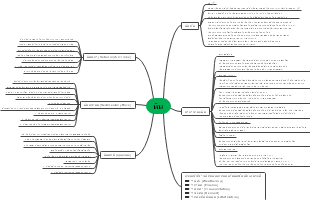
This is a mind map about minerals and rocks. Minerals are simple substances or compounds formed by chemical elements in the lithosphere through geological processes. They are the basic building blocks of rocks and ores.
Edited at 2023-11-05 16:06:57This is a mind map about bacteria, and its main contents include: overview, morphology, types, structure, reproduction, distribution, application, and expansion. The summary is comprehensive and meticulous, suitable as review materials.

This is a mind map about plant asexual reproduction, and its main contents include: concept, spore reproduction, vegetative reproduction, tissue culture, and buds. The summary is comprehensive and meticulous, suitable as review materials.
This is a mind map about the reproductive development of animals, and its main contents include: insects, frogs, birds, sexual reproduction, and asexual reproduction. The summary is comprehensive and meticulous, suitable as review materials.
This is a mind map about bacteria, and its main contents include: overview, morphology, types, structure, reproduction, distribution, application, and expansion. The summary is comprehensive and meticulous, suitable as review materials.
This is a mind map about plant asexual reproduction, and its main contents include: concept, spore reproduction, vegetative reproduction, tissue culture, and buds. The summary is comprehensive and meticulous, suitable as review materials.
This is a mind map about the reproductive development of animals, and its main contents include: insects, frogs, birds, sexual reproduction, and asexual reproduction. The summary is comprehensive and meticulous, suitable as review materials.
Minerals and Rocks
Basic characteristics of minerals
Minerals: Elements or compounds formed by chemical elements in the lithosphere through geological processes. They are the basic building blocks of rocks and ores.
Four basic attributes: 1. natural, 2. Inorganic solids (except mercury), 3. (relatively) fixed chemical composition (definable, expressed by chemical formula), 4.Specific internal structure
Elemental minerals and compound minerals, crystalline minerals, amorphous minerals, colloidal minerals (can be microcrystalline, cryptocrystalline or amorphous)
Basic characteristics - crystalline and amorphous
Most of the minerals in nature are crystals, and a small number are amorphous.
Basic properties of crystals: Self-limiting: It has the characteristic of spontaneously forming closed geometric polyhedrons. Symmetry: The regular recurrence of equal crystal faces, edges, and vertices. Uniformity: The macroscopic properties of all internal parts are the same. Anisotropy: Different physical properties in different directions. Stability: Compared with amorphous, liquid, and gaseous substances of the same kind, it has the smallest internal energy
Basic characteristics - mineral monomer form
Mineral monomer form refers to the form of mineral single crystal. Only crystalline minerals can appear in monomer form.
Monotypic: Crystals composed of crystal faces of the same type and size (47 types)
Polymorphism: crystal faces of different shapes, sizes, and many types
Crystal habit: The characteristic of the same mineral crystal tending to a certain form under certain external conditions.
一向延伸: 针状、柱状、纤维状 (一向延长) 二向延伸: 片状、板状 (二向延展) 三向延伸: 粒状(三向等长)
physical properties of minerals
Optical properties
color
It is the result of the selective absorption of light by minerals
Cause classification
Self-color: a color whose origin is directly related to the inherent chemical composition of the mineral itself Other colors: caused by factors other than those inherent in the mineral itself, such as impurities, impurity elements, and crystal defects. False color: caused by physical optical processes such as light interference and diffraction
streaks
Refers to the color of mineral powder
transparency
The ability of a mineral to transmit visible light
Hand specimen: 1 cm thick mineral slice Clear outline - transparent Only the outline is visible - translucent Outline is missing - opaque
Under the microscope: 0.03 mm mineral flakes Transparent - transparent Weak light transmittance - translucent Cannot transmit light - opaque
luster
Refers to the ability of minerals to reflect visible light
Grease gloss
waxy luster
Silk luster
Pearl luster
Earthy luster
mechanical properties
hardness
Ability to resist external mechanical effects (scoring, pressing, grinding)
Cleavage
It refers to the property that when minerals are acted upon by external forces, they crack in a certain direction and form a smooth plane.
fracture
After a mineral is struck by an external force, it does not crack along a certain crystallographic direction, but only forms a cross section.
Common fractures
Conchoidal fracture is a rounded smooth surface with irregular concentric stripes often appearing on the surface, resembling a shell, such as quartz and vitreous.
Jagged fractures are sharply jagged. Very ductile minerals have such fractures, such as natural copper.
Jagged fracture is uneven and rough. Most minerals have such fractures, such as apatite.
Classification of minerals
mineral naming
Generally named after the chemical composition, physical properties, morphological characteristics of minerals, or a combination of the two characteristics
Some are named after the place where the mineral was first discovered or the name of the person.
In addition, our country is accustomed to
"Ore" - a mineral that has a metallic luster or from which metallic elements can be extracted
"Stone" - a mineral with a non-metallic luster
"Jade" - a mineral that can be used as gemstones and handicrafts
Classification of minerals
Five major categories of minerals
Natural element minerals: natural gold (Au), diamond (C)
Sulfide: pyrite (FeS2), realgar (As4S4)
Oxides and hydroxides: quartz (SiO2), corundum (Al2O3)
Oxygen-containing salts: calcite (CaCO3)
Halides: Rock salt (NaCl), fluorite (CaF2)
Classification system of minerals
Category - category - (subcategory) - race - species - (subspecies)
Chemical composition is divided into major categories and classes Crystal structure classification families An independent unit with a certain structure and certain components is a species.
homophily and polymorphism
Understanding rock-forming minerals
Rock-forming minerals refer to the main minerals in the three major types of rocks
Three major types of rocks are common Quartz, muscovite, orthoclase, plagioclase
Igneous rock minerals: Mainly formed by magma, some are common in metamorphic rocks, but rare in sedimentary rocks. Peridot, biotite, ordinary pyroxene, ordinary hornblende
sedimentary rock minerals Calcite, dolomite, clay minerals
metamorphic rock minerals Garnet, epidote, sericite, chlorite