MindMap Gallery Python tutorial
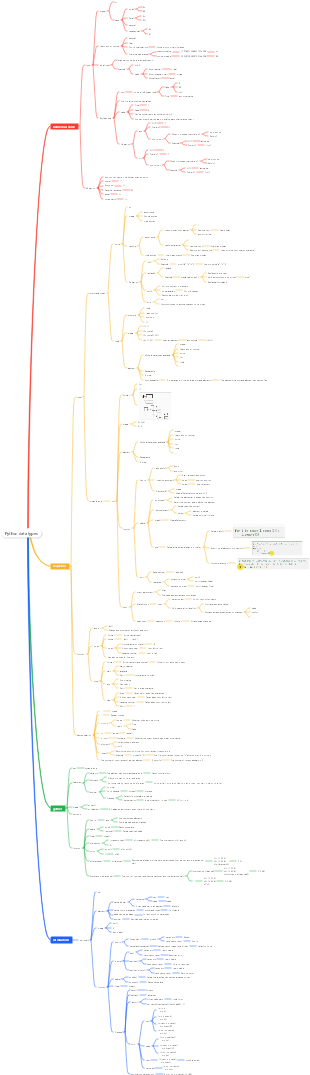
Python is a high-level programming language widely used in fields such as web development, data analysis, and artificial intelligence. This tutorial introduces the basics and common techniques of Python.
Edited at 2024-02-13 07:55:06This is a flowchart illustrating the process of archiving monthly failure analysis reports and tracking the implementation of improvement measures. The diagram is structured into five main steps, each with specific tasks and sub-tasks.Monthly Report Collection & Organization: This step involves collecting failure analysis reports from various departments, reviewing them for completeness, and categorizing them by product, failure mode, and severity. Root Cause Analysis & Statistics: Here, the focus is on categorizing causes, analyzing trends, identifying root causes, and compiling statistics on high-frequency failure modes and key components. Improvement Measure Formulation & Assignment: This step includes formulating improvement measures, assigning responsibilities, and setting timelines for implementation.Measure Implementation Tracking & Verification: It involves tracking the progress of implementation, verifying effectiveness, and confirming issue closure.Knowledge Base Update & Monthly Report Output: The final step covers archiving reports, updating the knowledge base, and compiling monthly summaries.This template can be easily reused and adapted using tools like EdrawMind to suit different organizational needs.

This is a timeline infographic detailing the annual product certification acquisition countdown process, structured into four sequential phases. The first phase, Certification Planning & Initiation, encompasses goal setting, timeline planning, resource preparation, defining specific certification objectives such as CCC/CE/FCC, formulating an annual plan with key milestones, and allocating necessary budget, personnel, and sample resources. Following this, the Application & Testing Phase involves material submission, coordination with certification agencies, core testing procedures, preparation of technical documents, application forms, and samples, selection of the appropriate certification agency, and execution of critical safety, EMC, and RF tests. The subsequent Rectification & Acquisition Phase focuses on addressing and rectifying any identified issues, re-verification processes, acquisition of the certificate, analysis of test issues, implementation of necessary fixes, and modification of samples for supplemental testing. Finally, the Countdown Monitoring phase emphasizes tracking progress, managing risks, monitoring remaining days and key milestones, managing time, technical, and cost risks, and maintaining effective internal and external communication throughout the process. This comprehensive template can be readily reused and adapted using tools like EdrawMind to meet diverse organizational requirements.
This is a flowchart detailing the weekly update and review plan for technical documents. The process is divided into six main stages, each with specific tasks and responsibilities. It begins with Weekly Planning, where the document scope is defined, update objectives are set, and schedules are arranged. Next, Document Updates involve maintaining various documents such as hardware design documents, test specifications, and BOM tables, alongside version control and archiving. Internal Review Preparation follows, focusing on compiling review materials, identifying participants, and setting agendas. The Review Meeting stage includes document examination, problem discussion, decision recording, and responsibility allocation. After the meeting, Review Feedback Processing takes place, involving issue tracking, document modification, quality checks, and closure verification. Finally, Output Deliverables are prepared, including official release versions, release notifications, review reports, and plans for the next week. This structured approach ensures systematic and efficient management of technical documents, and the template can be easily adapted using tools like EdrawMind.
This is a flowchart illustrating the process of archiving monthly failure analysis reports and tracking the implementation of improvement measures. The diagram is structured into five main steps, each with specific tasks and sub-tasks.Monthly Report Collection & Organization: This step involves collecting failure analysis reports from various departments, reviewing them for completeness, and categorizing them by product, failure mode, and severity. Root Cause Analysis & Statistics: Here, the focus is on categorizing causes, analyzing trends, identifying root causes, and compiling statistics on high-frequency failure modes and key components. Improvement Measure Formulation & Assignment: This step includes formulating improvement measures, assigning responsibilities, and setting timelines for implementation.Measure Implementation Tracking & Verification: It involves tracking the progress of implementation, verifying effectiveness, and confirming issue closure.Knowledge Base Update & Monthly Report Output: The final step covers archiving reports, updating the knowledge base, and compiling monthly summaries.This template can be easily reused and adapted using tools like EdrawMind to suit different organizational needs.
This is a timeline infographic detailing the annual product certification acquisition countdown process, structured into four sequential phases. The first phase, Certification Planning & Initiation, encompasses goal setting, timeline planning, resource preparation, defining specific certification objectives such as CCC/CE/FCC, formulating an annual plan with key milestones, and allocating necessary budget, personnel, and sample resources. Following this, the Application & Testing Phase involves material submission, coordination with certification agencies, core testing procedures, preparation of technical documents, application forms, and samples, selection of the appropriate certification agency, and execution of critical safety, EMC, and RF tests. The subsequent Rectification & Acquisition Phase focuses on addressing and rectifying any identified issues, re-verification processes, acquisition of the certificate, analysis of test issues, implementation of necessary fixes, and modification of samples for supplemental testing. Finally, the Countdown Monitoring phase emphasizes tracking progress, managing risks, monitoring remaining days and key milestones, managing time, technical, and cost risks, and maintaining effective internal and external communication throughout the process. This comprehensive template can be readily reused and adapted using tools like EdrawMind to meet diverse organizational requirements.
This is a flowchart detailing the weekly update and review plan for technical documents. The process is divided into six main stages, each with specific tasks and responsibilities. It begins with Weekly Planning, where the document scope is defined, update objectives are set, and schedules are arranged. Next, Document Updates involve maintaining various documents such as hardware design documents, test specifications, and BOM tables, alongside version control and archiving. Internal Review Preparation follows, focusing on compiling review materials, identifying participants, and setting agendas. The Review Meeting stage includes document examination, problem discussion, decision recording, and responsibility allocation. After the meeting, Review Feedback Processing takes place, involving issue tracking, document modification, quality checks, and closure verification. Finally, Output Deliverables are prepared, including official release versions, release notifications, review reports, and plans for the next week. This structured approach ensures systematic and efficient management of technical documents, and the template can be easily adapted using tools like EdrawMind.
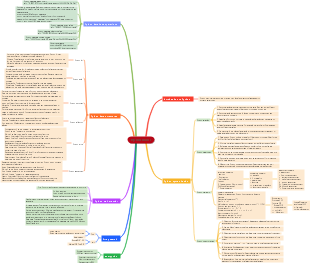
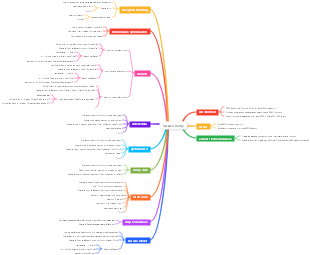
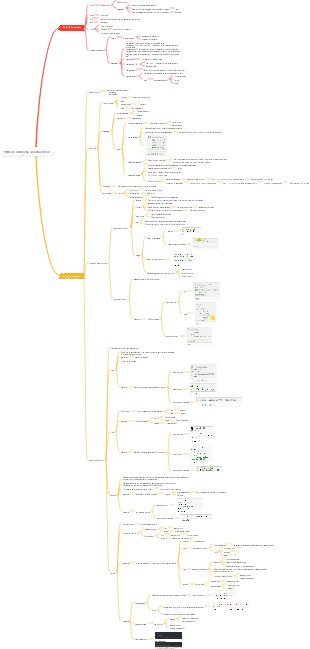
Python tutorial
introduce
Python is a high-level programming language widely used in fields such as web development, data analysis, and artificial intelligence. This tutorial will introduce the basic knowledge and common techniques of Python.
Python basics
type of data
Numbers: integers, floating point numbers, complex numbers
String: single quote, double quote, triple quote
List: mutable sequence
Tuple: immutable sequence
Dictionary: key-value pairs
Set: An unordered collection of non-repeating elements
Operators and expressions
Arithmetic operators: addition, subtraction, multiplication, division, remainder, integer division
Comparison operators: equal to, not equal to, greater than, less than, greater than or equal to, less than or equal to
Logical operators: AND, OR, NOT
control flow
Conditional statements: if, elif, else
Loop statements: for, while
Jump statements: break, continue, return
Python Advanced
function
Define functions: def keyword
Parameter passing: positional parameters, keyword parameters, default parameters, variable parameters
Anonymous function: lambda keyword
Modules and packages
Import module: import keyword
Custom module: Create .py file
Standard library: math, random, time, etc.
Exception handling
Exception type: ZeroDivisionError, TypeError, FileNotFoundError, etc.
try-except statement: catch exceptions
finally statement: executed regardless of whether an exception occurs
File operations
Open and close files
Read files: read, readline, readlines
Write files: write, writelines
Python application
Web development
Front-end development: Django, Flask, Bottle, etc.
Back-end development: database operations, API development, request processing
data analysis
Data processing: NumPy, Pandas
Data visualization: Matplotlib, Seaborn
Machine learning: Scikit-learn, TensorFlow, Keras
AI
Natural language processing: NLTK, SpaCy
Image processing: OpenCV, PIL
Deep learning: PyTorch, MXNet