 Wondershare EdrawMind
MindMap Gallery Pre-sales technical solutions
- 72
Pre-sales technical solutions
The general knowledge and technical solution framework of the IT software industry are referenced to facilitate the production of various types of technical solutions. Friends in need should quickly collect it!
Edited at 2024-01-31 17:26:11
- Analisi controllo gestione portata progetto
Mappa mentale per l’analisi del controllo della gestione del portata di progetto. Tre sezioni principali: 1. WBS Scope Breakdown – scomposizione gerarchica del lavoro con dettaglio dello Scopo del progetto. 2. Scope Boundary / Exclusions – definizione chiara dei confini del progetto e di ciò che è escluso per evitare scope creep. Strumento ideale per project manager e team di controllo per mantenere allineamento e ridurre rischi.
- Miglioramento continuo del sistema di gestione della qualità
Questo template, ideato con EdrawMind, è un modello completo per il miglioramento continuo del sistema di gestione della qualità, con una descrizione di circa 500 parole. È strutturato come un diagramma a lisca di pesce, strumento efficace per analizzare le cause principali dei problemi di qualità e definire le leve di controllo necessarie per risolverli. Il processo è organizzato in quattro fasi chiave: la prima è lo standard e la pianificazione, dove si definiscono gli obiettivi di qualità, i criteri di accettazione, i requisiti di prova e le porte di qualità (Quality Gate). La seconda fase analizza i processi e le porte di controllo, per garantire che ogni passaggio del lavoro segua i standard stabiliti. La terza fase riguarda l’esecuzione QA/QC, con la definizione di metodi di prova e ispezione, nonché regole per la gestione dei difetti e delle non conformità. L’ultima fase è il miglioramento e le azioni correttive e preventive (CAPA), insieme a una catena di audit per monitorare l’efficacia delle misure adottate. In basso, una tabella "Quality Gate" permette di tracciare ogni punto di controllo, con criteri specifici, metodi di prova, proprietario e stato di avanzamento. Grazie alla visualizzazione chiara e intuitiva di EdrawMind, questo strumento aiuta il team a identificare le cause root dei problemi di qualità, implementare azioni efficaci e mantenere un ciclo di miglioramento continuo, garantendo la qualità finale del prodotto o servizio.
- Ottimizzazione del piano di gestione della comunicazione per progetti
Questo template, creato con EdrawMind, è un modello di piano di comunicazione ottimizzato, con una descrizione di circa 500 parole. È uno strumento chiave per evitare incomprensioni tra stakeholder, garantire la trasparenza e mantenere il team allineato agli obiettivi del progetto. Il modello è composto da tre elementi fondamentali e interconnessi: la matrice di comunicazione, la cadenza timeline e le regole di comunicazione/SLA. La matrice di comunicazione è una tabella dettagliata dove per ogni pubblico o stakeholder, si definisce il tipo di informazioni da condividere, lo scopo della comunicazione, il canale da utilizzare (email, riunioni, piattaforme di progetto), la frequenza, il proprietario responsabile, il formato e il percorso di escalazione in caso di problemi. La cadenza timeline è una linea temporale che definisce le scadenze delle comunicazioni chiave, garantendo che le informazioni siano condivise in momento opportuno e non si verifichino ritardi o omissioni. Le regole di comunicazione e gli accordi sul livello di servizio (SLA) definiscono le norme formali della comunicazione, come i tempi di risposta, il tono da adottare e le responsabilità di ciascun membro del team. Grazie alla struttura visuale di EdrawMind, questo template permette di pianificare la comunicazione in modo strategico, trasparente e efficiente, riducendo i rischi di cattiva informazione, migliorando la collaborazione e garantendo che tutti gli stakeholder siano informati e coinvolti nel progetto.
Pre-sales technical solutions
- Analisi controllo gestione portata progetto
Mappa mentale per l’analisi del controllo della gestione del portata di progetto. Tre sezioni principali: 1. WBS Scope Breakdown – scomposizione gerarchica del lavoro con dettaglio dello Scopo del progetto. 2. Scope Boundary / Exclusions – definizione chiara dei confini del progetto e di ciò che è escluso per evitare scope creep. Strumento ideale per project manager e team di controllo per mantenere allineamento e ridurre rischi.
- Miglioramento continuo del sistema di gestione della qualità
Questo template, ideato con EdrawMind, è un modello completo per il miglioramento continuo del sistema di gestione della qualità, con una descrizione di circa 500 parole. È strutturato come un diagramma a lisca di pesce, strumento efficace per analizzare le cause principali dei problemi di qualità e definire le leve di controllo necessarie per risolverli. Il processo è organizzato in quattro fasi chiave: la prima è lo standard e la pianificazione, dove si definiscono gli obiettivi di qualità, i criteri di accettazione, i requisiti di prova e le porte di qualità (Quality Gate). La seconda fase analizza i processi e le porte di controllo, per garantire che ogni passaggio del lavoro segua i standard stabiliti. La terza fase riguarda l’esecuzione QA/QC, con la definizione di metodi di prova e ispezione, nonché regole per la gestione dei difetti e delle non conformità. L’ultima fase è il miglioramento e le azioni correttive e preventive (CAPA), insieme a una catena di audit per monitorare l’efficacia delle misure adottate. In basso, una tabella "Quality Gate" permette di tracciare ogni punto di controllo, con criteri specifici, metodi di prova, proprietario e stato di avanzamento. Grazie alla visualizzazione chiara e intuitiva di EdrawMind, questo strumento aiuta il team a identificare le cause root dei problemi di qualità, implementare azioni efficaci e mantenere un ciclo di miglioramento continuo, garantendo la qualità finale del prodotto o servizio.
- Ottimizzazione del piano di gestione della comunicazione per progetti
Questo template, creato con EdrawMind, è un modello di piano di comunicazione ottimizzato, con una descrizione di circa 500 parole. È uno strumento chiave per evitare incomprensioni tra stakeholder, garantire la trasparenza e mantenere il team allineato agli obiettivi del progetto. Il modello è composto da tre elementi fondamentali e interconnessi: la matrice di comunicazione, la cadenza timeline e le regole di comunicazione/SLA. La matrice di comunicazione è una tabella dettagliata dove per ogni pubblico o stakeholder, si definisce il tipo di informazioni da condividere, lo scopo della comunicazione, il canale da utilizzare (email, riunioni, piattaforme di progetto), la frequenza, il proprietario responsabile, il formato e il percorso di escalazione in caso di problemi. La cadenza timeline è una linea temporale che definisce le scadenze delle comunicazioni chiave, garantendo che le informazioni siano condivise in momento opportuno e non si verifichino ritardi o omissioni. Le regole di comunicazione e gli accordi sul livello di servizio (SLA) definiscono le norme formali della comunicazione, come i tempi di risposta, il tono da adottare e le responsabilità di ciascun membro del team. Grazie alla struttura visuale di EdrawMind, questo template permette di pianificare la comunicazione in modo strategico, trasparente e efficiente, riducendo i rischi di cattiva informazione, migliorando la collaborazione e garantendo che tutti gli stakeholder siano informati e coinvolti nel progetto.
- Recommended to you
- Outline
Consultation and Evaluation Chapter 6 Construction Plan Mind Map Contains Mistaken Points (Red Letters)
- 39
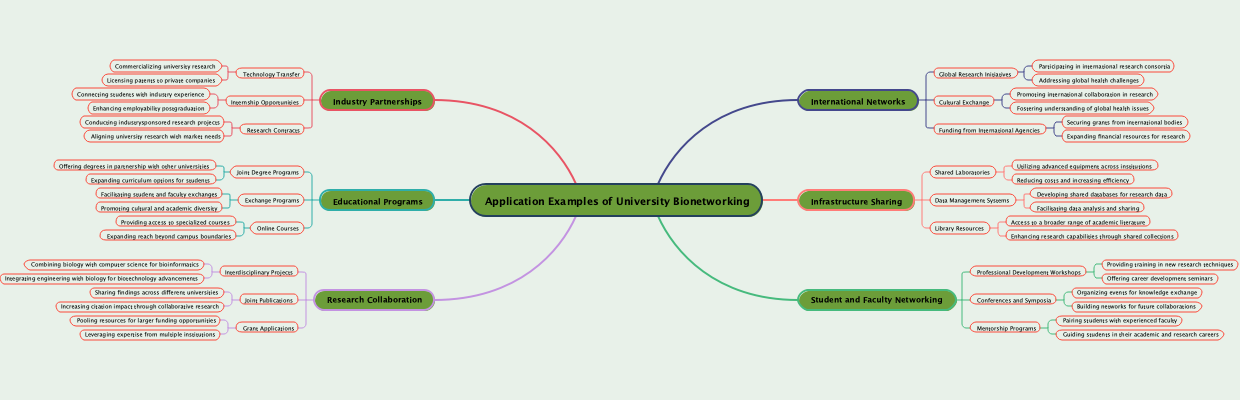


Pre-sales technical solutions
Standard specification system
(1) National technical standards:
(2) Industry application standards
①Business application standards
Business application standards are used to guide the way of expressing work during the construction process of business application systems.
②Safety standards
Safety standards determine corresponding management and implementation specifications in accordance with the graded protection system standards.
③Management standards
Prepared in accordance with CMMI and ITLL management systems, it can include project management methods, document management specifications, operation and maintenance management specifications, user management specifications, and quality management specifications.
Information security system
Class protection rating
①Safety management: Mainly to ensure safety at the management level, it is necessary to describe the safety management organization and establish a standardized safety management system.
②Physical security: Mainly to ensure the safety of the environment, equipment and storage media.
③Network security: mainly includes preventing data leakage and tampering and ensuring that there are no security threats to intermediate business networks and Internet exits.
④ System security: Mainly ensure the security of operating systems, databases and related commercial products used in the network.
⑤Application security: Mainly includes ensuring application security through CA system, web page anti-tampering, transmission encryption, intrusion prevention system, access control, etc.
System platform design
It mainly describes the overall planning and design of the infrastructure required by the system, including how to configure the hardware and how to deploy resources.
(1) Core business processing
Mainly describes the requirements for server resources.
For example, mid-to-high-end minicomputers support database servers. If there are two minicomputers, dual-machine cluster software is used to achieve data redundancy and fault tolerance through a set of disk array subsystems, and to realize resource and application allocation; through Multiple PC servers realize application server support and load balancing (used to balance the resource usage of various computer components or mainframe computers and server hosts).
(2) Data storage
Mainly describes the requirements for storage resources
For example, primary storage is implemented through disk arrays, partitions support core services, and business volume growth needs to be considered; real-time online backup is achieved through virtual tape libraries.
(3) Data exchange
Mainly describes how data is exchanged, including how to implement internal data exchange (such as extracting from the production library to the exchange library) and external data exchange (such as through the front-end server).
(4) External network services
Mainly implement various channels to provide services to users. Servers in the external network service area are mainly used for anti-virus, Web services and security management services.
(5) Operation and maintenance management
Realize the management of data center network, computers, data and other resources, including management server (detecting equipment operation, fault location and application audit), data backup server (implementing centralized data backup and recovery)
(6) Network system
Mainly describes how to plan the network
For example, the core data area is mainly accessed through core switches and Gigabit Ethernet; the wide area network access area is accessed through business private networks for handling agencies, and optical fiber access for external agencies; the operation and maintenance management area is implemented through the network management platform IP protocol topology management. 4.Information Resource Center
Information Resource Center
The information resource center is mainly used to store information and plan and design the information resources generated by the system.
① Production database: mainly includes various business resource databases, mainly used for business management.
②Historical database: It mainly includes the long-term accumulated business processing historical database. In order to improve the processing efficiency of the existing business system, relevant historical data will be transferred to the historical area.
③Exchange library: Backs up the resultant data in the business resource database, and supports horizontal and vertical data exchange.
Project implementation plan
The purpose of the project implementation plan is to arrange and deploy the planned and designed system implementation level
(1) System implementation process
① Requirements analysis stage: Based on the actual technical requirements of the system under investigation and the business requirements of each subsystem, prepare and submit a "System Requirements Analysis Report" that meets the specification requirements to the customer.
② Overall design stage: By analyzing the function, operation and performance requirements of the system, a high-level system structure, software structure, interface and data format design is generated, and a "System Design Report" is submitted to the customer.
③Detailed design stage: further analyze and refine the functional and performance requirements, document the detailed design of the software, and submit the "System Detailed Design Report" to the engineering leadership group.
④ Development and testing stage: The project development team must strictly control the project progress according to the "Project Implementation Plan", promote development and testing work with quality and quantity, and submit weekly work reports to the customer on a regular basis.
⑤ System deployment stage: It mainly implements the installation and debugging of the software on the server side. After completion, the "Database Installation Directory" and "Software Installation Method" files need to be submitted to the system maintenance personnel and assist users in software installation.
⑥System training stage: Training needs to be carried out according to different levels of users to ensure that relevant users can skillfully use their respective business systems and maintenance personnel can master the necessary system maintenance knowledge and technology.
⑦ System trial operation phase: During the trial operation period, the user is responsible for organizing on-site system testing for the system function modules listed in the "Software Function List", including the old and new systems working in parallel for a period of time for verification, so that each functional module is fully tested. Basic confirmation.
⑧System acceptance stage: When the project construction meets the requirements of the payment conditions, the user arranges project acceptance according to the progress plan and the project acceptance request submitted by the winning bidder.
(2) Project implementation plan
①Overall design plan: The main preparation method is Excel table, focusing on the main stages and completion date of the project.
② Detailed development plan: mainly displayed through Visio or Project, focusing on the decomposition of work tasks at different stages.
(3) Project personnel plan
①Project organization management: Mainly describes the organizational structure of personnel providing services for this project, which is generally displayed visually through diagrams. The main team includes project managers, pre-sales engineers, architecture designers, demand researchers, development testers, system integrators, system maintenance personnel, quality assurance personnel, etc.
①Project organization management: Mainly describes the organizational structure of personnel providing services for this project, which is generally displayed visually through diagrams. The main team includes project managers, pre-sales engineers, architecture designers, demand researchers, development testers, system integrators, system maintenance personnel, quality assurance personnel, etc.
After-sales service plan
The purpose of the after-sales service plan is to describe how to provide follow-up protection to customers after the system is delivered.
(1) Localization services
Customers generally care about whether the system contractor has local institutions or on-site personnel.
There are generally three ways to write localization services:
The first is to state that you have a local branch company and provide the corresponding business license certificate
The second is to provide proof that the company already has a list of local project personnel and a house rental contract in the local area.
The third is to promise to provide on-site services after winning the bid and write down the list of service personnel.
(2) After-sales service content
①Service content: including application system support, system optimization, new application addition, emergency maintenance, etc. It can be divided into service content during the free maintenance period and service content after the free maintenance period.
②Service method: generally includes two methods. First-line on-site services and second-line support services, such as telephone services or on-site services on demand.
(3) After-sales service commitment
It mainly promises after-sales service matters that customers care about, including free maintenance period, on-site service personnel, corresponding service time limits, etc.
How to write details
Company Profile
① Development history: Mainly describe the key nodes of the company's development, such as the year it was established, the year it went public, and the year it entered the industry.
②Company size: including how many people the company currently has, how much the company’s registered capital is, etc.
③ Awards: Mainly highlighting some important or core qualifications, such as basic qualifications such as software enterprise and system integration level one, and important honors including Science and Technology Progress Award, etc.
④Service scope: What is the main service scope and what types of products can be provided to customers.
⑤Service features: For example, customer response speed is high and rapid deployment and development can be achieved.
In this section, you need to clearly explain the value the company brings to customers.
Sorting through a list of different solutions
①Product background: What problems have been encountered in the industry and what opportunities have been created.
② Product goals: What problems is the goal of the product to solve and what goals is achieved?
③ Product functions: What functions does the product have and what is the main demonstration interface?
④ Product features: For example, whether it can be customized, etc.
⑤ Product advantages: For example, rapid product deployment can be achieved.
Classic case writing method
① Background situation: What was the current situation of the customers at that time, what background was the system construction based on, and whether it matched the current situation and scale of the new customers we need to develop, etc.
②Construction ideas: What are the main core advantages and what is the main framework of the system.
③Construction difficulties: mainly what problems were encountered during the system construction process and how to solve them later
For example, in response to the problem of excessive workload for connecting a certain project with external systems of other relevant departments, at the business level, we sorted out the related matters that need to be connected. At the technical level, we support three docking modes: multiple data interfaces, data exchange, and page embedding. At the management level, the vice president in charge of informatization coordinates the system docking work of various departments.
④Construction effectiveness: Which objects the system targets and what problems it solves
For example, after the system is completed, it can reduce the number of errands for insured persons, reduce the workload of handling personnel, and facilitate management personnel to view relevant reports.
Target competitors
competitor analysis
①What are the company’s strengths and weaknesses?
②What is the company’s position in the market?
③Who are the top ten companies in this industry, and what are the advantages of these companies?
In order to form a better impression in the minds of customers
Try not to belittle your competitors, as this may backfire.
(1) Display unique selling points
A unique selling point is something that only we have and our competitors don’t. Highlighting and emphasizing the unique selling points when introducing products can help us improve our chances of winning.
(2) Make targeted comparisons
Every product has advantages and disadvantages. Understanding the disadvantages of competitors' products, especially in the areas where your own company's products have advantages, will make customers feel that our products are more professional through comparison.
demand analysis
Step One: User Interviews
User interviews mainly involve talking to users to understand their understanding of the project and some of their thoughts and wishes.
Step Two: Job Responsibilities Analysis
Job responsibilities analysis mainly analyzes the interviewees’ positions and related responsibilities information to prepare for the next step of system user analysis.
Step Three: System User Analysis
System user analysis mainly abstracts out some common things through the description of positions and responsibilities, merges familiar positions into system users, and sorts out the business needs of system users.
Step 4: User scenario analysis
User scenario analysis is mainly divided into total scenario analysis and sub-scenario analysis. The overall scenario is to decompose the corresponding business needs into several user scenarios based on the system roles summarized in the third step; the sub-scenario is to further analyze each scenario in detail. describe
Step 5: User use case analysis
User use case analysis is to further subdivide each scenario into user use cases.
Step Six: Functional Requirements Analysis
Based on the analysis of each system user, we first briefly explain what each system user needs to do, and then further analyze the specific functions of each function point in detail, that is, what tasks the computer will help the user complete.
Note: The readers of functional requirements analysis are programmers, and they are also the functions that the system will implement in the future, so it is best to describe it in computer-style language and avoid using literary language to describe it.
Step 7: Non-functional requirements analysis
Non-functional requirements include performance requirements, security requirements, architectural requirements, etc. Contents other than functional requirements can be analyzed here.
Step 8: Requirements Specification
Combining the above analysis content and cutting it appropriately, a requirement specification with detailed content and standard format is formed.
Program preparation process
The first step is to clarify the purpose of writing the plan
(1) Who should the plan be written to?
Different reporting objects determine the different focus of the plan
A summary plan issued for the role of deputy director or company vice president is generally within 10 pages, and the content needs to be clear and concise. Explain clearly why you are doing this project, what benefits it will bring to the organization after doing it, and how much it will cost.
(2) What are the stages of project advancement?
During the project advancement stage, the type of plan will be determined together with the plan reporting targets.
During the project submission stage for approval, a relatively detailed project proposal or project feasibility study report is required. If it is early in the project, then the customer's needs may not be clear yet, and rushing to give a particularly detailed plan will only expose your own weaknesses.
(3) What are the problems that the plan needs to solve?
If the plan is prepared for bidding, then more detailed product index design content needs to be provided.
(4) Who is the biggest opponent at present?
Understanding the competitors currently involved in the project can better highlight our company's strengths and competitors' weaknesses when formulating the plan.
The second step requires collecting information, including the following:
(1) Similar solutions
In terms of plan type, if you want to prepare a project feasibility study report, you can find the feasibility study report that has been reviewed and approved and refer to the framework and granularity of the previous plan.
In terms of business type, if you want to compile content for a corporate website, you can find solutions similar to corporate websites and refer to the website's functions, characteristics compared to other companies, main costs, etc.
(2) Similar cases
Mainly project cases that have been implemented and accepted by the company
(3) Whether the company can implement
(4) Ask colleagues for help
The third step is to plan the program content, including the following:
(1) What is the main direction to guide customers?
This needs to be discussed internally and determined based on the business strategy at the current stage of the project.
For example, at this stage, should we highlight the advantages of our company, or should we not reveal all the main aspects of the company's products without understanding the customer's situation, so as to avoid being informed by competitors and falling into a passive situation.
(2) How to frame content boundaries
This directly determines the size of the project scope.
(3) How to quote
What circumstances determine the quotation and how to split the quotation also need to be mastered before sales. The quotation is generally determined by the customer's current budget or psychological price, the company's product cost, the cost of similar projects, etc.
(4) What is the construction period?
If the project is too large, whether it needs to be divided into stages should indicate some key time points, such as equipment procurement time, etc.
(5) Approximate number of pages
Generally, the project planning plan is within 10 pages.
Project proposals, project feasibility study reports and bidding documents need to be written according to the size of the project budget. For example, a project of 1 million yuan requires at least 100 pages of content.
The fourth step is to confirm the main content.
List the core ideas and outline and confirm them with people who understand the project
Common solution framework
① Preface content (preface and introduction): The preface and introduction are mainly used for thicker documents
For example, bidding documents can range from three to five hundred to as many as a thousand pages, which can guide experts to find what they want to see as quickly as possible.
② Current situation analysis (background and current situation): It mainly describes the known content or consensus within the industry, in order to prove that you have a certain understanding of the industry.
③Problem diagnosis (needs analysis and solution ideas): Mainly to explain the problems solved by the project and key construction ideas.
④Project design (overall design, application design, data architecture design, deployment design, functional design, etc.): It is the most important part of the plan. It needs to convey new ideas and spend a lot of energy to write. Generally, it needs to be visually displayed in the form of diagrams. Coming out is also where you can best shine.
Architecture knowledge
business structure
Technology Architecture
Functional architecture
Deployment architecture
SOA
microservices
Serverless
Big data platform
Cloud computing platform
⑤Implementation plan (implementation cycle, training plan, after-sales service, etc.): Just state your rationality.
Plan type
Project planning plan
The most important thing in the project planning plan is to clearly write down why you want to do it and what benefits it will have after doing it.
(1) Project background
This part needs to highlight the background of national policies and local planning, including the relevant local status quo or the status of established systems.
(2) Construction significance
This part reflects the necessity of construction from the perspective of national policies and unit needs, and points out the significance of construction.
(3) Overall goal
The main purpose is to understand the company's products, combine them with local characteristics, and develop targeted application systems.
(4)Construction content
To explain the construction content from a business perspective, it is mainly to start from a large level and explain what specific parts to do.
(5) Task decomposition
Two ways of writing
The first is the time nodes for each stage of project establishment, project construction, project online, and project acceptance.
The second is a route planned in stages, which needs to specify the specific tasks and the results achieved.
(6) Expected results
Mainly the results after project construction.
(7) Safeguard measures
Generally include institutional guarantee, organizational guarantee, financial guarantee, operational guarantee, etc.
Project construction plan
The most important thing about the project construction plan is that it has clear ideas (coherence) and completeness.
(1) Program overview
The writing method should be highly summarized and concise, so that relevant leaders or review experts can have an overall grasp of the goals, ideas, functions, methods, means, and measures of the project after reading the summary.
This part is an overall description of the project
Including the project's construction unit, construction goals, key construction content, features and highlights, budget, work progress and other key points
(2) Policy background
The writing idea is to refine the policy spirit based on the original policy text and summarize the requirements for the project.
This part should describe the necessity of doing this project from a policy level, provide policies that are close to this project, and provide newly released policy documents as much as possible. The list of policies should be hierarchical.
(3) Project status
This part needs to point out what the construction basis of the project is, and attention should be paid to highlighting the advantages of the existing system to make it comfortable for users.
The writing ideas can be divided into two aspects. One is the current status of informatization, which can be described from the perspectives of infrastructure and application systems; the other is the current status of business, which mainly discusses the characteristics of business development.
(4) Project issues
This part mainly discusses the core problems to be solved in this project. It can be combined with business development trends or based on project goals to write down at least 5 aspects of the problem.
The perspectives of project problems include: difficulty in meeting policy development needs, difficulty in resource integration, difficulty in providing unified external services, problems with existing systems, etc.
(5) Project goals
The project goal is usually a paragraph
Under what circumstances, through what means, what groups are helped (such as the public, managers, managers), and what is achieved.
(6) Project construction content
The content of the project construction is to clearly describe what needs to be done.
The construction content can be written from two aspects: application system and infrastructure, or it can be written from the perspective of project promotion plan.
(7) Project needs analysis
Project requirements analysis can be written from the perspectives of service objects, usage, service methods, business characteristics, etc.
①Business requirements: Mainly based on the functional requirements of the business department, describing the business goals to be achieved through the system from the customer's perspective.
② Business process: It can be divided into before the project is completed and after the project is completed, so as to compare the results brought by the project.
③Functional requirements: Mainly describe how to do this from the perspective of users and developers.
④Data requirements: The purpose is to estimate the required storage capacity. Data requirements can be estimated from the size of these three types of data: basic data, business data, and statistical data.
⑤Performance requirements: The purpose is mainly to estimate the performance of the server. Business processing pressure can be determined based on the magnitude of business processing, such as the size of the local population, the number of insured people, and the expected transaction volume.
⑥Equipment requirements: Mainly based on data requirements and performance requirements, used to estimate the required host, network, security, storage and other requirements.
(8) Overall project design
The purpose is to describe the content clearly and intuitively in the form of diagrams.
① Overall architecture design diagram: It can be described by a seven-layer diagram, including service layer, application layer, basic support layer, resource layer, infrastructure layer, standard service system and security protection system.
② Application design drawing: mainly describes the relationship between the systems in the project and the relationship between the system in the project and external systems.
③Data architecture diagram: What data the system has and how it flows.
④ System deployment diagram: Describes how the future network will proceed and how to deploy it.
(9) Functional design
Functional design mainly reflects the workload and needs to be partially matched with the budget. The workload of each functional module generally needs to be broken down to less than 2 people.
(10) Project implementation plan
There are two writing ideas for project implementation plans:
① From the perspective of project tasks, including system integration plan and application software plan. Application software planning can be scheduled to the subsystem level.
② From the perspective of project construction stage, it includes bidding, system research, overall design, detailed design, system development and testing, joint debugging and trial operation, deployment and implementation, promotion and other stages.
What you need to know
1. Provide information you need to know about the construction plan
(1) What is the reason for the customer to establish the platform? Is it a policy requirement or a business need?
(2) To whom the plan is written;
(3) What are the special features that customers need to highlight;
(4) Whether it can provide local policies, year-end summary, and work points for the new year;
(5) What is the customer’s budget?
2. Information needed to apply for a plan
(1) The format of the project application form that needs to be provided;
(2) What are the specific needs;
(3) Whether the hardware deployment is a self-built computer room or a government cloud.
3. Information needed to prepare bidding documents
(1) Whether there are competitors;
(2) Which bidding method is used, open bidding, competitive negotiation, single-source procurement application;
(3) The bidding agent is a bidding company or a procurement center;
(4) Is there a bidding document template (how much are the price points, technical points, and commercial points);
(5) Whether it is possible to set a registration threshold.
PPT
1. Good PPT production should keep these principles in mind
(1) You need to ask yourself several questions before making PPT
①What is the purpose of this PPT report?
Internal training: Internal training definitely needs to be more lively and enable the audience to grasp more content
External communication: External communication definitely requires more persuasion to make customers feel that your company's products are the most professional and the solutions are the most powerful.
②Who is the audience for this PPT report?
what's in it for them
For example, if the purpose of your PPT communication is to sell software products, then you must design different content according to the different report objects.
Company executives: Executives are more concerned about why they are doing this, how much it will cost, and what benefits it will bring.
Middle management of the company: The middle management is more concerned about whether the system is easy to use, whether it is easy to maintain and expand in the future.
Front-line operators within the company: These people are definitely more concerned about whether the system is easy to use and whether it can reduce their current workload.
③How much time do you have to prepare now?
(2) Misunderstandings in making PPT
The more you say, the less your audience will remember
Be sure to remember that a PPT only conveys one message
You can start from the following points
①Do not mention anything irrelevant to the topic in the slides or during the explanation.
② You need to choose pictures that can support your point of view and reflect the characteristics of the data.
③Animation effects need to be able to highlight key points, otherwise try not to use them.
④Don’t use too many words on the slides, try to simplify and delete redundant vocabulary.
Remove items that distract from the main focus
(3) How to display PPT
① Principle of simplification: put only key points instead of all text and graphics; each PPT only explains one topic; delete connective words.
②Three principles: Information is classified into groups of three.
③Digital principle: Convert adjectives into digital presentation. For example, a simple and easy-to-use design can be replaced by one that can be completed in 10 minutes.
④The style of the entire text should be consistent: the color matching and fonts should be consistent.
(4) Review after completion of production
①Is all the information I provide of concern to customers?
②What content can be made more prominent by not talking about it?
2. How to quickly make a PPT
(1) Basic steps
The first step is to sort out the core content based on the answers to basic questions before making the PPT.
Use the mind map to sort out the framework. In order to express the theme of this content, what parts of content need to be included, and what needs to be highlighted in these contents.
The second step is to choose the appropriate template and build the PPT framework.
Related tips
①Font settings
●In a venue with 30 people, the font size should be no smaller than 16 points;
●More people, font size no smaller than 24.
②Color color settings
●Choose a color scheme and pictures that are consistent with the template color scheme or the company’s main color.
●Common color schemes include: red and blue, orange and gray, yellow and black.
The third step is to design the specific content.
The main purpose is to design the specific content pages based on the central idea to be expressed in each PPT page, including how to match the pictures on each page and how to achieve graphical expression. For example, if you want to achieve a closed loop, you can go to the material library to search for relevant pictures.
The fourth step is to review the specific format.
① Review whether the key content is outstanding
●The font size becomes larger;
●The font becomes bold;
●Change color;
●Shadow effect.
② Whether the format is unified
You can use the "Slide Browse" function in "View" to check whether there are more than three colors in the PPT and whether the text is aligned and coordinated.
Form PPT ideas
SCQA structure
❏S (Situation): Background
The historical process and current situation of the company’s information construction in recent years
❏C (Complication): Conflict
Great achievements have been made, but there are also some problems, such as the lack of top-level design and the existence of information islands.
❏Q(Question):Question
Why do these problems occur.
❏A(Answer):Answer
Some of the measures currently being taken include strengthening top-level design and information system planning.
Form PPT ideas
❏P (Position): Put forward a point of view
The construction of information system brings more advantages than disadvantages to the company.
❏R(Reason):Reason
1. Informatization is the general trend, and we need to keep up with the trend of the times; 2. It is conducive to improving the company's work efficiency and achieving standardized management.
❏E(Example):Give an example
1. After the information system was put online, for the company as a whole, the turnover increased by XX million yuan; 2. After the information system was put online, the efficiency of each department increased by XX.
❏P (Position): emphasize point of view
The construction of information system brings more advantages than disadvantages to the company.
AIDA structure
❏A(Attention):Attention
Recently, our company has encountered some problems in management.
❏I(Interest):Interest
The company has many management processes, and there are often people who do not follow standardized procedures, causing trouble to management. If a standardized management and control system can be put in place, this problem can be solved.
❏D(Desire):desire
We hope that superior leaders can support and approve this plan of our company.
❏A(Action):action
List the detailed amount of funds required and their purpose.
FAB structure
❏F(Features):Selling Point
The standardized management and control system developed by our company can incorporate all company processes into the standardized management and control system to eliminate the habit of people not following standard procedures. All service processes have relevant records.
❏A(Advantages):Advantages
In addition to being able to solve standardized management problems, the system itself has powerful functions and stable performance.
❏B (Benefit): Value
High cost performance, high quality and low price.
icon type
(1) Line chart
It is mainly used for trend comparison analysis of time series and is suitable for data sets with relatively large changes. For pre-sales, it can be used to compare business growth between different months or different years.
(2) Pie chart
It is generally used in composition analysis to reflect the structure and composition of a single indicator. The value can be an absolute value, a relative proportion, or both at the same time. Suitable for scenes where a certain part needs to be highlighted. For pre-sales, it is suitable for project budget analysis, software and hardware comparison and composition.
(3) Column chart
Generally, the height of the column is used to reflect the numerical value. It is very intuitive and can be used for numerical sorting. It can also represent the comparison between multiple sets of data for an indicator. It is suitable for comparisons that highlight one of the dimensions.
(4) Scatter plot
It is mostly used for correlation analysis between two variables.
Customer related
customer persona
(1) Economic Buyer (EB).
This role is usually the final decision maker, and there is no need to ask others for instructions after making a decision.
Solution
The first is how to meet EB
The most important thing is to find out who can help with referrals and whether they can have a positive impact on the referrers.
The second is how to do what they like
Senior leaders are generally very busy, so they must have sufficient reasons and be well prepared before meeting to provide information that brings value to the other party.
(2) Technical Buyer (TB).
This role is responsible for providing technical requirements and evaluating technical solutions
Solution
The role of TB cares about the right to speak in content, and the most important thing in communicating with them is to give them enough respect.
It should be noted that TBs generally consider themselves to be technical experts. It is best not to use persuasion when communicating with them. You can influence them by taking them to participate in high-end technology seminars.
(3) Application Selector (User Buyer, UB).
demand side
This role is responsible for formulating business requirements and is also the person who ultimately uses and benefits from the product.
Solution
For UB, the most important thing is to pay attention to the other party
In the process of communicating with UB, the advantages of complete functions, reduced workload, and simple use should be highlighted.
customer motivation
1. Task-oriented customers
This type of customer will usually say "There are regulations above." For example, in a certain demonstration area or a pilot project, what they are most concerned about is whether they can fulfill the regulations, and their needs are urgent.
This type of customer will usually say "There are regulations above." For example, in a certain demonstration area or a pilot project, what they are most concerned about is whether they can fulfill the regulations, and their needs are urgent.
2. Customers who are trying to make up for the loss after a desperate situation
Such customers generally already have corresponding information system projects, but are very dissatisfied with the project results.
For this type of project, it is important to evaluate whether the current problems can be solved if it is taken over. Therefore, the early data collection must be comprehensive.
3. Customers who compete with each other
This type of customer is concerned about whether other units in the same industry have completed this project and are not willing to lag behind.
For this type of customer, tell them that you have a more solid foundation. Moreover, now we have the advantage of being a latecomer, we can take shortcuts, and the investment does not need to be that big. We just need to add some highlights.
4. Enterprising customers
The characteristic of this type of customers is that they hope to be innovative and leading
For this type of customer, you need to help the other party sort out their ideas. You can use prototype development, and then help the other party set an example and then create a benchmark case.
For this type of customer, you need to help the other party sort out their ideas. You can use prototype development, and then help the other party set an example and then create a benchmark case.
SPIN sales rules
Situation Question
The main purpose is to find the reality of the client's existing background
1. Background issues: Recognize and understand the current situation of customers
Use tips:
①不要问太多,客户会不耐烦。
②每一个问题都保证有偏重、有目的。
③背景问题与销售成功没有什么积极联系。
①Personal opinions related:
●What is your opinion?
●How long did you think about it?
●Have you decided to buy it?
●What are your goals in this regard?
②Business related:
●What industry are you in?
●How many employees do you employ?
●What is the annual sales volume?
●What are the main types of customers?
③System related:
●What system or equipment are you using now?
●How long have you been using it?
●Who will mainly use it?
Problem Question
Explore hidden needs based on customer difficulties, difficulties, and dissatisfactions
2. Difficult questions: Explore the existing problems of customers’ current situation
Use tips:
①使用关心的态度来询问,避免让客户感觉到是对他们的冒犯。
②善用对比(故事法)引出潜在问题。
③这类问题与小订单的成功销售联系更紧密,但是与大型项目订单成功联系不大。
④使用这类问题目的是揭示隐含需求。
①Are you satisfied with the existing equipment?
②Are there any flaws in the method you are using now?
③Are there any quality problems?
④Is it currently causing you a lot of trouble?
Implication Question
You can magnify the small problems that customers think will cause problems in the future if not solved, so that potential customers can take action to make a purchase.
3. Implied problems: Implied losses that may result from customer problems
Use tips:
①What impact will it have on the company’s long-term interests?
②Will these problems bring about an increase in costs?
③Will it cause the loss of customers?
④Will it cause a substantial shrinkage in performance?
Need-Payoff Question
It can eliminate the uncomfortable feeling caused by suggestive questions, provide positive solutions, and let customers tell you the benefits they have gained.
4. Demand-benefit problem: guide the value that may be generated after solving the problem
Use tips:
①在介绍对策之前,并且在暗示问题开发了买方难题的严重性后。
②你提供的方案一定是可以解决客户这些问题的。
③尽量让客户自己说出解决后的优点,可以训练客户进行内部销售。
① Why is it important to you to solve this problem?
②How will it help you after the solution?
③Is there any other way to help you?
Presentation scenarios of different solutions
1. Software demonstration to tell customers that you can meet their needs
It allows customers to see the company's products and related cases very intuitively, which is more convincing than text or PPT.
Before the software demonstration, you need to understand the customer's budget, needs, schedule, evaluation items, etc., and then dig out the key points that need to be reflected in the demonstration.
Presentation points
① Give priority to demonstrating the advantages, briefly and quickly discuss the controversial points of the product, and acknowledge but downplay the advantages of competitors.
② Focus on demonstrating the issues that customers are concerned about. Do not talk about them in a straightforward manner. Try to use cases to assist explanations and allocate time for adjustments as appropriate.
2. PPT presentation must cater to the needs of the audience
PPT presentations are generally based on the needs put forward by customers, and our solutions are presented to customers in the form of PPT.
Not only do you need to care about the content of the PPT and whether it is beautiful, but more importantly, whether the relevant information is clearly conveyed during the explanation process.
Confirm relevant information in advance
(1) Understand who the audience is and what they pay attention to
①The audience is an expert: The PPT structure is suitable for dividing first and then summarizing. You can first show why you think so and then provide the conclusion, so as to avoid showing the conclusion in advance and being questioned.
②The audience is the leader: The PPT structure is suitable for summarizing first and then dividing. Generally, leaders need to understand the conclusion first and then briefly understand the reasons for doing so within a limited time.
③The number of listeners is relatively large: Then cater to the most important people or more than 50% of the people.
(2) Cater to customers’ concerns
If it is a company executive, the executive is more concerned about why it is done, how much it will cost, and what benefits it will bring.
If you are at the middle level of the company, the middle level is more concerned about whether the system is easy to use, whether it is easy to maintain in the future, and whether it is easy to expand.
If they are front-line operators within the company, these people will definitely be more concerned about whether the system is easy to use and whether it can reduce their current workload.
be careful
① Familiar work before preaching:
Transcript
Trial lecture, can be recorded
Control the time, usually 1 to 2 minutes for a PPT
Before going on stage, you should give yourself a psychological hint and believe that this system is valuable and can really benefit you, and you must know more than the audience.
② Key points to note during the presentation:
In order to dispel the concerns of the audience, the point of view, structure and time need to be informed in advance at the beginning. If some customers need a meeting in half an hour, they will roughly know whether they can finish the lecture.
The prologue can use a story-like structure to make it easier for the audience to get into the scene.
It is best to use a question-and-answer style of communication during the explanation process, such as "You may think that the above content is common, so what is the highlight of the product? This is what I need to explain next." This can better Capture your audience's attention.
3. Talk about the bids on site and reflect our advantages based on the scoring standards
It refers to the process of on-site explanation according to the requirements of the bidding documents during on-site bidding. The purpose is to impress the on-site bid evaluation experts and give you the highest score based on the scoring standards.
(1) Focus on analyzing and studying bidding documents
At the beginning, you must analyze what content must appear in the PPT based on the bidding documents, and if there is a demonstration link, what content needs to be presented in the demonstration part.
(2) Highlight key content
①What are our advantages? Highlight our advantages compared to our competitors, such as industry experience, etc.;
②The overall strength of the company, including development history, staff size, branches/subsidiaries, qualifications and strength, etc.;
③ Highlight project ideas, including system architecture diagrams, business flow diagrams, etc.;
④ Highlight similar project cases to let bid evaluation experts see that we are really experienced;
⑤ Highlight localized services, including whether there are local branches/subsidiaries and whether there are other local cases.
(3) Points to note before and after explaining the process
① You can rehearse the explanation, then record the explanation and listen to it again to find out where you can add examples or how to modify the logic to make it smoother.
② Carry out time control. In order to prevent customers from running out of time, you can display multiple versions, including a 5-minute version, a 10-minute version and a 15-minute version.
③The presentation closely follows the scoring standards. Experts will score based on whether the content of the presentation is in place. Therefore, during the presentation, the key words of the scoring standards must be stated.
④ Add a story to the live demonstration, that is, explain the system to be demonstrated into a complete story, so that the audience can have a sense of the scene.
⑤ Prepare the system demonstration environment to ensure that the demonstration system can be opened under various browser versions. If a network is required on site, a wireless network card must be prepared in advance.
4. Technical communication/on-site Q&A to relieve customers’ concerns
Generally, after explaining to the customer, the customer will ask questions.
Possible Causes
●Customers are listening carefully;
●Customers are interested in learning more;
●Customers have different views and opinions;
●Customers have doubts and dissatisfaction;
●Customers want to examine our ability level;
●Customers support others.
The main answering process includes
The first step is to look at the questioner;
The second step is to analyze which of the above aspects is the potential motivation of the questioner, and whether he is interested in it or has doubts about it;
The third step is to thank the questioner, for example, this is a very good question;
The fourth step is to think about the answer before answering the question in front of everyone, because maybe not only the questioner is concerned, but everyone is concerned about this issue;
The fifth step is to confirm the effect of the answer. You can also ask whether you are satisfied with the answer, and then observe the customer's facial expressions to see whether the customer nods or shakes his head frequently to judge whether the other party is satisfied.
Points to note regarding communication include:
(1) What if customers keep questioning you?
As pre-sales, we need to understand that it is the customer's right to question. We need to keep a calm mind and confirm the questions at the same time, such as "Are you confused about the installation and deployment of our company's products?" Let the other party feel recognized first. Then answer the customer calmly.
(2) What should you do if you can’t answer the questions raised by customers?
Before communicating, you need to consider what questions different users on site will ask. You can invite other company personnel to accompany you during the communication, such as project managers, product managers, etc. If you really cannot answer a question, you can promise to communicate and then reply.
5. Presentation skills
1.FABE——Translate solution features into customer value
Features: Facts and characteristics related to a product or service, that is, the unique characteristics of the product itself.
Advantage: What are the advantages brought by this feature.
Benefite: What value and benefits it brings to customers. This is targeted at sales targets and can bring purchasing motivations to customers, including improving efficiency, reducing costs, increasing information transparency, and maintaining flexibility.
Evidence: Proof of these values and benefits. Including photos, customer letters, technical reports, customer letters, newspaper articles, etc., which can be used as proof of the series of introductions just made through on-site demonstrations.
Example
2. Clarify objections and dispel customers’ doubts
Response steps
① Agree with the customer’s objections.
② Listen patiently to the customer’s objections.
③Confirm where the customer’s resistance points are.
④ Give a reasonable explanation.
Notice
①Don’t get confused and think that this means that the customer will reject us, thus appearing at a loss.
②Don't directly point out the customer's mistakes. If you make the customer lose face, the customer will definitely make you lose face.
②Don't directly point out the customer's mistakes. If you make the customer lose face, the customer will definitely make you lose face.
meet customers
The most important thing before meeting is confidence
Preparation process
The first step is to clarify the purpose of the visit. Ask yourself what you hope to achieve with this visit.
① Who you want to meet this time: how to call them, what areas they focus on, whether they know our company, and what reporting method they prefer.
②A brief background on this project: why it should be done.
The second step is to prepare the content.
①Ask other pre-sales personnel about their experience, cases, and highlights in related projects.
② Ask the product manager to find out whether there is a demonstration system and whether there are relevant highlights.
③ Search the customer’s existing system information and customer organizational structure through the customer website or search engine.
④Look at business-related policy documents.
⑤ Prepare plan or PPT.
The third step is to check and confirm the preparation materials. Ask yourself three questions from the customer's perspective, and adjust and modify the information based on these questions.
①Why should I see you?
②What valuable services can you provide me?
③What is special about you compared to others?
The fourth step is to rehearse the customer problem.
Think in advance about how to answer questions that customers may ask. If you are not particularly confident, you can write a verbatim draft in advance.
In addition, remember three sets of numbers before each conversation and speak them out during on-site communication, which can reflect professionalism and make the customer's impression more profound.
The fifth step is to confirm the interview information.
Before the visit, you need to check whether the information is complete, including personal business cards, product information, notebooks, paper and pen, etc.
Adjust your status and make yourself more confident
If you don’t believe in yourself, your customers will definitely not believe in you.
Three levels of believing in yourself
The first level: Believe in the strength of your company.
The second level: Believe that the company's products can bring value to customers.
The third level: Believe in your ability as a pre-sales person.
When meeting, the most important thing is to observe
Listening more and speaking less is a good way to communicate on site
(1) Ask more questions.
(2) Listen more.
① Focus on the other person, rather than listening and organizing the words yourself.
②Nod and smile, this will help the other person talk more.
③Don't make any sound to avoid disturbing the other party's speech.
Observe customer expressions and adjust the content and rhythm of your communication
① When a customer disagrees with your opinion, there may be several manifestations, including covering the mouth with hands, touching the nose, touching the back of the head, etc.
②When the customer agrees with your opinion, there may be several behaviors, including actions such as stroking the hair.
③When customers are impatient, there may be several manifestations, including pinching their fingers and playing with them.
④When a customer has no intention to buy, there may be several manifestations, including not looking directly into your eyes and lowering his head.
After meeting, the most important thing is to summarize
(1) Internal
Note to myself: Be aware of the entire project situation, and have files available for review when needed in the future.
Accounts to others: You can report to the leader on the progress of the project and the resource support needed in the future.
(2) External
You can extract the key content and send it to the customer. Firstly, the customer will think that you are serious about your work, and secondly, it will reiterate the consensus reached at this meeting.
Components of the visit record
Written for others to read
①Customer’s organizational structure: that is, who are the customer’s current EB, TB, and UB?
②The thoughts of each role of the customer: What the above three roles know about our company, their attitudes of support or opposition, and what they hope to promote next.
③ Funding sources and budget: Where does the money for this project come from and how much money is there? This is directly related to how profitable the project will be in the future.
④Project advancement progress: mainly important nodes such as when the customer wants the system to go online and when the bidding is expected to be held.
⑤Next action: Mainly what is the next step that needs to be done within the company, whether it is to follow up the plan before sales or follow up the business relationship through sales.
⑥Resources needed: If other resources are needed to advance the project after preliminary evaluation, an application must be made together.
Summary of the visit
For personal summary improvement
formats that can be taken
①What is the goal of this visit?
②What happened during the visit?
③How is it different from what you expected?
④What are the reasons for these differences?
⑤What should we do next time?