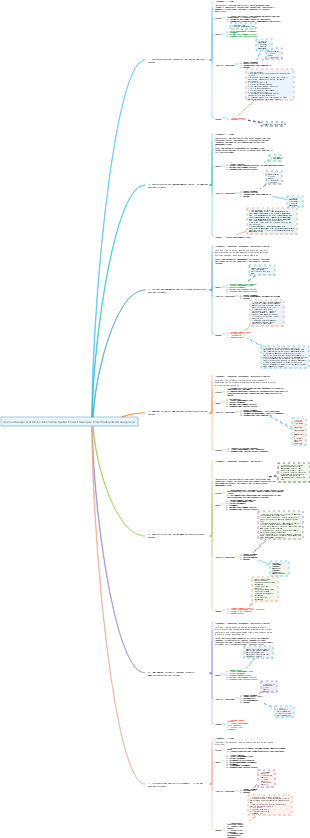
MindMap Gallery Information system project manager knowledge system (Chapter 3 Project scope management)
Project establishment management includes project establishment management content, feasibility study, project evaluation and demonstration. The map explains the content contained in the three aspects in detail, which is suitable for friends who organize and memorize knowledge points.
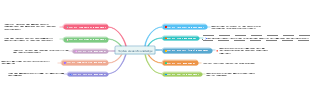
Edited at 2022-11-15 10:57:26This is a flowchart illustrating the process of archiving monthly failure analysis reports and tracking the implementation of improvement measures. The diagram is structured into five main steps, each with specific tasks and sub-tasks.Monthly Report Collection & Organization: This step involves collecting failure analysis reports from various departments, reviewing them for completeness, and categorizing them by product, failure mode, and severity. Root Cause Analysis & Statistics: Here, the focus is on categorizing causes, analyzing trends, identifying root causes, and compiling statistics on high-frequency failure modes and key components. Improvement Measure Formulation & Assignment: This step includes formulating improvement measures, assigning responsibilities, and setting timelines for implementation.Measure Implementation Tracking & Verification: It involves tracking the progress of implementation, verifying effectiveness, and confirming issue closure.Knowledge Base Update & Monthly Report Output: The final step covers archiving reports, updating the knowledge base, and compiling monthly summaries.This template can be easily reused and adapted using tools like EdrawMind to suit different organizational needs.
This is a timeline infographic detailing the annual product certification acquisition countdown process, structured into four sequential phases. The first phase, Certification Planning & Initiation, encompasses goal setting, timeline planning, resource preparation, defining specific certification objectives such as CCC/CE/FCC, formulating an annual plan with key milestones, and allocating necessary budget, personnel, and sample resources. Following this, the Application & Testing Phase involves material submission, coordination with certification agencies, core testing procedures, preparation of technical documents, application forms, and samples, selection of the appropriate certification agency, and execution of critical safety, EMC, and RF tests. The subsequent Rectification & Acquisition Phase focuses on addressing and rectifying any identified issues, re-verification processes, acquisition of the certificate, analysis of test issues, implementation of necessary fixes, and modification of samples for supplemental testing. Finally, the Countdown Monitoring phase emphasizes tracking progress, managing risks, monitoring remaining days and key milestones, managing time, technical, and cost risks, and maintaining effective internal and external communication throughout the process. This comprehensive template can be readily reused and adapted using tools like EdrawMind to meet diverse organizational requirements.
This is a flowchart detailing the weekly update and review plan for technical documents. The process is divided into six main stages, each with specific tasks and responsibilities. It begins with Weekly Planning, where the document scope is defined, update objectives are set, and schedules are arranged. Next, Document Updates involve maintaining various documents such as hardware design documents, test specifications, and BOM tables, alongside version control and archiving. Internal Review Preparation follows, focusing on compiling review materials, identifying participants, and setting agendas. The Review Meeting stage includes document examination, problem discussion, decision recording, and responsibility allocation. After the meeting, Review Feedback Processing takes place, involving issue tracking, document modification, quality checks, and closure verification. Finally, Output Deliverables are prepared, including official release versions, release notifications, review reports, and plans for the next week. This structured approach ensures systematic and efficient management of technical documents, and the template can be easily adapted using tools like EdrawMind.
This is a flowchart illustrating the process of archiving monthly failure analysis reports and tracking the implementation of improvement measures. The diagram is structured into five main steps, each with specific tasks and sub-tasks.Monthly Report Collection & Organization: This step involves collecting failure analysis reports from various departments, reviewing them for completeness, and categorizing them by product, failure mode, and severity. Root Cause Analysis & Statistics: Here, the focus is on categorizing causes, analyzing trends, identifying root causes, and compiling statistics on high-frequency failure modes and key components. Improvement Measure Formulation & Assignment: This step includes formulating improvement measures, assigning responsibilities, and setting timelines for implementation.Measure Implementation Tracking & Verification: It involves tracking the progress of implementation, verifying effectiveness, and confirming issue closure.Knowledge Base Update & Monthly Report Output: The final step covers archiving reports, updating the knowledge base, and compiling monthly summaries.This template can be easily reused and adapted using tools like EdrawMind to suit different organizational needs.
This is a timeline infographic detailing the annual product certification acquisition countdown process, structured into four sequential phases. The first phase, Certification Planning & Initiation, encompasses goal setting, timeline planning, resource preparation, defining specific certification objectives such as CCC/CE/FCC, formulating an annual plan with key milestones, and allocating necessary budget, personnel, and sample resources. Following this, the Application & Testing Phase involves material submission, coordination with certification agencies, core testing procedures, preparation of technical documents, application forms, and samples, selection of the appropriate certification agency, and execution of critical safety, EMC, and RF tests. The subsequent Rectification & Acquisition Phase focuses on addressing and rectifying any identified issues, re-verification processes, acquisition of the certificate, analysis of test issues, implementation of necessary fixes, and modification of samples for supplemental testing. Finally, the Countdown Monitoring phase emphasizes tracking progress, managing risks, monitoring remaining days and key milestones, managing time, technical, and cost risks, and maintaining effective internal and external communication throughout the process. This comprehensive template can be readily reused and adapted using tools like EdrawMind to meet diverse organizational requirements.
This is a flowchart detailing the weekly update and review plan for technical documents. The process is divided into six main stages, each with specific tasks and responsibilities. It begins with Weekly Planning, where the document scope is defined, update objectives are set, and schedules are arranged. Next, Document Updates involve maintaining various documents such as hardware design documents, test specifications, and BOM tables, alongside version control and archiving. Internal Review Preparation follows, focusing on compiling review materials, identifying participants, and setting agendas. The Review Meeting stage includes document examination, problem discussion, decision recording, and responsibility allocation. After the meeting, Review Feedback Processing takes place, involving issue tracking, document modification, quality checks, and closure verification. Finally, Output Deliverables are prepared, including official release versions, release notifications, review reports, and plans for the next week. This structured approach ensures systematic and efficient management of technical documents, and the template can be easily adapted using tools like EdrawMind.
Chapter 3: Project Management
Project management content
Output project proposal
definition
It is a necessary condition for the project construction unit to submit a project application to the superior authority.
It is to propose a framework and overall vision for the proposed project.
It is the initial stage of the project development cycle
It is the basis for the country or superior authorities to select projects.
core content
Explain the need for the project
Project market forecast
Market forecasts for product solutions or services
Necessary conditions for project construction
sponsor
Prepared by the construction unit
feasibility study report
definition
Conduct investigation, research and comparative analysis of project content and supporting facilities to provide basis for project decision-making
Fertility research has the characteristics of predictability, impartiality, reliability and scientificity.
Seven core contents
Project bidding management
Tender
tender
bid evaluation
award
sign contract
feasibility study
Feasibility study content
economic feasibility
Input-output analysis
Return on investment analysis
sensitivity analysis
technical feasibility
Operating environment feasibility
Feasibility in other aspects
Feasibility Analysis Steps
Determine project size and goals
Study a running system
Establish a logical model of the new system
Export evaluation plan
Recommend feasible solutions
Prepare and submit feasibility study report
feasibility study stage
Opportunities to study
Find investment opportunities and identify investment directions
preliminary feasibility study
Purpose: Preliminarily determine whether the project is marketable and profitable
content
Market and production capacity
Equipment and material input analysis
Network planning and physical layout solution selection
Project Design
Project schedule
Project Investment and Cost Estimation
Detailed feasibility study
Definition: Conducted after preliminary feasibility, more detailed and occupying more resources than preliminary research
Function: It is the basis for project evaluation and decision-making
Research methods
economic evaluation method
market forecasting method
investment estimation method
incremental net benefit method
Research principles
scientific
impartiality
objectivity
Research steps
Entrust and sign contracts
Organize people to make plans
Research and collect information
Economic Analysis and Evaluation
Prepare detailed feasibility study report
Project evaluation and demonstration
Project demonstration
definition
Regarding the advancement and applicability of the technology to be implemented, Economic rationality and profitability, Implementation possibilities and risks A technical and economic evaluation activity that conducts comprehensive and scientific comprehensive analysis to provide objective basis for project decision-making.
three aspects of argument
Market demand
why to do
Development Technology
Can it be done well?
Economic benefits
Is there any money to make?
Argument steps
Determine owner goals and project scope
Collect and analyze relevant information
Design multiple feasible solutions
Comparative analysis of multiple solutions
Choose the best option and conduct detailed demonstration
Prepare project demonstration reports, environmental impact reports, and procurement method approval reports
Prepare funding plan and project implementation schedule
Argument function
It is the basis for project implementation
It is the basis for raising funds and obtaining bank loans.
It is the basis for the preparation of planning, design, procurement, construction, organization and resource allocation.
It is an important guarantee to prevent risks and improve project efficiency.
Project Evaluation
definition
On the basis of project demonstration, a third-party organization will evaluate, analyze and demonstrate the necessity, construction conditions, production conditions, product market demand, engineering technology, economic benefits and social benefits of the proposed project according to policies, regulations and other requirements, and then judge the project Feasibility assessment process
in accordance with
Project proposals and other approval documents
Project feasibility study report
The application report of the submitting unit and the approval opinions of the competent department
Other agreements or contract documents related to resources, allocation, water, electricity, transportation, funds, etc.
Other necessary attachments or information
Argument steps
Design multiple feasible solutions
Comparative analysis of multiple solutions
Choose the best option and conduct detailed demonstration
Prepare project demonstration reports, environmental impact reports, and procurement method approval reports
Prepare funding plan and project implementation schedule
Designated book for the National Computer and Software Professional Technical Qualification (Level) Examination National Computer Professional and Technical Qualification Examination Office Chapter 3: Project Management 3.1 Project management content 3.2 Feasibility study 3.3 Project evaluation and demonstration