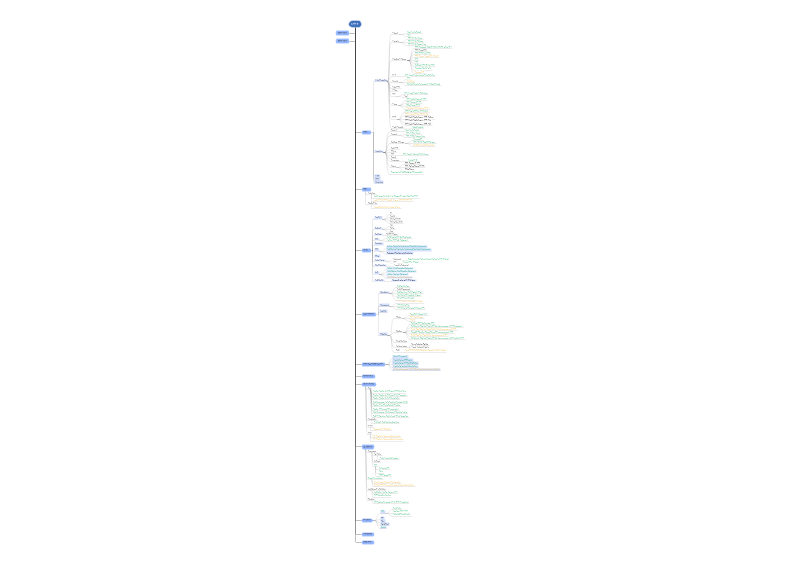
MindMap Gallery Data Security
Dama knowledge system, data security includes the planning, establishment and execution of security policies and procedures to provide correct authentication, authorization, access and auditing for data and information assets.
Edited at 2024-04-02 16:33:26Avatar 3 centers on the Sully family, showcasing the internal rift caused by the sacrifice of their eldest son, and their alliance with other tribes on Pandora against the external conflict of the Ashbringers, who adhere to the philosophy of fire and are allied with humans. It explores the grand themes of family, faith, and survival.

This article discusses the Easter eggs and homages in Zootopia 2 that you may have discovered. The main content includes: character and archetype Easter eggs, cinematic universe crossover Easter eggs, animal ecology and behavior references, symbol and metaphor Easter eggs, social satire and brand allusions, and emotional storylines and sequel foreshadowing.
[Zootopia Character Relationship Chart] The idealistic rabbit police officer Judy and the cynical fox conman Nick form a charmingly contrasting duo, rising from street hustlers to become Zootopia police officers!
Avatar 3 centers on the Sully family, showcasing the internal rift caused by the sacrifice of their eldest son, and their alliance with other tribes on Pandora against the external conflict of the Ashbringers, who adhere to the philosophy of fire and are allied with humans. It explores the grand themes of family, faith, and survival.
This article discusses the Easter eggs and homages in Zootopia 2 that you may have discovered. The main content includes: character and archetype Easter eggs, cinematic universe crossover Easter eggs, animal ecology and behavior references, symbol and metaphor Easter eggs, social satire and brand allusions, and emotional storylines and sequel foreshadowing.
[Zootopia Character Relationship Chart] The idealistic rabbit police officer Judy and the cynical fox conman Nick form a charmingly contrasting duo, rising from street hustlers to become Zootopia police officers!
Data Security
introduction
Data security includes the planning, establishment and execution of security policies and procedures to provide correct authentication, authorization, access and auditing of data and information assets.
Source of data security requirements
1. Stakeholders
2. Government regulations: The starting point for formulating government regulations is to protect the interests of stakeholders
3. Specific business concerns: Every organization’s proprietary data needs to be protected
4. Legal access requirements: While protecting data security, organizations must also enable legal access.
5. Contractual obligations: Contracts and confidentiality agreements also have an impact on data security requirements
Business drivers: Risk reduction and business growth are key drivers of data security activities
1. Reduce risk: As data regulations increase, often in response to data theft and breaches, so do compliance requirements
Process: P Plan C Control D Development O Operation
Target
1. Enable appropriate access to enterprise data assets and prevent inappropriate access
2. Understand and comply with all regulations and policies regarding privacy, protection and confidentiality
3. Ensure the privacy and confidentiality needs of all stakeholders are enforced and audited
Deliverables
1. Data security architecture
2. Data security policy
3. Data Privacy and Confidentiality Standards
4. Data security access control
5. Data access view for regulatory compliance
6. Safety classification records
7. Authentication and User Access History
8. Data security audit report
tool
access control system
Protect software
Identity management technology
Intrusion detection/intrusion prevention software
Metadata tracking
Data desensitization/encryption
Metrics
Security implementation indicators
Security Awareness Indicators
Data protection indicators
Security incident indicators
Confidential data diffusion rate
step
1) Identify and classify sensitive data assets
2) Find sensitive data in the enterprise
3) Determine ways to protect each asset
4) Identify how information interacts with business processes
2. Business growth
3. Security as an asset
Data security goals and principles
Target
1. Enable appropriate access and prevent inappropriate access to enterprise data assets
2. Support compliance with privacy, protection and confidentiality systems and regulations
3. Ensure that the privacy and confidentiality requirements of stakeholders are met
in principle
1. Collaboration
2. Corporate planning
3. Active management
4. Clarify responsibilities
5. Metadata driven
6. Reduce exposure to reduce risk
Risk classification
1. Critical Risk Data (CRD)
2. High Risk Data (HRD)
3. Moderate Risk Data (MRD)
security process
1) 4A plus E
Access
Audit
Authentication
Authorization
Entitlement
2) Monitoring
data integrity
In terms of security, data integrity (Data Integrity) is an overall state requirement to avoid being affected by improper additions/deletions.
Sarbanes-Oxley in the United States
encryption
Encryption is the process of converting plain text into complex codes to hide privileged information, verify transmission integrity, or verify the identity of the sender. encryption
Hash
Convert arbitrary length data to fixed length data identifier
Symmetric encryption
Symmetric encryption uses a key to encrypt and decrypt data
DES: Data Encryption Standard
3DES: Triple DES
AES: Advanced Encryption Standard
IDEA: International Data Encryption Algorithm
asymmetric encryption
In asymmetric encryption, the sender and receiver use different keys.
asymmetric encryption algorithm
RSA
Diffie-Hell-man
PGP (Pretty Good Privacy) is a free public key encryption application
confusion or desensitization
Reduce data availability by obfuscating (making it obscure or unclear) or desensitizing (removing, shuffling, or otherwise changing the appearance of the data) without losing the meaning of the data or its relationship to other data sets.
Types of desensitization
static desensitization
Persistent Data Masking permanently and irreversibly changes data. This type of desensitization is typically not used in production environments, but rather in development (or test) environments. Although static desensitization changes the data, the data can still be used for testing, applications, reports, etc.
1. In-flight Persistent Masking
Off-the-shelf masking is used when moving data between a source (usually a production environment) and a target (usually a non-production) environment requires desensitization or obfuscation.
2. In-place Persistent Masking
Floor desensitization can be used when the data source and target are the same. Read unmasked data from the data source, and directly overwrite the original data after masking.
dynamic desensitization
Dynamic Data Masking is the process of changing the appearance of data to the end user or system without changing the underlying data.
Desensitization method
1. Replace
Replaces a character or integer value with a character or integer value in a search or standard pattern. For example, you can replace the name with a random value from a list
2. Mixed arrangement
Exchange data elements of the same type within a record or exchange data elements of the same attribute between different rows.
3. Space-time variation
Move the date forward or backward by a number of days (small enough to preserve the trend), enough to make it unrecognizable.
4. Numerical variation
Apply a random factor (plus or minus a percentage, small enough to maintain the trend), significant enough to make it unrecognizable.
5. Cancel or delete
Delete data that should not be in the test system
6. Random selection
Replace some or all data elements with random characters or a sequence of single characters.
7. Encryption technology
Convert a stream of recognizable, meaningful characters into a stream of unrecognizable characters via a cipher code.
8. Expression desensitization
Change all values to the result of an expression
regular expressionregular expression
9. Key value desensitization
The results of the specified masking algorithm/process must be unique and repeatable for masking database key fields (or similar fields).
Data security type
1. Facility safety
2. Equipment security
3. Credential security
1) Identity management system
2) User ID standards for email systems
3) Password standards
4) Multi-factor identification
4. Electronic communications security
Data security constraints
1. Confidentiality level
Confidential information is shared only on a "need to know" basis
2. Regulatory requirements
The main difference between confidentiality and supervision is that the requirements come from different sources
1) Confidential data
1. Open to the general audience
2. For internal use only
3. Confidentiality
4. Restricted Confidentiality
5. Top secret
2) Regulatory restricted data
Activity
Managing behaviors related to corporate security requires different levels of systems
1. Enterprise security system
2. IT security system
3. Data security system
tool
1. Antivirus/security software
2. HTTPS
3. Identity management technology
4. Intrusion detection and intrusion prevention software
5. Firewall (defense)
6. Metadata tracking
7. Data desensitization/encryption
Implementation Guide
Data security in the outsourcing world
Everything can be outsourced, except liability
A Responsible, Commented, Consulted, Informed (RACI) matrix also helps clarify the roles, segregation of duties and responsibilities of different roles, including their data security obligations.
Establish clear accountability and ownership to support the overall data security regime and its implementation.
Proliferation of confidential data
The number of copies of confidential data should be measured to reduce proliferation. The more places confidential data is stored, the greater the risk of leakage.