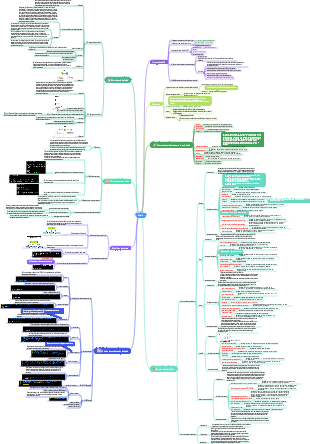
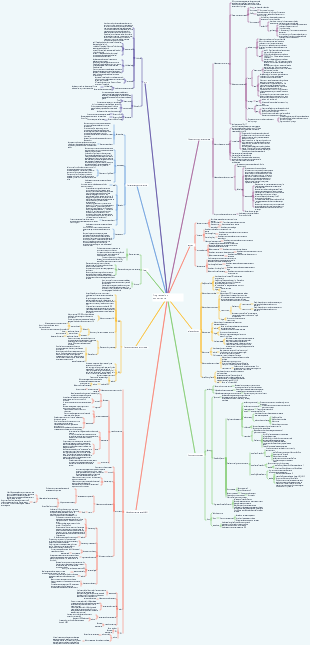
MindMap Gallery Chapter 7 Project Cost Management
Project cost management focuses on the cost of resources required to complete project activities, but the impact on the use, maintenance, and support costs of the project's products, services, or results should also be considered when making project decisions. The picture below organizes the latest PMP test points, and the content is very comprehensive and detailed.
Edited at 2020-12-20 11:01:03Chapter 7 Project Cost Management
Overview
Core idea
Project cost management focuses on the cost of resources required to complete project activities, but the impact on the use, maintenance, and support costs of the project's products, services, or results should also be considered when making project decisions.
Different stakeholders will calculate project costs at different times and using different methods.
Project Cost Management Trends and Emerging Practices (Learn About)
Expand Earned Value Management (EVM) and introduce the concept of Earned Progress (ES)
Tailoring considerations
knowledge management. Does the organization have an easy-to-use, formal knowledge management system and financial database that project managers are required to use?
Estimates and budgets. Does the organization have formal or informal policies, procedures and guidelines related to cost estimating and budgeting?
Earned value management. Does the organization use earned value management to manage projects?
Use of agile methods.
Does the organization use agile methods to manage projects? What impact does this have on cost estimates?
Governance. Does the organization have formal or informal audit and governance policies, procedures and guidelines?
Agile factors to consider
For projects with high variability, incomplete scope, and frequent changes, lightweight estimation methods can be used to quickly generate high-level forecasts of project labor costs, and the forecasts can be easily adjusted when changes occur.
subtopic
Detailed estimating is suitable for short-term planning using just-in-time
1. Planning cost management
Overview
The process of determining how to estimate, budget, manage, monitor, and control project costs.
What this process does: Provides guidance and direction on how to manage project costs throughout the project.
enter:
Project Charter
Specifies pre-approved financial resources from which detailed project costs can be determined.
The project approval requirements stipulated in the project charter also have an impact on project cost management.
project management plan
◆Progress management plan
Established criteria and activities for preparing, monitoring and controlling project progress
It also provides processes and control methods that affect cost estimation and management.
◆Risk management plan
Provides ways to identify, analyze and monitor risks
It also provides processes and control methods that affect cost estimation and management.
business environment factors
◆ Organizational culture and structure that can affect cost management;
◆ Market conditions, which determine what products, services and results are available in local and global markets;
◆ Currency exchange rate, used to convert project costs incurred in multiple countries;
◆ Published business information can often obtain resource cost rates and related information from business databases, and these databases dynamically track the cost data of human resources with corresponding skills, and also provide standard cost data of materials and equipment. Relevant information can also be obtained from the price list published by the seller;
◆ Project management information system can provide a variety of solutions for managing costs;
◆ Differences in productivity between different regions may have a huge impact on project costs.
organizational process assets
◆ Financial control procedures (such as periodic reporting, necessary fee and payment review, accounting coding and standard contract clauses, etc.);
◆ Knowledge base of historical information and lessons learned;
◆ Financial database;
◆ Existing formal and informal policies, procedures, and guidelines related to cost estimating and budgeting.
Tools & Techniques
expert judgment
Input should be sought from an individual or group with expertise or training in:
◆ Similar projects in the past;
◆ Information from industries, disciplines and application areas;
◆ Cost estimation and budgeting;
◆ Earned value management.
data analysis
Alternatives analysis
This may include a review of strategic methods of raising capital, such as self-funding, equity investment, borrowed investment, etc.
Consideration of the method of acquiring project resources (such as make, purchase, hire, or lease) may also be included.
Meeting
output
cost management plan
The cost management plan is a component of the project management plan that describes how project costs will be planned, scheduled, and controlled. The cost management process and its tools and techniques should be documented in the cost management plan.
unit of measurement.
The unit of measurement for each resource needs to be specified, such as person-hours, person-days, or weeks to measure time, meters, liters, tons, kilometers, or cubic yards to measure quantity, or a total price expressed in currency.
Accuracy.
Depending on the scope of activities and project size, set how much to round up or down the cost estimate (for example, $995.59 is rounded up to $1,000).
Accuracy.
Specify an acceptable range (such as ±10%) for activity cost estimates, which may include a certain amount of contingency reserves.
Organization program link.
The work breakdown structure (see Section 5.4) provides a framework for the cost management plan so that cost estimation, budgeting and control can be carried out in a standardized manner. The components of the WBS used in project costing are called control accounts (CA), each control account has a unique code or account number that is directly linked to the accounting system of the performing organization.
Control critical value.
Deviation thresholds may need to be specified for monitoring cost performance. It is the maximum variance allowed before some action is required, usually expressed as a percentage deviation from the baseline plan.
Performance Measurement Rules.
Earned value management (EVM) rules for performance measurement need to be specified. For example, a cost management plan should:
■ Define control accounts in the WBS for performance measurement;
■ Determine the EVM technique to be used (such as weighted milestone method, fixed formula method, percentage of completion method, etc.);
■ Specify the tracking method and the EVM formula used to calculate the project's estimate at completion (EAC), which can be used to validate the estimate of completion derived from a bottom-up approach.
report format.
The format and frequency of preparation of various cost reports need to be specified.
Other details. including but not limited to):
■ Description of strategic funding options;
■ Procedures for dealing with exchange rate fluctuations;
■ Procedures for recording project costs.
2. Estimated costs
Overview
Estimating costs is the process of making an approximate estimate of the cost of resources required to complete project work.
The main purpose of this process is to determine the funding required for the project.
Estimated costs are cost predictions based on known information at a specific point in time.
When estimating costs, you need to identify and analyze alternative cost options that can be used to start and complete the project; you need to weigh alternative cost options and consider risks, such as comparing homemade costs with outsourced costs, purchase costs with leasing costs, and the sharing of multiple resources. programs to optimize project costs.
cost estimate unit
Cost estimates are usually made in a certain currency unit (such as US dollars, euros, yen, etc.)
However, other units of measurement, such as person-hours or person-days, can sometimes be used to eliminate the effects of inflation and facilitate cost comparisons.
During the project life cycle, the accuracy of project estimates will gradually improve as the project progresses.
For example, a rough order of Magnitude (ROM) estimate of the project can be derived during the initiation phase, ranging from −25% to 75%;
Later, as the information becomes more detailed, the range of deterministic estimates can be narrowed to −5% to 10%.
Some organizations have developed guidelines for when to perform optimizations and the level of confidence or accuracy to achieve with each optimization.
Cost estimates should take into account all resources that will be charged to the project, including (but not limited to) labor, materials, equipment, services, facilities, as well as special cost categories such as inflation allowances, financing costs, or contingency costs.
enter
project management plan
Cost management plan.
See Section 7.1.3.1. The cost management plan describes the estimating methods that can be used and the accuracy and precision required for cost estimates.
Quality management plan.
See Section 8.1.3.1. The quality management plan describes the activities and resources required by the project management team to achieve a set of project quality objectives.
Scope benchmark.
project scope statement
WBS
WBS Dictionary:
Project Scope Statement.
Reflects the funding constraints arising from the cycle of project capital expenditures, or other financial assumptions and constraints.
Work breakdown structure. WBS
Specifies the interrelationships between all project deliverables and their components.
WBS Dictionary.
In the WBS dictionary (see Section 5.4.3) and related detailed statements of work, the deliverables are listed and the work required for each component of the WBS to produce the deliverables is described.
project files
Lessons Learned Register
Project schedule.
If the project budget includes financing costs (including interest)
If the resource cost depends on the length of use (such as management fees)
If the cost estimate includes time-sensitive costs (such as materials whose prices fluctuate seasonally)
Activity duration estimates will have an impact on cost estimates
Resource requirements.
See Section 9.2.3.1. Resource requirements specify the types and quantities of resources required for each work package or activity.
Risk register.
See Section 11.2.3.1. The risk register contains details of individual project risks that have been identified and prioritized, and the actions taken to address those risks. A risk register provides detailed information that can be used to estimate costs.
business environment factors
market conditions.
What products, services and results can be obtained from the market, from whom and on what terms. Regional and/or global supply and demand conditions can significantly affect resource costs.
Published Business Information.
Resource cost rates and related information can often be obtained from commercial databases, which dynamically track cost data for human resources with corresponding skills and also provide standard cost data for materials and equipment. Relevant information can also be obtained from the seller's published price list.
Exchange rates and inflation rates.
For large-scale projects spanning multiple years and involving multiple currencies, exchange rate fluctuations and inflation need to be understood and factored into the estimating cost process.
organizational process assets
◆ Cost estimation policy;
◆ Cost estimation template;
◆ Knowledge base of historical information and lessons learned.
Tools & Techniques
expert judgment
See section 4.1.2.1. Input should be sought from an individual or group with expertise or training in:
◆ Similar projects in the past;
◆ Information from industries, disciplines and application areas;
◆ Cost estimation methods.
analogy estimation
See Section 6.4.2.2. Cost analogies are estimated using parameter values or attributes from similar past projects.
Low cost and less time consuming. Used in the startup phase when detailed information is insufficient and results need to be obtained quickly.
parameter estimation
See section 6.4.2.3. Parametric estimating refers to the use of statistical relationships between historical data and other variables, such as square footage in building construction, to estimate the cost of project work
The accuracy of parameter estimation depends on the maturity of the parameter model and the reliability of the underlying data.
Parametric estimating can be for the entire project or a portion of the project, and can be used in conjunction with other estimating methods.
Bottom-up estimation
Estimated individuals are aggregated layer by layer
The accuracy of a bottom-up estimate, and the cost itself, often depends on the size or other attributes of the individual activity or work package.
three point estimate
See Section 6.4.2.4. The accuracy of single-point cost estimates can be improved by taking into account the uncertainty and risk in the estimate and using three estimates to define an approximate range of activity costs: ◆ Most likely cost (c M). The cost of an activity resulting from a more realistic estimate of the work required and associated costs. ◆The most optimistic cost (c O). The cost based on the best case scenario for the activity. ◆ The most pessimistic cost ( c P ). Cost based on the worst-case scenario for the activity. The expected cost (c E ) is calculated using the formula based on the assumed distribution of activity costs over three estimate intervals. Two commonly used formulas are triangular distribution and beta distribution, and their calculation formulas are: ◆Triangular distribution. c E = (c O c M c P ) / 3 ◆ Beta distribution. c E = (c O 4c M c P ) / 6 Calculate the expected cost based on an assumed distribution of three points and describe the uncertainty interval for the expected cost.
data analysis
Alternatives analysis.
Alternatives analysis is a technique for evaluating identified alternatives to decide which option to choose or which method to use to perform project work. For example, evaluate the impact of buying and manufacturing deliverables on cost, schedule, resources, and quality respectively.
Reserve analysis.
A contingency reserve is a portion of the budget that is included in the cost baseline to address identified risks; the contingency reserve is often thought of as that portion of the budget that addresses “known-unknown” risks that affect the project. Project managers have access to
For example, you can predict that some project deliverables will need to be reworked, but you don’t know how much work the rework will entail. A contingency reserve can be set aside to cover these unknown amounts of rework. From a specific activity to an entire project, any level can have its contingency reserve.
The contingency reserve can be a percentage of the cost estimate, a fixed value, or determined through quantitative analysis.
As project information becomes clearer, contingency reserves can be drawn down, reduced, or eliminated. Contingency reserves should be clearly listed in cost documents.
The contingency reserve is part of the cost baseline and is part of the project's overall funding requirements.
quality cost.
When estimating, various assumptions about quality costs (see Section 8.1.2.3) may be used. This includes an assessment of:
Whether to increase investment to meet the requirements or bear the costs caused by not meeting the requirements;
Whether to seek short-term cost reduction, or bear the consequences of frequent problems later in the product life cycle.
Project Management Information System (PMIS)
Project management information systems can include spreadsheets, simulation software, and statistical analysis tools that can be used to assist in cost estimating. These tools simplify the use of certain cost estimating techniques and allow multiple cost estimating options to be quickly considered.
decision making
vote
Voting is the process of evaluating multiple future courses of action to achieve a desired outcome. These techniques can engage team members, improve the accuracy of estimates, and increase accountability for estimate results.
output
Cost Estimate
The cost estimate includes a quantitative estimate of the likely costs to complete the project work, contingency reserves to deal with identified risks, and management reserves to deal with unplanned work.
Cost estimates can be summarized or detailed.
The cost estimate should cover all resources used by the project, including (but not limited to) direct labor, materials, equipment, services, facilities, information technology, as well as some special cost categories, such as financing costs (including interest), inflation allowances, Exchange rate or cost contingency reserves. Indirect costs can be charged at the activity level or higher if they are also included in the project estimate.
Estimate basis
The amount and type of supporting information required for a cost estimate will vary by application area, and regardless of its level of detail, supporting documentation should clearly and completely describe how the cost estimate was derived.
◆ Documentation on the basis for the estimate (e.g., how the estimate was prepared);
◆ Documentation of all assumptions;
◆ Documentation on known constraints;
◆ Documentation on identified risks that should be considered when estimating costs;
◆ Description of the estimate range (for example, “$10,000 ±10%” explains the range of expected costs);
◆ A description of the confidence level in the final estimate.
Project file updates
Assumption log.
See section 4.1.3.2. During the cost estimating process, new assumptions may be made, new constraints may be identified, or existing assumptions or constraints may be re-examined and modified. The hypothesis log should be updated accordingly with this new information.
Lessons learned register.
See section 4.4.3.1. Techniques for estimating costs effectively and efficiently need to be updated in the Lessons Learned Register.
Risk register.
See Section 11.2.3.1. The risk register may need to be updated as risk responses are selected and agreed during the cost estimation process.
3. Make a budget
Overview
Budgeting is the process of summarizing the estimated costs of all individual activities or work packages to establish an approved cost baseline.
The main purpose of this process is to establish a cost baseline against which project performance can be monitored and controlled.
The project budget includes all funds approved for execution of the project,
The cost baseline is the approved project budget allocated by time period and includes contingency reserves but does not include management reserves.
enter
project management plan
Cost management plan.
See Section 7.1.3.1. The cost management plan describes how project costs will be incorporated into the project budget.
Resource Management Plan.
See Section 9.1.3.1. The resource management plan provides information about rates (for human and other resources), travel cost estimates, and other foreseeable costs that must be considered when estimating the overall project budget.
Scope benchmark.
project scope statement
WBS
WBS Dictionary
project files
◆ Basis for estimation.
See Section 6.4.3.2. Include basic assumptions in the basis for your estimate, such as whether overhead or other costs should be included in the project budget.
◆ Cost estimation.
See Section 7.2.3.1. After the cost estimates for each activity within each work package are aggregated, the cost estimate for each work package is obtained.
◆ Project schedule.
See Section 6.5.3.2. The project schedule includes planned start and completion dates for project activities, milestones, work packages, and control accounts. Based on this information, costs can be summarized into the calendar periods in which they are expected to occur.
◆ Risk register.
See Section 11.2.3.1. The risk register should be reviewed to determine how risk response costs will be aggregated. Updates to the risk register are included in the project document updates, see section 11.5.3.3.
business documents
◆Business case.
The business case identifies key factors for project success, including financial success factors.
◆Effectiveness management plan.
Benefits management plans include target benefits, such as net present value calculations, time frames for achieving benefits, and benefit-related measurement indicators.
protocol
See Section 12.2.3.2. When developing a budget, consider the cost of the products, services or results to be or have been procured, as well as applicable agreement information.
business environment factors
Enterprise environmental factors that can affect the cost estimation process include (but are not limited to) exchange rates. For large-scale projects spanning multiple years and involving multiple currencies, exchange rate fluctuations need to be understood and incorporated into the budgeting process.
organizational process assets
◆ Existing formal and informal policies, procedures and guidelines related to cost budgeting;
◆ Knowledge base of historical information and lessons learned;
◆ Cost budgeting tool;
◆ Reporting methods.
Tools & Techniques
expert judgment
Input should be sought from an individual or group with expertise or training in:
◆ Similar projects in the past;
◆ Information from industries, disciplines and application areas;
◆ Financial principles;
◆ Funding requirements and sources
cost summary
Cost estimate of activities → work packages → control accounts → entire project
data analysis
Data analysis techniques that can be used in the budgeting process include (but are not limited to) reserve analysis that can establish project management reserves. Management reserve is a project budget specifically set aside for management control purposes to deal with unforeseen work within the project scope. It is intended to deal with "unknown-to-unknown" risks that will affect the project. Management reserves are not included in the cost baseline but are part of the overall project budget and funding requirements. When management reserves are used to fund unforeseen work, the used management reserves are added to the cost baseline, resulting in a change in the cost baseline.
Reserve analysis.
Establish project management reserves
Management reserve is a project budget specifically set aside for management control purposes to deal with unforeseen work within the project scope. It is intended to deal with "unknown-to-unknown" risks that will affect the project.
Management reserves are not included in the cost baseline but are part of the overall project budget and funding requirements.
When management reserves are used to fund unforeseen work, the used management reserves are added to the cost baseline, resulting in a change in the cost baseline.
Historical information review
Reviewing historical information can help with parameter or analog estimation.
Historical information can include various project characteristics (parameters) that are used to build mathematical models that predict the total project cost. These mathematical models can be simple (for example, the total cost of building a house depends on the construction cost per unit area) or complex (for example, the cost model of a software development project has multiple variables, each of which is affected by many factors). Analog and parametric models can vary widely in cost and accuracy. They will be most reliable when:
◆ The historical information used to build the model is accurate;
◆ Parameters in the model are easy to quantify;
◆ The model can be adjusted so that it is applicable to large projects, small projects and various project stages.
Funding limit balance
Ensuring adequate funding for each phase, component, and overall project within established funding constraints, which may result in changes to the schedule
If a discrepancy between funding constraints and planned expenditures is discovered, the schedule of the work may need to be adjusted to balance the level of funding expenditures.
This can be accomplished by adding mandatory dates to the project schedule.
Coping with Stage Fund Investment Restrictions
Financing
Financing refers to obtaining funds for a project. Long-term infrastructure, industrial and public services projects often seek external financing. If a project uses external funding, the funding entity may impose certain requirements that must be met.
output
cost basis
The cost baseline is the approved project budget allocated by time period, including contingency reserves, and does not include any management reserves
, which can only be changed through a formal change control procedure, is used as a basis for comparison with actual results.
The cost baseline is the sum of the approved budgets for different schedule activities.
Project funding requirements
Project funding requirements = cost baseline management reserves
The cost baseline includes both projected expenditures and projected liabilities.
Project funds are usually invested in incremental steps and may be uneven and ladder-like.
Project file updates
Cost Estimate. See Section 7.2.3.1. Update the cost estimate to record any additional information.
Project schedule. See Section 6.5.3.2. The project schedule may document the estimated costs of various activities.
Risk register. See Section 11.2.3.1. New risks identified during this process are recorded in a risk register and managed through the risk management process.
4. Control costs
Overview
Controlling costs is the process of monitoring project status to update project costs and manage changes to the cost baseline.
The main function is to maintain the cost baseline throughout the project.
The analysis should focus on the relationship between the expenditure of project funds and the corresponding work completed.
The key to effective cost control is managing an approved cost baseline. Project cost control includes:
◆ Influence factors that cause cost basis changes;
◆ Ensure all change requests are processed promptly;
◆ Manage changes when they actually occur;
◆ Ensure that cost expenditures do not exceed the approved funding limit, neither exceeding the limits allocated by time period, by WBS component, by activity, nor exceeding the overall project limit;
◆ Monitor cost performance and identify and analyze deviations from cost baselines;
◆ Supervise work performance against fund expenditure;
◆ Prevent unapproved changes in cost or resource usage reports;
◆ Report all approved changes and their associated costs to relevant parties;
◆ Try to keep expected cost overruns within acceptable limits.
enter
project management plan
Cost management plan.
See Section 7.1.3.1. The cost management plan describes how project costs will be managed and controlled.
Cost basis.
See Section 7.3.3.1. Compare the cost baseline to actual results to determine whether changes or corrective or preventive actions are needed.
Performance measurement benchmarks.
See section 4.2.3.1. When using earned value analysis, performance measurement baselines are compared to actual results to determine whether changes, corrective actions, or preventive actions are necessary.
project files
Lessons Learned Register
Lessons learned early in the project can be applied to later stages to improve cost control.
Project funding requirements
Project funding requirements include estimated expenditures and estimated debt.
job performance data
Work performance data contains data about project status, such as which costs have been approved, incurred, invoiced, and paid.
organizational process assets
◆ Existing formal and informal policies, procedures and guidelines related to cost control;
◆ Cost control tools;
◆ Available monitoring and reporting methods.
Tools & Techniques
expert judgment
◆ Deviation analysis;
◆ Earned value analysis;
◆ Forecast;
◆ Financial analysis.
data analysis
◆ Earned value analysis (EVA).
Earned value analysis compares actual schedule and cost performance to a performance measurement baseline. EVM integrates scope baseline, cost baseline and schedule baseline to form a performance measurement baseline. For each work package and control account, it calculates and monitors the following three key indicators:
budget at completion BAC
Budget At Completion
The budgeted value of all planned work is the cost baseline (earned value analysis, contingency reserves are not included in the calculation)
BAC = total PV at completion
The project is completed when EV=BAC
Planned value PV
plan value
The budgeted value of work planned to be completed by a certain point in time.
PV=planned workload
Also called BCWS
Earned value EV
Earned Value
The budgeted value of work actually completed as of a certain point in time
EV=actual workload
Also called BCWP
Actual cost AC
actual cost
How much money has actually been spent up to a certain point in time?
AC = actual workload x actual unit price
Also called ACWP
Deviation analysis
Variance analysis is used to explain the causes, effects and corrective measures of cost variance (CV = EV — AC), schedule variance (SV = EV — PV) and completion variance (VAC = BAC — EAC). (The bigger the better)
Schedule Variance (SV) Schedule Variance
Expressed as the difference between earned value and planned value. It refers to how far ahead or behind a project is at a given point in time.
Formula: SV = EV — PV.
Cost Variance (CV) Cost Variance
Expressed as the difference between earned value and actual cost, it is the budget deficit or surplus at a given point in time.
Formula: CV = EV — AC.
Schedule Performance Index (SPI) Schedule Performance Index
It is an indicator for measuring schedule efficiency, expressed as the ratio of earned value to planned value, and reflects the efficiency of the project team in completing the work. When SPI is less than 1.0, it means that the amount of work completed does not meet the planned requirements; when SPI is greater than 1.0, it means that the amount of work completed exceeds the plan.
Because the SPI measures the total effort on the project, a separate analysis of performance on the critical path is also required to confirm whether the project will be completed earlier or later than the planned completion date.
SPI is equal to the ratio of EV to PV. Formula: SPI = EV/PV.
Cost Performance Index (CPI) Cost Performance Index
A measure of the cost efficiency of budgeted resources, expressed as the ratio of earned value to actual costs. It is the most critical EVA metric and measures the cost efficiency of work completed. When the CPI is less than 1.0, it means there is a cost overrun for the work done; when the CPI is greater than 1.0, it means there is a cost surplus so far.
CPI is equal to the ratio of EV to AC. Formula: CPI = EV/AC.
Deviations from the original cost baseline can be evaluated through cost performance measurements.
Identify differences between cost baseline and actual project performance by comparing planned costs to actual costs
trend analysis. See section 4.5.2.2.
Trend analysis is designed to examine changes in project performance over time to determine whether performance is improving or deteriorating.
chart
In earned value analysis, the three parameters of planned value, earned value and actual cost can be monitored and reported either in stages (usually on a weekly or monthly basis) or on a cumulative basis. Figure 7-12 shows the EV data as an S-curve for a project that is over budget and behind schedule.
predict
As the project progresses, the project team can forecast the Estimate at Completion (EAC) based on project performance, and the forecast results may differ from the Budget at Completion (BAC). If it is apparent that the BAC is no longer feasible, the project manager should consider forecasting the EAC. Forecasting EAC is to predict future project situations and events based on currently available performance information and other knowledge.
ETC Estimate To Complete
The estimated expected cost of the remaining work up to a certain point in time (how much more work is estimated to cost for the remaining work)
EAC Estimate at Completion
Estimated total expected cost of project completion as of a certain point in time
AC actual cost AC actual cost
How much money has actually been spent up to a certain point in time?
BAC Budget At Completion
The budgeted value of all planned work is the cost baseline (earned value analysis, contingency reserves are not included in the calculation)
EAC=ETC AC
Estimate at completion = Estimate to be completed Actual cost
AC is the raw performance data, which is the measured value
ETC needs to be calculated
EAC Estimate at Completion
EAC=AC (BAC-EV)
Atypical, remaining work continues according to planned performance
EAC=AC (BAC-EV)/CPI=BAC/CPI
Typically, remaining work continues at the current cost performance index
EAC=AC (BAC-EV)/(CPI*SPI)
The remaining work will also be affected by CPI and SPI.
Key index CR=CPI*SPI
EAC=AC bottom-up reestimated ETC
The scheduled plan is no longer valid
memory method
BAC-EV=budgeted value of remaining work
EAC=AC (budgeted value of remaining work/remaining work performance)
If calculating the progress completion estimate, the relevant parameters should be converted into time units. However, CPI and SPI cannot use time units and can only use monetary units.
Reserve analysis
In the process of cost control, reserve analysis can be used to monitor the use of contingency reserves and management reserves in the project to determine whether these reserves are still needed, or whether additional reserves need to be added. As project work progresses, these reserves may have been planned to cover the costs of risks or other contingencies; conversely, if opportunities for cost savings are seized, the savings may be added to the contingency reserve or as earnings ( Profit) is divested from the project.
If the identified risks do not materialize, unused contingency reserves may have to be deducted from the project budget, freeing resources for other projects or operations. At the same time, further risk analysis within the project may reveal the need to request additional reserves for the project budget.
To complete Performance Index (TCPI) To complete Performance Index
The To-Complete Performance Index (TCPI) is a cost performance indicator that the use of remaining resources must achieve in order to achieve specific management goals. It is the remaining work cost/remaining budget.
TCPI refers to the cost performance indicator that the implementation of the remaining work must achieve in order to achieve specific management goals (such as BAC or EAC). If the BAC (budget at completion) is no longer feasible, the project manager should consider using a forecasted EAC (estimate at completion). Once approved, the BAC is replaced with the EAC.
TCPI formula based on BAC: TCPI = (BAC — EV) / (BAC — AC).
If BAC is no longer feasible, the TCPI formula based on EAC: TCPI = (BAC — EV) / (EAC — AC).
Formula memory method: CPI=EV/AC, TCPI=(BAC-EV)/(BAC-AC)
Completion deviation VAC=BAC-EAC
TCPI<1
The remaining work is less than the money and can be easily completed
TCPI=1
The remaining work is the same as the money, just finished
TCPI>1
There's more work left than money, so it's not easy to finish.
Project Management Information System (PMIS)
Project management information systems are often used to monitor the three EVM indicators of PV, EV, and AC, draw trend charts, and predict the likely range of final project results.
focus
output
job performance information
See section 4.5.1.3. Work performance information includes information about the performance of project work (against a cost baseline), allowing the assessment of deviations in work performed and work costs at both the work package level and the control account level. For projects using earned value analysis, CV, CPI, EAC, VAC, and TCPI will be recorded in the work performance report (see Section 4.5.3.1).
cost forecast
Whether it is a calculated EAC value or a bottom-up estimated EAC value, it needs to be recorded and communicated to relevant parties.
change request
See section 4.3.3.4. After analyzing project performance, change requests may be made to the cost and schedule baselines, or other components of the project management plan. Change requests should be reviewed and processed through the implementation of the overall change control process (see Section 4.6).
Project Management Plan Update
cost management plan
The control threshold or required accuracy used to manage project costs. They should be updated based on feedback from interested parties.
cost basis
After changes to scope, resources, or cost estimates are approved, corresponding changes need to be made to the cost baseline. In some cases, cost deviations may be so severe that cost baselines need to be revised to provide a realistic basis for performance measurement.
performance measurement benchmarks
After changes to scope, schedule performance, or cost estimates are approved, corresponding changes need to be made to the performance measurement baseline. In some cases, performance deviations may be so severe that a change request is required to revise the performance measurement baseline in order to provide a realistic basis for performance measurement.
Project file updates
Assumption log.
See section 4.1.3.2. Cost performance may indicate the need to revise assumptions about resource productivity and other factors that influence cost performance.
Basis for estimation.
See Section 6.4.3.2. Cost performance may indicate a need to revisit the original estimate basis.
Cost Estimate.
See Section 7.2.3.1. Cost estimates may need to be updated to reflect the actual cost effectiveness of the project.
Lessons learned register.
See section 4.4.3.1. Techniques for effectively maintaining budgets, variance analysis, earned value analysis, forecasts, and corrective actions to address cost variances should be updated in the Lessons Learned Register.
Risk register.
See Section 11.2.3.1. If cost deviations occur, or costs may reach critical values, the risk register should be updated.
cost management process
planning cost management
Estimate cost
Budgeting
Control costs
cost management objectives
Complete all work on the project within the approved budget
Cost classification
direct cost
Spending directly on the project
s
Labor wages, housing, water, electricity, etc.
Cost optimization method: control the project duration around the optimal duration
Break-even point, profit will start after exceeding the break-even point
opportunity cost/sunk cost
opportunity cost
When one option is chosen and another feasible option is given up, the benefit of the largest option not chosen is the opportunity cost.
Sunk costs
Resources spent on failed projects, etc.
Learn to let go and don’t be entangled in the past that cannot be changed
Irrecoverable costs that have been incurred
life cycle cost
Consider maintenance operations in terms of all costs incurred from the beginning of the project to the end of the project in the time dimension.
During the design stage, all costs throughout the entire life cycle of the project must be comprehensively considered to achieve cost optimization.
Consider the lowest cost from an overall perspective
Cost Estimating and Budgeting
Different stages have different estimation accuracy requirements, and the later the stage, the more accurate it will be.
The estimated left and right allowable deviations are not symmetrical and can be more or less.
Funding limit balance
Commitment to have funds in place: how much money will be spent by what time, and how much money will be given by Party A
The dotted line should be below the red line
Completion Budget Management Reserve = Project Budget
Earned value analysis
Three indicators
PV planned value The cost planned in the current time
PV=Planned unit price*Planned workload
AC Actual Cost
EV Earned Value Currently completed Value of results recognized by customers
EV = planned unit price * actual workload
CV Cost Variance
EV-AC
SV progress deviation
EV-PV
earned value curve
Six situations
Cost overruns, behind schedule
Cost overruns, schedule ahead of schedule
Cost overruns, behind schedule
Cost savings, behind schedule
Cost savings ahead of schedule
Earned Value Curve: Banana Curve
The flatter, the better
Two indices: Comparing performance across projects. Cost and schedule should be considered at the same time
Cost performance indexCPI=EV/AC
Schedule performance index SPI=EV/PV
Greater than 1 is better than less than 1, equal to 1 is best
Completion Estimate
EAC=BAC/CPI (cost performance index at the time of evaluation)
Cost not corrected
EAC=AC (BAC-EV) I can’t get back the money I spent. I will complete the project at the planned cost in the second half.
cost correction
EAC=AC [(BAC-EV)*(CPI*SPI)] The money spent cannot be recovered. The second half considers costs and schedule deviations, which are required for final completion.
The cost schedule is not corrected
TCPI performance index to completion
TCPI0=(BAC-EV)/(BAC-AV) Remaining work/remaining cost Less than 1 is better, the closer to 1 the better
TCPI1=(BAC-EV)/(EAC-AV)
Completion deviation VAC=BAC-EAC
Example
PV
AC
EV: planned budget multiplied by work progress percentage = actual work value
summary
How to evaluate EV
Planned completion speed = completion budget/completion progress PAR=BAC/SAC=20000/10=2000