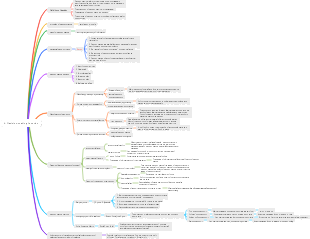
MindMap Gallery Human Resource Management 1 Chapter 3 Job Analysis
Self-Study in Business Administration, Human Resources Management Major, Human Resources Management 1. Important test points and short-answer questions throughout the chapter. The case questions have been marked to simplify the complex ones. Each chapter will take several hours to sort out to help you pass every exam.
Edited at 2024-03-07 22:10:00This is a mind map about bacteria, and its main contents include: overview, morphology, types, structure, reproduction, distribution, application, and expansion. The summary is comprehensive and meticulous, suitable as review materials.

This is a mind map about plant asexual reproduction, and its main contents include: concept, spore reproduction, vegetative reproduction, tissue culture, and buds. The summary is comprehensive and meticulous, suitable as review materials.
This is a mind map about the reproductive development of animals, and its main contents include: insects, frogs, birds, sexual reproduction, and asexual reproduction. The summary is comprehensive and meticulous, suitable as review materials.
This is a mind map about bacteria, and its main contents include: overview, morphology, types, structure, reproduction, distribution, application, and expansion. The summary is comprehensive and meticulous, suitable as review materials.
This is a mind map about plant asexual reproduction, and its main contents include: concept, spore reproduction, vegetative reproduction, tissue culture, and buds. The summary is comprehensive and meticulous, suitable as review materials.
This is a mind map about the reproductive development of animals, and its main contents include: insects, frogs, birds, sexual reproduction, and asexual reproduction. The summary is comprehensive and meticulous, suitable as review materials.
3Job Analysis
Job Analysis Overview
Basic concepts in job analysis
Job analysis and personnel evaluation are the basic work of the entire human resources development and management process.
work concept
(1) Narrow sense: It is an activity carried out to achieve a certain purpose within a period of time, that is, a task; (2) Broad sense: closely connected with the organization, that is, the sum of all roles of an individual in the organization
job analysis concept
: The systematic process of collecting job information related to a specific job
The result of job analysis is generally job description, which is the direct result of job analysis. It is expressed in the form of: job description (or job description), qualification description (job specification)
Concepts related to job analysis
1. Work element: It is the smallest unit of activity in the work that cannot be further broken down.
2. Work task: consists of one or more work elements
3. Job responsibilities: composed of various related tasks, one or more tasks
4. Position: Position is a collection of tasks and responsibilities. It is the basic unit that organically combines people and things. The number of positions is also called establishment.
5. Job title: a group of positions with similar or identical responsibilities. Job title is a collection of similar positions. It is a general term for positions.
6. Authority: Certain powers conferred by the position according to law
7. Grade: also called job type, a collection of all positions with similar work nature
Contents of job analysis
Five aspects of information analysis
Job title analysis job content analysis Work environment analysis Working conditions analysis work process analysis
Information analysis in job analysis content Mnemonic: the name of the analysis content, whether the environmental conditions can complete the process
The role of job analysis
(1) It is an important condition and basis for formulating and implementing scientific and reasonable human resources planning. (2) It is the basis for organizational recruitment, selection and staffing (3) It is a necessary condition for organizing employee training and development (4) It is an important prerequisite and objective basis for performance management (5) Provide reliable guarantee for enterprises to develop fair and reasonable salary systems (6) Provide career consultation and career guidance to employees
In short: all functions of modern human resource management and development, including human resource acquisition, integration, retention and motivation, control and adjustment, Functions such as training and development are based on and predicated on job analysis.
Job analysis procedures and methods
job analysis process
1. Preparation Phase
① Determine the purpose; ② Determine the scope of the position; ③ Cooperation from direct managers; ④ Obtain support from senior managers.
2. Investigation and analysis stage
① Communicate with the job holders of the positions involved in the job analysis; ② Develop an investigation and analysis work plan; ③Investigating and analyzing information data - the core step in the entire job analysis
3. Implementation phase
① Goals and focus; ② Implement publicity and training; ③Establish a project team and orderly organizational control; ④Select a method of collecting information.
4. result stage
Form information analysis report and prepare work instructions
5. Application feedback stage
Final review and adjustment
job analysis methods
1. observational analysis
(1) "Hawthorne Effect" (2) Principles: ①Concealment principle ②Detailed principle ③Trust principle ④Communication principle ⑤Stability principle ⑥Representative principle
Advantages and Disadvantages of Observation
(1) Advantages: ① Job analysts can have a relatively comprehensive and in-depth understanding of job requirements (physical activities; such as assembly line workers) ② Low cost, economical and practical, and easy to operate (2) Disadvantages: ① Not suitable for work with high mental labor requirements and intermittent work that deals with emergencies. ② It is difficult to accept for some employees. They feel that they are being monitored or threatened, which makes them psychologically disgusted with the work analysts. It may also cause deformation of operating actions. ③ Unable to obtain information on qualification requirements for job holders
2. interview method
1. Interview method: Also known as the face-to-face method, it is mainly a method in which job analysis experts communicate face-to-face with the employees of the analyzed job about the job to obtain relevant information. 2. Interview content [short answer questions]: work objectives, work content, nature and scope of work, responsibilities, and qualifications
3. Advantages and Disadvantages of Interview Method
(1) Advantages: ① Able to discuss work-related information in depth and extensively ②The job analyst can explain and guide the interview questions in a timely manner ③The job analyst can promptly correct the information defects in the interview outline according to the actual situation ④Job analysts can conduct on-site confirmation of the information obtained and the job holders in a timely manner (2) Disadvantages: ① It takes more time and costs more ② May cause distortion of work information ③The conversational skills of both parties will affect the effectiveness of the interview
3. Questionnaire method
1. Classification: ① Position Orientation Questionnaire; ② Personnel Orientation Questionnaire
2. Advantages and disadvantages of questionnaire method
(1) Advantages: ① Low cost and fast speed; ②Wide scope of investigation; ③The survey sample size is large. (2) Disadvantages: ① It is difficult to arouse the interest of the respondent; ② The content is small and insufficient detailed information cannot be obtained. The questionnaire is too long and easily boring; ③ Information cannot be exchanged face to face, and it is difficult to understand the true attitudes and motivations of the respondents.
4. functional job analysis
1. FJA for short, is based on the functions and responsibilities that employees need to perform as the core, and lists the categories of work information that need to be collected and analyzed to conduct job analysis. 2. The basis of this method is DPT theory: • D – Information about “data” • P - “people” information • T – Information about “things”
3. Contents of functional job analysis
(1) Task description (2) Analysis of work characteristics (3) Employee characteristics analysis (necessary conditions: ① training ② ability ③ personality ④ physical condition) (4) Functional job analysis method includes four factors (① How much guidance is needed ② Reasoning and judgment ability ③ Mathematical ability ④ Verbal and expression ability )
5. work diary method
: A method that requires employees engaged in work to keep a work diary or log every day to provide information and basis for job analysis.
Advantages of the work diary method: The information is highly reliable and suitable for determining information about work responsibilities, work content, work relationships, labor intensity, etc.; recording it day by day or after work activities can avoid omissions; it requires less cost; The most detailed information can be collected Disadvantages of the work diary method: it focuses attention on the activity process rather than the results; the workload of organizing information is large and the summary work is cumbersome; the filler may miss some content due to carelessness, thus affecting the analysis results; filling in the log will cause Affect normal work, If it is filled in by a third party, the human investment will be huge and it is not suitable for handling a large amount of business; there will be errors, and necessary inspections of the record analysis results will be required.
6. work participation method
The work participation method is only suitable for relatively simple job analysis
Writing a statement of work
Main contents of the statement of work
① Job identification, ② Work overview, ③ Work contacts, ④ Job responsibilities and tasks ⑤Work authority, ⑥Performance standards, ⑦Working conditions and physical environment, ⑧Work specifications
Principles to follow when writing a statement of work
1) Not for the right person, but for the right position 2) Don’t treat the person but the matter 3) Focus on the present rather than the future 4) Inappropriate treatment of responsibilities
Basic requirements for writing a statement of work
Clear, specific, concise and standardized
job design
The meaning and content of job design
The purpose of job analysis: to clarify the tasks to be completed and the characteristics of the people required to complete these tasks The purpose of job design: clarify the content and methods of the job
Contents of job design
(1) Job content (2) Job responsibilities (3) Working relationship (4) Work results (5) Feedback on work results (6) Reaction of the incumbent
【Tip】Built-in joints, feedback response
Factors affecting job design
(1) Environmental factors: human resource reserves available to society, social expectations (2) Organizational factors: specialization, work processes, work habits (3) Behavioral factors [short answer questions]: work integrity, importance of work, autonomy, skill diversity, interactive feedback
Principles of job design
(1) The principle of setting up posts according to specific circumstances - the general principle of traditional work design (2) Systematic principle: work design must be consistent with organizational strategy and organizational design ideas (3) Principle of practicality (4) Principle of simplicity (5) Matching principle: In work design, whether each person’s workload is reasonable and whether the time is balanced should be considered
form of work design
1. Task-based: clear task objectives are decomposed layer by layer according to the characteristics of the work process, and implemented with certain forms of positions.
2. Based on ability: clear work goals are broken down into positions according to the characteristics of the work process. The job responsibilities are relatively broad and the requirements for employees' work abilities are more comprehensive.
3. Team-based: It is a market-oriented and customer-oriented design. , combine various positions to form a team to work
job design methods