MindMap Gallery Differential Calculus of Functions of One Variable
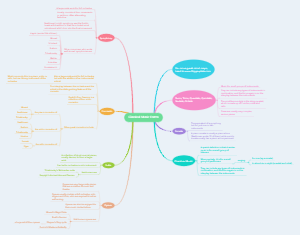
Differential calculus of functions of one variable, application questions on derivatives include: Question type: Monotonicity, extreme value and maximum value of function Question type 2: The concavity, inflection point, asymptote and curvature of a curve Question: Existence and number of roots of three equations Question Type 4: Proving function inequalities Question Type Five Related Proof Questions of Differentiation Mean Value Theorem
Edited at 2023-07-24 17:04:58This is a mind map about bacteria, and its main contents include: overview, morphology, types, structure, reproduction, distribution, application, and expansion. The summary is comprehensive and meticulous, suitable as review materials.
This is a mind map about plant asexual reproduction, and its main contents include: concept, spore reproduction, vegetative reproduction, tissue culture, and buds. The summary is comprehensive and meticulous, suitable as review materials.
This is a mind map about the reproductive development of animals, and its main contents include: insects, frogs, birds, sexual reproduction, and asexual reproduction. The summary is comprehensive and meticulous, suitable as review materials.
This is a mind map about bacteria, and its main contents include: overview, morphology, types, structure, reproduction, distribution, application, and expansion. The summary is comprehensive and meticulous, suitable as review materials.
This is a mind map about plant asexual reproduction, and its main contents include: concept, spore reproduction, vegetative reproduction, tissue culture, and buds. The summary is comprehensive and meticulous, suitable as review materials.
This is a mind map about the reproductive development of animals, and its main contents include: insects, frogs, birds, sexual reproduction, and asexual reproduction. The summary is comprehensive and meticulous, suitable as review materials.
Differential Calculus of Functions of One Variable
Derivatives and Differentials
Question Type 1 Concepts of Derivatives and Differentials
1. Define the limit
2. Define derivatives
If I don’t know if it’s differentiable, I’ll just use the definition.
3. Definition is derivable
First determine the derivative and then determine the derivative is continuous.
In Lópida, pay attention to whether the nth order of the question is differentiable (derivative to n-1, that is, the order where the derivative is continuous). Higher orders need to be defined by derivatives.
some conclusions
It is not necessary or sufficient that fx is differentiable and |fx| is differentiable
About |f(x)| (combined images)
If f(x0)≠0, then |fx| is differentiable at x0 "==" fx is differentiable at x0
If f(x0)=0, |fx| can be derived at x0 as "==" f'(x0)=0
When f(x)=g(x)|x-a|, g(x) is continuous at a, then the necessary and sufficient condition for fx to be differentiable at a is g(a)=0.
Principle (generalized use), in this derivative definition of fx, according to the derivative definition, x tends to a from both sides, but there is an absolute value, making the final result different (one positive g(a) and one negative g(a)) , if you want to make two limits that are opposite numbers the same, take both of them to be 0. That is, let g(a)=0. Generalize it to the function f(x)=g(x)|p(x)| and you can get it. If the real root of the absolute value function p(x)=0 is reflected in g(x)=0, then This point is derivable, otherwise it is not. In the absolute value, the points with px=0 are not differentiable, but because they are multiplied by gx=0 at this time, that is, the left and right derivative definition limits are equal and become differentiable.
Commonly used k|x| is not differentiable at 0, x|x| is differentiable at 0
This method can be used to determine the non-differentiable point of this type of function
Question Type 2 Geometric Meaning of Derivatives
Tangents, normals, parametric equations
Question Type 3: Calculation of Derivatives and Differentials
1 Derivation of composite functions
They exist only if they all exist. Whether they exist or not does not necessarily mean that the whole does not exist.
2 Implicit function derivation method
Use the original equation to simplify
Try to differentiate the factors that are zero after substituting into x as a whole
3 Derivatives of parametric equations
Polar coordinates → parametric equations
4 Derivatives of inverse functions
reciprocal of derivative
5 Logarithmic derivation
For continuous multiplication and continuous division, the square root
Derivative applications
Question type 1: Monotonicity, extreme value and maximum value of functions
Extreme points: one necessary and three sufficient
In a continuous function, if there is no definition when directly substituting x, you can try to use both sides to find the limit.
When the limit is greater than or less than zero, we want to preserve the local number.
Question type 2 Concave and convexity, inflection points, asymptotes and curvature of curves
The turning point is one necessary and three sufficient
It does not have to be a point where the second derivative is equal to zero to be an inflection point. According to the definition, as long as the concavity and convexity around the inflection point change, even if it is not differentiable
In the asymptote, in the same trend, if there is a level, there will be no slope.
Constructor function (auxiliary function)
####
Question Type 3: Existence and number of roots of equations
1 Existence
zero point theorem
Rolle's theorem
2 numbers
Monotonicity
Finding the number of roots can also be used to prove the existence of
The parameters are separated when deriving the derivation, and they will be eliminated after derivation to facilitate discussion.
Corollary of Rolle's Theorem Rolle's original words
$If f^{(n)}≠0 on the interval I, then f(x)=0 has at most n real roots$
It is often used to assist in proofs. If there are at least n roots calculated by hand and at most n roots calculated by Rolle, then there are n roots.
Rohr can also be used to determine the stationary point.
Question Type 4: Proving function inequalities
Monotonicity, maximum value, lattice, Taylor, concavity and convexity, basic inequalities
Question type 5: Proof questions related to the differential mean value theorem
####
Constructor
1. Analysis and restoration
2. Differential equations
3. Commonly used basic formulas (essentially also analytical reduction method)
4 Construct the function based on the inspiration given in the question
For example, the sum of the second derivative and functions
If the interval is continuous and the two endpoint values are known, if there is a value in the middle that is greater or less than the two endpoint values, there will be a maximum value, and this maximum value is the maximum value.
When using the constructor followed by Roll,
If one point is a, another point should also be a,
Pay attention to how to get another point value = a. (a is always 0)
Definite integrals can also be used to evaluate, especially when a linear term is multiplied by a definite integral constant, 0 can be obtained directly, and then according to the integral mean value theorem, it can be concluded that there are points in the interval that satisfy this condition.
It is not required that two points are not equal
The twice-mean value theorem (pull the middle)
Cauchy and Lazhong
Requires two points to be unequal
Determine segmentation point
Determining the segmentation point is the key point of difficulty in this type of question. In general, the first question will provide the proof of the segmentation point. If it is not given, the mean value theorem will be used in the second question, and the obtained result will be used to reverse Push the segmentation point.
When inferring segmentation points, you can use the variable substitution method to simplify the operation, and you can also guess the location of special points from the problem settings.
Mean Value Theorem
If double medians are used, double pull-centers are generally used. At this time, a segmentation point is selected, and the segmentation point is used as an intermediary to connect the medians on both sides.
Taylor
Analyze the conditions in the question and perform Taylor expansion for x values with more known forms. If several x have the same number of known parameters, find the x whose derivative value is known. If it is known that f(1)=0 and f'(2)=1, then expand 2 first.
Commonly used theorems
Roll
Fermat
Generally, Rolle is given priority, followed by Fermat. When two points with the same derivative = 0 cannot be found, Fermat is considered. Fermat often requires that the maximum value in a continuous interval must be the extreme value. This needs to be based on the meaning of the question. To find the extreme point, the derivative of the extreme point is 0, and this point is the point you are looking for.
Taylor
Pull in
Pulling in is also about slope
In any question that requires derivatives and functional relationships, Lagrangian can be considered, especially if the values of some points are given.
For example, if the range of fx is given in the question, you can use the range to calculate the range of f'(x).