MindMap Gallery Pedagogy Chapter 8 Teaching Objectives
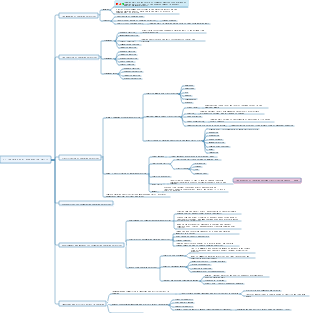
This is a mind map about teaching objectives in Chapter 8 of Education, which includes the theory of classification of teaching objectives, The basis for designing teaching objectives, Teaching goal design requirements, etc.
Edited at 2023-12-04 10:02:10This is a mind map about bacteria, and its main contents include: overview, morphology, types, structure, reproduction, distribution, application, and expansion. The summary is comprehensive and meticulous, suitable as review materials.

This is a mind map about plant asexual reproduction, and its main contents include: concept, spore reproduction, vegetative reproduction, tissue culture, and buds. The summary is comprehensive and meticulous, suitable as review materials.
This is a mind map about the reproductive development of animals, and its main contents include: insects, frogs, birds, sexual reproduction, and asexual reproduction. The summary is comprehensive and meticulous, suitable as review materials.
This is a mind map about bacteria, and its main contents include: overview, morphology, types, structure, reproduction, distribution, application, and expansion. The summary is comprehensive and meticulous, suitable as review materials.
This is a mind map about plant asexual reproduction, and its main contents include: concept, spore reproduction, vegetative reproduction, tissue culture, and buds. The summary is comprehensive and meticulous, suitable as review materials.
This is a mind map about the reproductive development of animals, and its main contents include: insects, frogs, birds, sexual reproduction, and asexual reproduction. The summary is comprehensive and meticulous, suitable as review materials.
teaching objectives
It is the changes in all aspects of students that are preset and continuously generated by teachers before carrying out teaching activities and as teaching activities are carried out.
Teaching goals are related to teaching purposes and training goals, but they are different from the two. Teaching goals are formulated based on these two and are their concreteness, refinement and discipline. Teaching objectives are the embodiment of curriculum objectives in the teaching process.
Features (preview Zeng Keling)
Anticipation, systematicity and decomposability, hierarchy, feasibility and reality, flexibility and generativity.
Function
Guidance and control function, incentive function, evaluation function, aggregation function
Teaching goal classification theory
Bloom's taxonomy of educational objectives.
Bloom's Taxonomy of Educational Objectives divides educational objectives into three areas and believes that teaching objectives are hierarchically structured complex behaviors that can be divided into simple behaviors and can be represented by visible behaviors.
Content cognition, memory understanding and other emotional areas. Receptive reaction and other motor skill areas, perceptual imitation, etc. Issues of concern, learning issues, teaching issues, assessment issues, consistency issues.
Characteristics: Measurability, operability, feasibility; hierarchical, cumulative (taking into account the laws of students’ psychological development)
Evaluation: Advantages: Using explicit behavior as a unified basis, the complexity is divided into a teaching target system. Each target has levels and is easy for teachers to operate; it takes into account emotions, actions, and cognition, correcting the mistakes of previous education that focused on cognition; allowing teachers to Taking into account all levels of teaching, and being able to clarify general procedures and steps. ; Use clear behaviors to describe teaching objectives and provide a basis for teaching evaluation. Disadvantages: The complete and unified teaching objectives are divided into trivial parts and ignore the inner connection of emotion, movement and cognition. The hierarchical structure of each field is not scientific enough, and people's cognition sometimes jumps in levels. The goals are too detailed, which leads to rigid and rigid teaching design and reduces the generativity of teaching goals. Some important educational outcomes, such as understanding and appreciation, cannot be fully translated into observable explicit behaviors. The means and goals of curriculum design are inseparable. It is unscientific to choose the means after determining the goals.
Gagné’s classification theory of learning outcomes.
Gagne, an American educational psychologist, believes in The Conditions of Learning that the result of learning or the goal pursued by teaching activities is to form students' five abilities.
Content includes verbal information, motor skills, intellectual skills, and cognitive strategies
Evaluation provides a basis for the hierarchical division of teaching objectives and provides reference and guidance for the measurement and evaluation of teaching results.
Babanski teaching process optimization.
Study the teaching process as a system, and combine human conditions, teaching process, structure, and basic links of teaching implementation to form a system that can provide the optimal solution to a task under certain conditions. This optimal solution does not mean the most optimal solution. Ideal refers to what looks best based on certain criteria based on reality under existing conditions.
Ausubor's theory of meaningful learning.
Meaningful learning Ausubor divides learning into mechanical learning and meaningful learning based on the relationship between learning materials and learners’ original cognitive structures. Students’ active learning method is meaningful learning. Meaningful learning means that the new knowledge represented by symbols establishes a substantive, non-artificial connection with the appropriate concepts already in the cognitive structure of the learner's mind.
Introduction, American cognitive psychologist Ausubel believes that students' learning should be meaningful.
The content includes abstract symbol learning, concept learning, proposition learning, and discovery learning.
Compared with acceptance learning, discovery learning means that the learning results are not directly discovered and conclusive, but require students to engage in active psychological activities before the final results enter the cognitive structure. Including applied learning, problem solving, learning, and creative learning. Evaluation: We believe that meaningful receptive learning and discovery learning are equally important to students, and deny the view that one-sided emphasis on discovery learning and devaluation of receptive learning.
The basis for designing teaching objectives.
Students, teaching content, social needs.
Teaching goal design requirements
Holistic and systematic, the teaching objectives are specific, accurately expressed to facilitate detection, and the difficulty of the objectives.
Three goal modes and corresponding expressions.
Chinese scholars draw lessons from Eisner's theory and divide curriculum and teaching goals into behavioral goals, generative goals, and expressive goals.
behavioral goals
Teaching objectives focus on the students' behavioral results. Representative figures such as Bobbitt, Chester, and Taylor Bloom. This kind of goal focuses on the students' behavior, not the teacher's behavior, and should describe students' learning. Results, not learning process.
The advantages are that it is highly operable, easy to inspect and evaluate, improves educational efficiency and scientificity, is helpful for teachers to adjust teaching behaviors, and is helpful for establishing a scientific concept full of humanistic care.
Disadvantages: It ignores students' psychological changes and only focuses on explicit behaviors, which has an obvious tendency of behaviorism. Behavioral goals only reflect teaching goal setting from a certain perspective and are not necessarily comprehensive. The response to students' true level will mislead teaching evaluation. Not paying attention to the student process and neglecting the cultivation of creativity.
A representation method that combines cognitive goals, internal processes, and explicit behaviors.
The representative figure is Glenland who believes that the essence of learning lies not only in the changes in external behaviors, but also the real goal of education is the changes in inner emotional abilities. However, these changes cannot be directly measured and observed, so in order to indirectly understand these changes, it is necessary to enumerate Examples of overt behaviors that reflect inner changes. Make goals specific.
Methods state the teaching objectives and list specific examples of behaviors that students can demonstrate in order to achieve the objectives.
Evaluation not only retains the advantages of the behavioral target expression method, but also avoids the disadvantages of focusing only on external behavioral changes and ignoring internal psychological changes.
generative goals
It is neither a goal predetermined by the outside, but a goal that is naturally generated as the educational process unfolds in the educational situation. Focusing on the process of learning activities is not the result.
Representative figure, Dewey opposed externally imposed goals. The goal of curriculum is not the pre-reification of educational experience, but the result of educational experience. Stenhouse's critical behavioral approach believes that school education includes training, teaching, and guidance.
Generative goals rely on the comprehensive quality of teachers, while behavioral goals are predetermined goals, preventing teachers from creating and exerting themselves, and ignoring teachers, the most precious resource. It is precisely because of this that the slogan of teachers and researchers was put forward. Behavioral goals and generative goals can complement each other.
performance goals
It does not prescribe a fixed common response for students, but uses a theme to allow students to expand their horizons through personalized activities around the application of the skills they have learned. Cultivate students' individuality and creativity. Expressive goals do not specify that students will obtain the behaviors specified by the designated goals after engaging in learning activities. Instead, they identify problems that children deal with in situations at work, allowing children to explore the content they are interested in and pay attention to the subject spirit.
Eisner
Different course objectives have their own value and can complement each other. Behavioral goals are specific and clear, easy to operate and evaluate, and applicable to knowledge, skills and training. Generative goals, consider students’ interests and abilities, and focus on the process. Performance goals, on the other hand, have their own specificities in cultivating abilities and critical thinking, and should be used comprehensively based on the goal level, student tasks, analysis results, and student characteristics.