 Wondershare EdrawMind
MindMap Gallery Learn marketing planning from 0 to 1
- 32
Learn marketing planning from 0 to 1
It comprehensively teaches you what marketing planning and methods are, with a detailed introduction and comprehensive description. I hope it can help interested friends learn.
Edited at 2023-11-27 16:09:08
- bacteria
This is a mind map about bacteria, and its main contents include: overview, morphology, types, structure, reproduction, distribution, application, and expansion. The summary is comprehensive and meticulous, suitable as review materials.
- Plant asexual reproduction
This is a mind map about plant asexual reproduction, and its main contents include: concept, spore reproduction, vegetative reproduction, tissue culture, and buds. The summary is comprehensive and meticulous, suitable as review materials.
- Reproductive development of animals
This is a mind map about the reproductive development of animals, and its main contents include: insects, frogs, birds, sexual reproduction, and asexual reproduction. The summary is comprehensive and meticulous, suitable as review materials.
Learn marketing planning from 0 to 1
- bacteria
This is a mind map about bacteria, and its main contents include: overview, morphology, types, structure, reproduction, distribution, application, and expansion. The summary is comprehensive and meticulous, suitable as review materials.
- Plant asexual reproduction
This is a mind map about plant asexual reproduction, and its main contents include: concept, spore reproduction, vegetative reproduction, tissue culture, and buds. The summary is comprehensive and meticulous, suitable as review materials.
- Reproductive development of animals
This is a mind map about the reproductive development of animals, and its main contents include: insects, frogs, birds, sexual reproduction, and asexual reproduction. The summary is comprehensive and meticulous, suitable as review materials.
- Recommended to you
- Outline

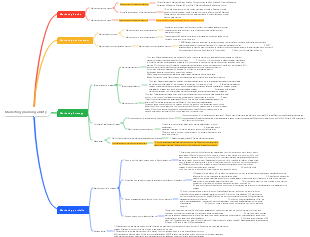


Marketing Planning
frame
Dragon Ball: Internal and external environment analysis Response to internal resource conditions, external opportunities and threats
Analytical method: 1.PESTEL (Politics, Economics, Society, Technology, Environment, Law) 2.SWOT (Strengths, Weaknesses, Opportunities, Threats) 3.Boston matrix method 4. General Electric Company’s operating matrix method
Leader: Determine the planning ideas. After the company systematically analyzes the internal environment, it determines the overall marketing planning ideas for the next step.
Dragon Body: Design of Strategies and Techniques After the foundation of planning ideas is determined, it is necessary to provide implementable design of marketing strategies and strategic techniques.
Marketing Strategy 4Ps Products, prices, channels, promotions Planning of four controllable elements of marketing
Dragon's Tail: Plan Execution and Adjustment When a company's operation planning or planning activities have a greater impact, it is necessary to formulate a planning plan as a blueprint for the company's implementation.
Basics
Marketing basics
Marketing Management
Transaction marketing style focuses on transactions | focuses on sales activities | pursues sales growth | focuses on developing new customers
Relationship marketing focuses on customer relationships | Aims to increase customer stickiness, facilitate multiple transactions, and form sustained customer relationships | Focus on customer satisfaction
Value marketing style focuses on brand value | pursues higher customer resources and brand assets | focuses on tapping customer value
Value network camp style focuses on network and value network | focuses on introducing external resources and utilizing network effects to improve management level and efficiency | focuses on the establishment and use of value network
Marketing planning principles
Humanistic Principle, Human Resource Orientation, a theory that promotes enterprise development by exploring consumer needs and unleashing the creativity of planners
The principle of difference refers to a theoretical system that makes different choices for different subjects in different periods, depending on different environments.
Integration principle: Treat the planning object as a system, and use the perspectives of collectiveness, dynamics, hierarchy, and correlation to form a complete planning method and achieve optimized planning effects.
The principle of benefit focuses on cost control and pursues the dual benefits (economic benefits and social benefits) of the enterprise's planning behavior itself.
Basic quality requirements
A wealth of knowledge
Perceptiveness
Broad tolerance
Scientific rigor and creative spirit
good expressiveness
execution ability
process
1. Environmental analysis
2. Marketing goal setting
Follow the SMART principle S specific M measurable A is attainable R correlation relevant T time-bound
3. Marketing strategy planning
4. Marketing tactical planning
5. Form a marketing plan
6. Marketing planning implementation
7.Evaluation and Correction
8S marketing model, brand building system, regional market operation system, organization management system, sales force management system, promotion flow management system, product structure system, benefit distribution system, channel distribution system
Creativity and methods
The role of creativity in planning
Provide ideas and plans for planning
Make planning activities more unique and innovative
Creative steps and methods
step
1. Define the problem. Defining the problem to be solved is the first step in creativity.
2. Imagine the best results. Setting your goals higher and farther away is very helpful to overcome inertia in thinking and improve the quality and level of creativity.
3. Verify data: Verify and evaluate the completeness, usefulness and validity of various data we possess based on the ideas proposed by the creative ideas
4. Find inspiration. If we say defining the problem, imagining the best results, and verifying the information, these three steps are the preparation stage for planning creativity. Looking for inspiration is the brewing stage of creativity. Don’t rely on waiting and luck. You should think creatively based on full preparation and accumulation. Only in this way can you get inspiration.
5. Go out of the familiar field and focus on the problem to be solved. Be good at acquiring knowledge in other fields and be good at using this knowledge flexibly.
6. Try various combinations. Start from different starting points of thinking and try various combinations of solutions. This is a very important step in our creative process
7. Relax yourself. People’s thinking is most active in a relaxed state. It is also about creativity that can be maximized. Maintaining a relaxed state is the prerequisite and necessary guarantee for successful creativity
8. Preliminary proposals should be recorded quickly and completely, and compared and screened according to the purpose and needs of the creativity. Creative solutions must be novel, unique, and feasible.
9. Verify creativity. The first is to decide the final choice of the creative plan; the second is to summarize the experiences and lessons learned in the creative stage.
Methods and techniques
1. Inspirational thinking method: Think diligently and ask why. Capture the spark of thought in the moment. Put the question aside for now. Try to stay as relaxed as possible
Suddenness: It means that the arrival of inspiration cannot be accurately predicted, and more often it occurs when we are unprepared.
Fleeting: Indicates that inspiration occurs instantly. If we don't catch it in time, it will quickly disappear without a trace.
Innovation: Inspiration is the result of creative thinking and a breakthrough in conventional thinking. "New, strange and special" are its most basic characteristics
2. Group thinking method. The most representative method is brainstorming and brainstorming.
Brainstorming
1. The number of people participating in the discussion is appropriate, not too many
2. Not clearly informing you of the ultimate purpose of this discussion. Explain clearly the issues that need to be discussed
3. Encourage each participant to speak actively and state their views on the problem
4. Keep a record of everyone’s speech. The more ideas, the better. Ignore the quality for now
5. During the discussion, it is not allowed to refute other people’s opinions or draw premature conclusions.
3. Lateral thinking: A thinking method that uses some information that is not directly related to the problem to find ways to solve the problem. Instead of following routines, using this method for creativity and conception can often achieve better results.
4. Reverse thinking: a thinking method that seeks ways to solve problems from the normal thinking path and the reverse side.
5. Combination thinking: refers to a thinking method that produces creativity by matching and connecting things or functions of different natures.
6. Analogical thinking
Direct analogy: An analogy that establishes a direct connection between two things
Symbolic analogy: a thinking method that uses concrete things to express some abstract concepts or thoughts and feelings.
Causal analogy: A way of thinking about unknown things based on the similarities between the cause-and-effect relationships of known things and the cause-and-effect relationships of unknown things.
Comprehensive analogy method: It is an analogy method mainly used when the quality of the planning object is very complex.
steps of creative thinking
Select focus Focus is what we want (flower)
Horizontal replacement is an interruption to the logical sequence (a flower withering replacement will never wither)
Make connections Eliminate white space (fake flowers)
Integrated marketing planning
Marketing plan
type
Planning type: a comprehensive marketing plan to achieve certain market goals for the company’s products, services, product lines or brands that have not yet been launched.
Diagnostic type: Various problems inevitably arise during operational activities. Find the cause if there is a problem. Propose improved countermeasures and methods
Planning type: The company plans its marketing work for the next year in advance.
structure
Outline: Describe the background information of the planning project, introduce the planning team, and summarize the main content of the planning document. It must be concise and clear for people to understand at a glance.
Environmental Analysis
Macro environment analysis
1. Human environment: population size and growth rate, age distribution and racial mix, education level, family type, regional characteristics
2. Economic environment: social purchasing power, consumer income, savings and credit, inflation, spending patterns
3. Political environment: changes in business management laws and the role of government
4. Natural environment: increasing energy costs, shortage of raw materials, and anti-pollution pressure
5. Cultural environment: core cultural values, subcultures, and subcultural values
6. Technical environment: technological innovation regulations, research and development budget
Competitive environment analysis
Example analysis of competitors: marketing strategy, business scale, production capacity, production technology
Competitor strategy analysis: market share, pricing levels and adjustments, advertising expenditures, promotional activities and effects, advertising themes and appeals
SWOT analysis
The company’s internal strengths (S), weaknesses (W), external environment opportunities (O), and threats (T)
Market selection and positioning
Market segments
Determine segmentation variables: geographical, humanistic, psychological, social factors
Analyze market segment effectiveness: measurability, sufficiency, accessibility, differentiation, likelihood of action
Target market selection
Determine the target market model: intensive single market, selective specialization, product specialization, market specialization, complete market coverage
Analyze the attractiveness of the target market organization
Market positioning
Basis for selecting positioning: product characteristics or types, product uses and usage occasions, user types, and competition conditions
Clear positioning strategy: head-on strategy, avoidance strategy, counter-positioning, high-end club
Choose differentiation tools: products, services, personnel, image, channels
Marketing strategy and goals
Marketing strategy selection
marketing strategy
competitive strategy
Cost leadership strategy
Differentiation Strategy
intensive strategy
market position strategy
market leader strategy
Market Challenger Strategy
market follower strategy
market filler strategy
product life cycle strategy
Introduction stage strategy
growth stage strategy
mature stage strategy
Decline phase strategy
development strategy
intensive growth strategy
Integrated growth strategy
Diversified growth strategy
Determination of strategic goals
Select strategic goals: survival, maximum current profit, market share maximization, maximum market skimming, product quality leader
Determine specific goals: sales, profit, market share, gross profit margin, repayment rate, strategic cycle, strategic stage
Marketing strategy
Product Strategy
Enrich product levels: core benefits, formal products, additional products, expected products, and potential products
Optimize product portfolio: depth, length, height, density of product portfolio
Implement brand marketing: branding decisions, brand user decisions, brand name decisions, brand strategy decisions, and brand positioning decisions
Design packaging and labels
Implementing service marketing: the special 3Ps of service marketing—people-oriented, physical proof, and process management
Price Strategy
Choose a pricing method: cost-plus pricing, cognitive value pricing, value pricing, prevailing price pricing, auction pricing
Make price adjustments: product mix pricing, price discounts and allowances, promotional pricing, geographic pricing
Initiating price changes and their reactions: initiating price cuts, initiating price increases, and reacting to competitors' price changes
Promotional strategy
Clear promotion goals: increase product visibility or expand product sales
Select promotional tools: Choose one or more of advertising, sales promotion, public relations, personal selling, and direct marketing, and formulate an implementation plan
Channel strategy
Choose channel method: self-operated channels, channels through intermediaries (first-level, second-level, third-level)
Channel design decisions: analyze service output levels, establish channel goals and structures, identify main channel options, and evaluate options
Channel management decisions: selecting, training, motivating, and evaluating channel members
Establish a channel system: vertical channel system, horizontal channel system, multi-channel system
Organization and Implementation Plan
Organize the sales force: design the size and organizational structure of the sales force, recruit, train, supervise, motivate and evaluate sales personnel
Develop an implementation schedule: a working day schedule indicating the main person in charge and the task indicators that should be completed in different time periods
Expense budget: Make a scientific and reasonable budget for various expense items that will be spent in the marketing strategy
Control contingency measures: environmental uncertainty, such as market risk, competition risk, foreign exchange risk, policy risk
Planning book writing skills
Complete structure and clear hierarchy
Clear main line and strategic leadership
Rich icons and in-depth analysis
Marketing diagnosis
structure
Current situation and problems of enterprise marketing
First, determine the causes of business problems and start from several aspects.
The market environment in which the enterprise operates (macro and micro)
Strategic Choice
Product Positioning
product quality
price system
promotion method
Channel selection
Organizational management
executive control
Secondly, the investigation method for diagnosing the disease is introduced. Based on market research, we understand the market dynamics and clarify the company's marketing strategy and marketing management. The more scientific the method used, the more convincing the investigation conclusion will be.
Cause Analysis
Collect data (different diagnostic content requires different data collection)
Analyze data (can be summarized and organized in the form of tables)
Improvement measures: Problem analysis is the foundation and problem solving is the key
Skill
Problem-oriented and well-founded
The countermeasures are practical and to the point.
One to one correspondence, strict logic
annual marketing plan
structure
Sales Performance
cost input
Plan execution comparison
Goals and features
Purpose
Commerciality: Bringing sales and profits to the company
Features
Innovation: determines the effectiveness of marketing planning
Logical formula Scientific creativity x possibility of realization = maximum expected effect
Timeliness: Doing things at the right time is more timely
Comprehensiveness: Marketing is the father, planning is the mother
marketing
philosophy
math
economics
Behavior
sociology
psychology
Planning (advanced strategy)
literature
aesthetics
psychology
Flexibility: determined by the complexity and variability of the environment faced by marketing activities
Feasibility: means that the marketing plan must be achievable by the enterprise through efforts