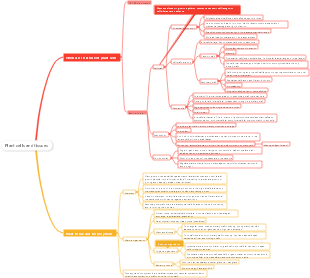
Plant cell growth and differentiation
Differentiation of plant cells
differentiation and dedifferentiation
Reproduction of plant cells
Mitosis
Characteristics and significance of mitosis
Plant tissues and tissue systems
Tissue: A group of cells formed by division, growth and differentiation of cells from the same origin
type
Meristem: Group of cells capable of continuous division
According to the position on the plant body
apical meristem
Location: Top of rhizome and its branches
Function: Make the rhizome continuously elongate and form side branches and leaves on the stem. The stem apical meristem will eventually produce reproductive organs
Characteristics: small and equal diameter, thin-walled, the nucleus is located in the center and occupies a larger volume, the vacuoles are small and dispersed, the protoplasm is thick, and there are no after-contents
lateral meristem
Location: The side of the rhizome near the edge, including the cambium and cork cambium.
Function: Make the rhizome thicker. The activity of the cork cambium causes the formation of new protective tissue on the surface of thick rhizomes or injured organs.
Characteristics: Low premium is long spindle-shaped, the protoplasts are highly vacuolated, and the cytoplasm is not thick. Division is cyclical
Monocots without thick growth have lateral meristems. Activity is weak or non-existent in herbal dicotyledons
intermediary meristem
Location: between mature tissues of stems, petioles, ovary stalks, flower stalks, inflorescence rachis and other organs; the apical meristem is retained in local areas in the above-mentioned organs.
Characteristics: The dividing activity lasts for a short time and transforms into mature cells.
According to the nature of the source
primitive meristem
Position: Located at the front end of the rhizome, it consists of the undifferentiated, youngest and long-lasting and strong meristems.
Characteristics: small size, relatively large nuclei, thick cytoplasm, mostly equal-diameter polyhedrons
primary meristem
The top of the rhizome is composed of cells derived from the original meristem
Initial differentiation, any organization with strong division ability, transition from meristematic tissue to mature tissue
Secondary meristem: a meristem formed by mature tissue cells that have regained their ability to divide after dedifferentiation.
The cambium layer of the rhizome and the cork cambium layer
Mature tissue: derived from meristem (maturity is relative)
Protective tissue: Covers the surface of the plant to protect it
Epidermis: differentiated from primary meristem cells
Location: Covering the surface of young organs
Generally there is only one layer of cells, the outer wall is thickened and covered with a layer of cuticle
stratum corneum (keratin and wax)
stratum corneum (keratin and cellulose)
Existence time: Only the epidermis of primary growth (no bold growth) herbaceous plants is effective. The epidermis of the thickened rhizome will be destroyed due to the thickening of the organs, and its protective function is replaced by the periderm of the secondary protective tissue.
There are many stomata on the aerial epidermis
Periderm: secondary meristem-formation of cork cambium
Rhizome surface with thickened growth
The cork cambium splits circumferentially, differentiates outward into corks, and differentiates inward to form the inner layer of the cork.
Cork layer: protective role Cork cambium layer: secondary meristem. Derive lenticels outward: conduct gas exchange with the outside world. Inner layer of plug: parenchyma cells, no suberization
Parenchyma: the main tissue that performs various metabolic activities
Classification
Assimilation Organization: Photosynthesis
Contains a large amount of chloroplasts, which synthesize organic matter through photosynthesis
All green parts of plants
Storage tissue: stores large amounts of nutrients (starch, fat, protein)
Various storage organs, rhizome cortex and pith and other parenchyma tissues
water storage organization
The cells are larger, with a large central vacuole and a large amount of sticky sap. They are mostly found in xerophytes and succulent plants.
Absorptive tissue: Distribution: Mainly distributed in the root hair area at the root tip. Characteristics: The cell wall and cuticle are thin, and the outer wall protrudes outward to form root hairs. Function: Absorbs water and inorganic salts.
Ventilation tissue: has a large number of intercellular spaces
Distribution: rhizomes of aquatic and hygrophytic plants Characteristics: forming an interconnected ventilation system to allow organs born under water to receive oxygen
transmitter cells
Intracellular processes grow in the cell wall, the cytoplasm is thick, rich in mitochondria, and has well-developed plasmodesmata.
A site where a large amount of solute is concentrated and short-distance transport is strong
Function: Carry out rapid material transfer, which is conducive to short-distance transportation
Mechanical organization: supports reinforcement function
chlamydia
Features: unevenly thickened living cells, often containing chloroplasts living cells
Contains no lignin, has toughness, plasticity, and stretch support, and does not hinder the rapid growth of young organs.
Sclerenchyma Characteristics: Uniformly thickened secondary walls, lignified, leaving only dead cells with cell walls
Transport organization: long-distance transport of materials
xylem
Vessel molecules: transport water (dead cells) Tracheids: gymnosperms and ferns only have tracheids Wood fibers: cell wall thickening, support function Wood parenchyma cells: often lignified, storage function
Phloem
Sieve tube molecules: transport organic matter (living cells) companion cells provide energy for sieve tubes Bast fibers Phloem parenchyma cells: storage and lateral transport
Secretory tissue/structure: secretes substances to the plant body surface
External: glandular epidermis, glandular trichomes, nectaries, drains
Internal: secretory cells, secretory chambers, secretory ducts, milk ducts
Organizational system: a collection of organizations with different forms and functions
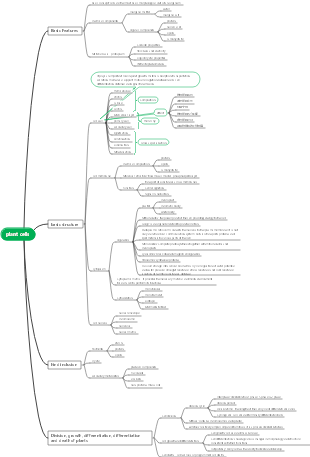
Section 1 Morphological Structure of Plant Cells
Cells are the basic unit of plants
In 1839, Schleiden and Schwann proposed the cell theory
With the exception of viruses, all organisms are made of cells
cell concept
Cells are the basic unit of life activities
An independent, orderly and self-controlled metabolic and functional system
Fundamentals of organismal growth and development
Plant cell shape and size
Various shapes, including spheroids, polyhedrons, spindles, and columns
Small in size, 10-100 microns in diameter
structure
plant cells
protoplast
cell nucleus
The most prominent structure in eukaryotic cells
Chromatin: The main form of genetic material in the nucleus, its main components are DNA and protein
Nucleolus: Contains a large amount of RNA and proteins, and is the site for ribosomal RNA synthesis and processing and the assembly of ribosomal subunits.
cytoplasm
plasma membrane
Composition: phospholipids, membrane proteins, membrane sugars
Features: Fluid mosaicism
Cytoplasmic matrix: The gelatinous material in the cytoplasm other than organelles is called cell matrix. Cytoplasmic movement: The cytoplasmic matrix is in a state of constant movement, which can drive the organelles in it to make regular and continuous flow within the cell.
Mediator of material transport and information transmission between organelles. An important place for cell metabolism.
organelles
double layer membrane
Plastids are closely related to the synthesis and storage of sugars
Chloroplasts, carry out photosynthesis. Double membrane, thylakoids (granas), matrix
Chlorophyll: the main photosynthetic pigment, absorbing and utilizing light energy to directly participate in photosynthesis
Lutein and carotene: transfer absorbed light energy to chlorophyll to assist photosynthesis
chromatic bodies
Accumulation of starch and lipids, cross-pollination and seed dispersal, giving plants a variety of colors
white body
No pigment, colorless granular form
Storage of nutrients, starch and fat synthesis center. Amyloid, oil body, protein body
Cytoskeleton (microtubules, microfilaments, intermediate fibers)
Mitochondria, containing cristae, matrix
single layer film
endoplasmic reticulum, reticular duct system
Rough endoplasmic reticulum, with ribosomes attached, involved in protein (enzyme) synthesis
Smooth endoplasmic reticulum synthesizes and transports lipids and polysaccharides
Golgi apparatus, a stack of flat sacs
Participates in the processing of proteins and the synthesis and secretion of polysaccharides; it is the place where cell secretions are processed and packaged, and finally forms secretory vesicles to discharge the secretions out of the body; it participates in the formation of new cell membranes and cell walls during plant division
Vacuole, surrounded by a cell membrane and filled with cell fluid (aqueous solution containing a variety of organic and inorganic substances)
Anthocyanins (Anthocyanins)
Physiological functions: generate turgor pressure and maintain a certain stiffness of tissues (osmotic regulation); properties of lysosomes (digestion): storage place for metabolites (storage)
Lysosomes, produced by the breakdown of the Golgi apparatus, contain a variety of hydrolases that break down all biological macromolecules
Microbody
Peroxisomes: Cooperate with chloroplasts and mitochondria to participate in the photorespiration process and decompose peroxides
Glyoxysomes: Transformation of Fatty Acids
Ribonucleosomes (ribosomes)
RNA and proteins follow the instructions of the mRNA to synthesize polypeptide chains from amino acids.
Attached to rough endoplasmic reticulum, present in cell nuclei, chloroplasts, and mitochondria
sphere
Storage organelle with properties of lysosome
cell wall
Function: determine and maintain cell shape, protect protoplasts, participate in cell growth, cell-to-cell recognition and other life activities
level
Intercellular layer (formed when cells divide): The main component is pectin, which adheres adjacent cells
The primary wall (formed by protoplast secretion before cells stop growing) exists on the inside of the intercellular layer. Its main components are cellulose, hemicellulose, and pectin. Elastic and plastic
Secondary wall (cells stop growing and form on the inside of the primary wall after it is formed) cellulose and wood. Enhance cell wall mechanical strength, support and protection
pits and plasmodesmata
Primary pit field: The cell wall growth is not uniformly thickened, and the primary wall is thinner. There are many small pores on it, through which the protoplasmic filaments of the cells are connected to adjacent cells. Plasmodesmata: Protoplasmic filaments that pass through the cell wall and communicate with adjacent cells.
Aftercontents: products of protoplast metabolism in cells. Some are waste and some are storage. Birth metabolites: starch, protein, lipids. Secondary metabolites: tannins, anthocyanins
stored nutrients
Starch (starch granules) single starch granules, compound starch granules, semi-complex starch granules
Fats and oils contain the highest energy and smallest volume of storage substances. The main difference lies in their physical properties.
Proteins exist in an amorphous or crystalline state
Aleurone particles: amorphous spherical particles wrapped by a film
Pseudocrystal: It has the duality of crystal and colloidal and is square in shape.
Physiologically active substances: vitamins, growth hormones, enzymes
Other substances: inorganic salts, alkaloids, tannins, organic acids, crystals
Cutaneous tissue system: epidermis and periderm Basic tissue system: parenchyma, chlamydia, sclerenchyma Vascular tissue system: conductive tissue xylem and phloem
Gymnosperms and ferns do not have sieve tubes but have sieve cells
Features: 1. Partial or complete thickening of cell wall, mechanical support 2. Multiple existence in bundles, tight arrangement, reinforcement
Can dedifferentiate to form meristems and participate in the occurrence of lateral meristems - cambium and cork layers.
Function: Reduce water transpiration in the body, control gas exchange between plants and the environment, prevent pests and diseases from invading and mechanical damage
Features: Approximately square with no intercellular spaces; thin cell walls; relatively large nuclei; dense cytoplasm; strong ability to divide
Different tissues form organs according to certain rules
1. Digestion in lysosomes 2. Release of enzymes into the cytoplasm 3. Utilization of stored substances
Any vesicle surrounded by a single membrane is called the vacuole system, including vacuoles, lysosomes, spheres, and microbodies.
Grana: light reaction matrix: dark reaction
Protoplast: Various structures within cells composed of protoplasm. The main place and important part of all types of metabolism. Protoplasm: The material in cells that makes up a biological organism
 Wondershare EdrawMind