MindMap Gallery How to solve problems efficiently
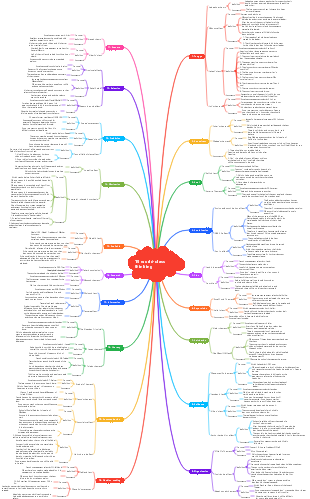
Do you often encounter problems and have no idea how to start? You don’t understand the problem, tend to ignore the root cause, lack systematicness, and overcomplicate your thinking. This article combines a variety of thinking models to help you quickly locate the problem, understand the essence of the problem, and find the key to the problem. Get solutions while developing your problem-solving skills.
Edited at 2023-11-14 22:12:44This is a mind map about bacteria, and its main contents include: overview, morphology, types, structure, reproduction, distribution, application, and expansion. The summary is comprehensive and meticulous, suitable as review materials.

This is a mind map about plant asexual reproduction, and its main contents include: concept, spore reproduction, vegetative reproduction, tissue culture, and buds. The summary is comprehensive and meticulous, suitable as review materials.
This is a mind map about the reproductive development of animals, and its main contents include: insects, frogs, birds, sexual reproduction, and asexual reproduction. The summary is comprehensive and meticulous, suitable as review materials.
This is a mind map about bacteria, and its main contents include: overview, morphology, types, structure, reproduction, distribution, application, and expansion. The summary is comprehensive and meticulous, suitable as review materials.
This is a mind map about plant asexual reproduction, and its main contents include: concept, spore reproduction, vegetative reproduction, tissue culture, and buds. The summary is comprehensive and meticulous, suitable as review materials.
This is a mind map about the reproductive development of animals, and its main contents include: insects, frogs, birds, sexual reproduction, and asexual reproduction. The summary is comprehensive and meticulous, suitable as review materials.
How to solve problems efficiently
Clarify the question
Determine what the real problem is
Four steps to clarify the problem
1. Find the real goal behind the problem through asking questions
Why is the stated goal not the real goal?
I didn’t think it through either
You can keep asking why
Try changing your “why” to something softer
deliberately hidden
Xinjie expresses hope for a win-win situation
You need to collect relevant information to understand the other party and try to find the interests that cause the other party to hide their true needs.
Take the other person’s face into consideration and communicate and verify with the other party carefully.
When the other party deliberately hides, you can try to use the conflict layer model
Superficial needs (claimed), interests (why claimed), real needs (must be met)
When facing conflicts with others, ask yourself 3 questions first
What are the other party’s real needs?
In what other ways can the other party’s needs be met?
How can I help the other person achieve this?
2. Clarify goals through smart principles
Ensure goals comply with SMART principles
S specific
Measurable
achievable
R is relevant to you
T has a time limit
I (related to you) need to complete a (specific) thing within... (a certain period of time), and the effect achieved is... (measurable and achievable)
3. Sort out the available resources and constraints and clarify the current situation
Available resources
For example: the time should not exceed 3 hours per week, and the total financial budget should not exceed 5,000 yuan.
limitation factor
For example: I have injured my knee and cannot run.
4. Combine the goals and current situation and restate the clarified questions
One sentence to clarify the problem that needs to be solved
Integrate the goals we came up with that are in line with the SMART principle, the current situation that describes the available resources and constraints, and express it in one sentence. This is the real problem that we finally clarify and need to be solved.
Why most people don’t clarify questions
The brain cannot afford a lot of thinking and will run as energy-efficiently as possible. By insisting on concentration and constantly practicing logical thinking and structured thinking, you will eventually be able to change your lazy thinking habits and become an efficient thinker.
analyse problem
Break down a large and complex problem into small problems and determine the factors that affect the problem
The second step is to analyze the problem
Why do you need to analyze the problem after clarifying it?
This is because after being clarified, the difference between expectations and status quo is still very large, and our thinking cannot complete such a large distance in one step.
Analyze the essence of the problem
Break down big unsolvable problems into small ones that can be solved.
How to break down small problems
Tool - logic tree, the use of logic tree must follow the MECE principle
Improve the efficiency of analyzing problems through thinking models
Why do we need to use models to analyze problems?
The model is a logical tree structure that has been verified to be feasible and can improve analysis efficiency.
Use models to analyze the essence of problems
Use the world's best brains to help you analyze problems
How to use models to analyze problems?
Determine the nature of the problem
Pick the right model
Complete analysis with models
Two basic types of workplace issues
Improve personal thinking efficiency
·Keywords: "steps, planning"
Matching model: PDCA cycle model
Communicate and collaborate with others
Keywords: "behavior analysis"
Matching model: "Knowing, Ability and Willing" model
PDCAAL model
plan
Think clearly about the 5W1H elements of this job
action
Divide work according to plan and implement it concretely
examine
Check whether each executor achieves the expected goal
Ask for help
Need stakeholder support
deal with
Achieving the target - recognition and rewards, summarizing successful experiences, failing to achieve the target - second round of PDCA
Summary methodology
Produce a methodology for how to do this
After completing a piece of work and producing a methodology for how to do it, you can hand it over to others, and then you can do more difficult things.
knowledge-ability-willing model
·A person's behavior change needs to meet three conditions: cognition, ability and willingness
Case: Always procrastinating-》Complete work on time
Cognition: It is important to complete work on time
Ability: Work ability can support him to complete the work on time
Desire: He needs to do this
propose a hypothesis
For the many small problems analyzed, find the most critical one or several through assumptions
There are two ways to formulate a hypothesis
become an expert
Four key factors that influence the journey from novice to master
1High level teacher
The most outstanding talents in the field
2 high value methods
·Underlying thinking methods and action-level methodologies that can solve problems
3 High-frequency and timely feedback
Look for someone who can give you timely feedback
4. High-frequency and timely practice
·Practice with purpose and constantly break through your comfort zone every time
Use the experts
Tip 1: Bring relevant information and your own conclusions
Tip 2: Use SCQA model to express efficiently
S
SitualionBackground What kind of situation did you encounter?
C
Complication conflict What kind of conflicts occurred?
Q
Question question The problem to be solved is
A
Answer answer your assumption is
Test hypothesis
Verify whether the assumption in the previous step is correct and determine whether this assumption is the key to the problem
The most effective method to verify hypotheses-control variable method
imagination ≠ fact
Determine the correctness of the proposed hypothesis by conducting experiments
control variable method
Solving everyday problems requires only the simplest usage, which is to conduct controlled experiments.
Case: How chain supermarkets display products
1 Set up experimental group and control group
The first group (experimental group) implemented the "near strategy" to display products in the next month.
The second group (experimental group) implemented the "far strategy" to display products in the next month.
The third group (control group) did not make any strategies for the next month and remained as they were.
2 Compare the average sales of three groups of stores
One month later, compare the average sales of the three groups of stores
Common conditions: Each group randomly selects 50 stores in the same city
3Analyze which strategy works best
The first set of "near strategies" is more effective
The second group of "far strategies" is more effective
In the third group, the two strategies are almost the same.
Propose a plan
Propose solutions and identify solutions based on key issues identified
1. Propose a plan
Two gadgets for when you can’t think of a solution
Brainstorming
Leverage the wisdom of the crowd
Core Principle: Openness and Non-Judgement
Experience extraction
Leverage the wisdom of successful experience
2. Screening plan
Tools for scientific decision-making - Decision-making balance sheet
Common decision scenarios
How to choose between multiple offers
expert or management
If you don’t like your current job, should you resign?
Competencies required in five steps to solve problems
Clarify the question
Communication skills
analyse problem
Structured thinking ability
propose a hypothesis
Test hypothesis
critical thinking skills
set a strategy
Creativity