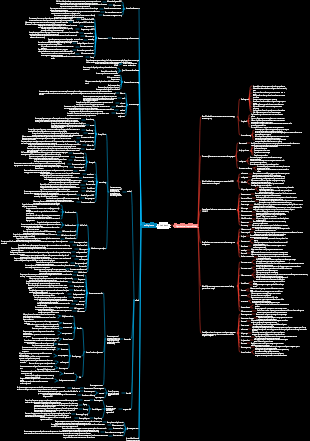
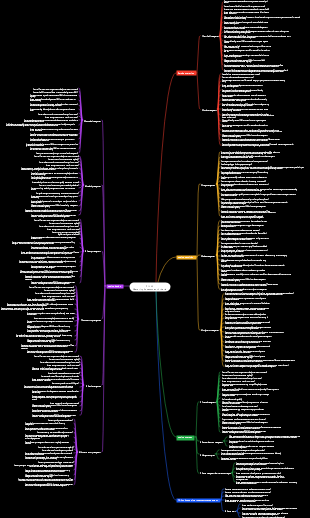
MindMap Gallery ITIL architecture (short version)
Referring to the relevant theoretical methods and best practical experiences of ISO20000, ITIL and ITSS, a relatively complete introduction to ITIL architecture (abbreviated), including service strategy, service design, service transformation, service operation, continuous improvement, etc., after purchasing the copyright, the map will There are continuous updates and iterations, so stay tuned!
Edited at 2024-03-04 15:09:18This is a mind map about bacteria, and its main contents include: overview, morphology, types, structure, reproduction, distribution, application, and expansion. The summary is comprehensive and meticulous, suitable as review materials.

This is a mind map about plant asexual reproduction, and its main contents include: concept, spore reproduction, vegetative reproduction, tissue culture, and buds. The summary is comprehensive and meticulous, suitable as review materials.
This is a mind map about the reproductive development of animals, and its main contents include: insects, frogs, birds, sexual reproduction, and asexual reproduction. The summary is comprehensive and meticulous, suitable as review materials.
This is a mind map about bacteria, and its main contents include: overview, morphology, types, structure, reproduction, distribution, application, and expansion. The summary is comprehensive and meticulous, suitable as review materials.
This is a mind map about plant asexual reproduction, and its main contents include: concept, spore reproduction, vegetative reproduction, tissue culture, and buds. The summary is comprehensive and meticulous, suitable as review materials.
This is a mind map about the reproductive development of animals, and its main contents include: insects, frogs, birds, sexual reproduction, and asexual reproduction. The summary is comprehensive and meticulous, suitable as review materials.
ITIL architecture
service strategy
1.1. Strategic management of IT services
Define and maintain the 4Ps principles (vision, positioning, plan, model) of an organization's service and service management strategies, ensuring that these strategies are defined, maintained and achieve their goals.
1.2. Service Portfolio Management
The scope of service portfolio management is all services provided by a service provider, including services planned to be delivered, services that have been delivered, and services that have been withdrawn.
1.3. IT service financial management
1. Budget: predict and control the income and expenditure of money within the organization;
2. Accounting: fully explain how money is spent; charging: charge customers for services provided.
1.4. Demand management The scope of demand management includes:
1. Identify and analyze service-related business activity patterns (PBA);
2. Identify user needs (UP) and analyze their service usage patterns;
3. Work with capacity management to identify, negotiate and implement measures that impact demand.
1.5. Business relationship management The scope of business relationship management includes:
1. For internal service providers, business relationship management is typically performed by senior representatives from the IT department and senior managers from the business units;
2. For external service providers, business relationship management is usually performed by separate functional departments or account managers.
service design
design coordination
Ensure that the objectives of the service design phase of the service life cycle are met by providing and maintaining a single point of coordination and control for all activities and processes in the service design phase.
Service catalog management
Provide a single source of information for all agreed services and ensure that this information is widely available to all authorized parties.
Service level management
Ensure that all IT services currently provided can meet the agreed level, and that IT services to be provided in the future can also meet the agreed and achievable goals.
2.4. Availability Management Cost-effectively protect all services with availability levels that meet or exceed current or future business requirements. Several aspects of usability:
1. Availability
2. Reliability
3. Maintainability
4. Serviceability
2.5. Capacity Management
Ensure that the capacity levels of IT services and IT infrastructure meet or exceed current or future business needs in a cost-effective and timely manner. Sub-processes include: business capacity management, service capacity management, and component capacity management.
2.6. IT service continuity management
ITSCM life cycle:
The first stage: start;
Phase Two: Needs and Strategies;
The third stage: implementation;
Phase Four: Continuous Operation.
2.7. Information security management
Integrate IT security and business security to ensure the confidentiality, integrity and availability of organizational assets.
2.8. Supplier Management
Manage suppliers and the services they provide to provide seamless IT service quality to the business and ensure value creation for the organization.
service transition
3.1. Conversion planning and support
Provide a complete service transition plan and coordinate the resources required to implement this plan.
3.2. Change management
Control the life cycle of all changes to ensure that beneficial changes are implemented at the minimum cost. Types of change requests include standard changes, emergency changes, and normal changes.
3.3. Service asset and configuration management
The Service Asset and Configuration Management (SACM) process includes managing the complete life cycle of each CI;
The SACM process ensures that Cis are identified, baselines are established and maintained, and changes to them are controlled;
The SACM process also includes interfaces with internal and external service providers where there may be assets and configuration items that need to be controlled.
3.4. Release and deployment management
Plan, schedule and control the build, test and deployment of releases to deliver new functionality to the business while protecting the integrity of existing services.
3.5. Service verification and testing
Ensure new or changed IT services match design specifications and meet business needs.
3.6. Change evaluation
The change evaluation process describes a formal method for evaluating important changes.
3.7. Knowledge management
Includes oversight of knowledge, information and data management; does not include capture, maintenance and use of configuration data.
4. Service operation
4.1. Incident (situation) management
Manage events throughout their life cycle, which includes detecting events, clarifying their meaning, and then deciding on appropriate control actions. If these events represent operational information as well as warnings and exceptions, they serve as the basis for daily automated operational activities. Event types include information events, warning events, and exception events.
4.2. Fault (event) management
The main purpose of fault management is to restore normal service operations as soon as possible and minimize the impact of faults on the business, which includes any events that interrupt or may interrupt services.
4.3. Request for performance
Process responsible for managing the life cycle of all service requests from users.
4.4. Problem management
The process responsible for managing the life cycle of all issues, seeking to minimize the negative impact of failures and problems on the business.
4.5. Access management
Providing users with permissions to use a service or a set of services so that it performs the policies and activities defined in information security management.
5. Continuous service improvement Continuous improvement of products (services)
Seven steps to improvement
Step 1: Identify improvement strategies;
Step 2: Define what you will measure;
Step 3: Collect data;
Step 4: Process data;
Step 5: Analyze information and data;
Step 6: Present and use information;
Step 7: Implement improvements.