MindMap Gallery Natural Medicinal Chemistry Sugars and Glycosides - Overview, Configuration and Classification
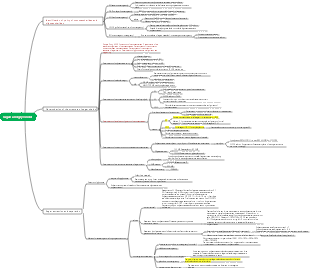
This is a mind map about natural medicinal chemistry sugars and glycosides - overview, configuration and classification. Sugars are carbohydrates, derivatives of polyhydroxy aldehydes or ketones. They are the primary products of plant photosynthesis and are the majority of natural products. The starting materials for synthetic products.
Edited at 2024-01-16 20:25:10This is a mind map about bacteria, and its main contents include: overview, morphology, types, structure, reproduction, distribution, application, and expansion. The summary is comprehensive and meticulous, suitable as review materials.

This is a mind map about plant asexual reproduction, and its main contents include: concept, spore reproduction, vegetative reproduction, tissue culture, and buds. The summary is comprehensive and meticulous, suitable as review materials.
This is a mind map about the reproductive development of animals, and its main contents include: insects, frogs, birds, sexual reproduction, and asexual reproduction. The summary is comprehensive and meticulous, suitable as review materials.
This is a mind map about bacteria, and its main contents include: overview, morphology, types, structure, reproduction, distribution, application, and expansion. The summary is comprehensive and meticulous, suitable as review materials.
This is a mind map about plant asexual reproduction, and its main contents include: concept, spore reproduction, vegetative reproduction, tissue culture, and buds. The summary is comprehensive and meticulous, suitable as review materials.
This is a mind map about the reproductive development of animals, and its main contents include: insects, frogs, birds, sexual reproduction, and asexual reproduction. The summary is comprehensive and meticulous, suitable as review materials.
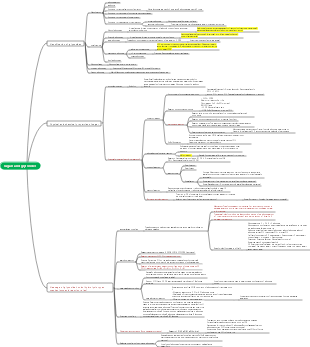
sugars and glycosides
concept
carbohydrate
Carbohydrates, derivatives of polyhydroxy aldehydes or ketones, are the primary products of plant photosynthesis and the initial raw materials for most natural synthetic products.
Glycosides
Glycosides or glycosides are compounds formed by dehydration of sugar or sugar derivatives and aglycone through the hemiacetal or hemiketal hydroxyl group of the sugar and the aglycone.
Stereochemistry of monosaccharides
Three-dimensional structure representation of monosaccharides
Fischer projection
Rules: Horizontal front and vertical back
Conversion with Haworth style
The group on the right side of the Fischer formula is below the face, and the group on the left side is on the face.
Haworth style
dominant conformation
Three-dimensional configuration of monosaccharides
Absolute configuration (D, L)
Fischer style
The hydroxyl group on the chiral carbon farthest from the carbonyl group is D-type to the right and L-type to the left.
Haworth style
The last chiral carbon participates in the ring formation
The direction of the large substituent on C5 or C4 is D-type upward and L-type downward.
The last chiral carbon does not participate in the ring formation
aldofuranose
Those with C5-R are type D and those with C5-S are type L.
Aldopentylpyranose, ketohexopyranose
If the hydroxyl group of the last chiral carbon is on the ring, it is L type, and if it is below the ring, it is D type.
Relative configuration (α, β)
Haworth style
The last chiral carbon participates in the ring formation
The ipsilateral side is β type and the opposite side is α type.
The last chiral carbon does not participate in the ring formation
Determine the D/L type first and then the α/β type. If it is D type, upward is β type and downward is α type; if it is L type, upward is α type and downward is β type.
dominant conformation
C1 type
Most monosaccharides are
1C type
A few sugars such as rhamnose
α and β only represent the relative configuration of the terminal carbons of sugars. The absolute configurations of the terminal carbons of β-D and α-L sugars are both R; the terminal carbons of β-L and α-D sugars are The absolute configuration of is S
Classification of sugar
sugar
Monosaccharide
five carbon aldose
L-Arabinose (L-Ara), D-xylose (D-Xyl), D-ribose
six carbon aldose
D-glucose (D-Glc), D-mannose (D-Man), D-galactose (D-gal), D-allose
Six-carbon ketose
D-fructose (furan type when forming a disaccharide or polysaccharide, pyran type when free), L-sorbose
Methyl five-carbon aldose
L-rhamnose (L-Rha)
branched chain sugar
D-celery sugar
amino sugar
Refers to sugars in which the primary or secondary alcohol groups of monosaccharides are replaced with amino groups, mainly found in animals and microorganisms.
deoxysugar
A sugar in which 1 to 2 OHs of a monosaccharide molecule are replaced by H atoms
Mainly found in cardiac glycosides and microbial metabolites
Uronic acid
A compound in which a primary alcohol group in a monosaccharide molecule is oxidized to a carboxyl group
Uronic acid can easily cyclically synthesize lactone in aqueous solution and exists in an equilibrium state.
Sugar alcohol
A polyol obtained by reducing the aldehyde or ketone group of a monosaccharide to OH
Cyclic Alcohol
Cyclic polyhydroxy compounds, which are monosaccharide derivatives from the perspective of origin
Oligosaccharides (2-9)
Sugars with free aldehyde or ketone groups are called reducing sugars
Such as sophora sugar, primrose sugar
cyclodextrin
A starch produced by Bacillus macerans and other bacteria, which can hydrolyze starch into 6 to 8 grapes Oligosaccharides in which sugars are bound in a 1,4-ring
Polysaccharides (more than 10)
Classification
homopolysaccharide
heteropolysaccharides
Plant polysaccharides
starch
Classification
Amylose (sugar starch)
α1→4 connection, turns blue when exposed to iodine
Amylopectin (glutinous starch)
α1→4 and α1→6 are connected and turn purple when exposed to iodine.
Helical shape, each spiral ring has 6 glucose molecules
Iodine molecules or ions can enter the spiro channel to form colored inclusion compounds
Alpha-glycosidase inhibitors can control the rise in postprandial blood sugar in diabetics
cellulose
β1→4 connection, linear shape, humans and carnivores contain very little β-glucosidase, so they cannot be absorbed and utilized
fructan
Inulin
D-fructose β2→4 is linked to D-glucose and can be used to measure renal clearance.
Hemicellulose
Heteropolysaccharides, acidic polysaccharides that can be dissolved in alkaline water (because there are uronic acids on the branch chains)
gum
mucilage and mucilage
animal polysaccharides
glycogen
The structure is similar to starch, with a higher degree of polymerization and more branches. In case of iodine: reddish brown
Chitin
The structure and stability are similar to cellulose. It is composed of N-acetylglucosamine connected through β1→4
Acid mucopolysaccharides (proteoglycans)
heparin
Chondroitin sulfate
hyaluronic acid