MindMap Gallery Modern social survey methods 6 questionnaires
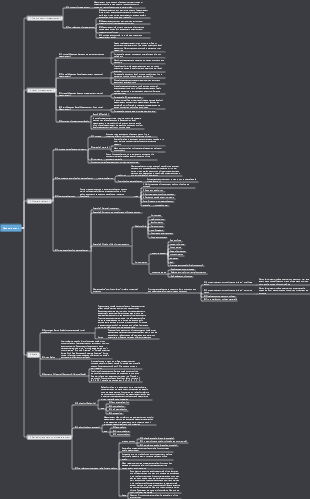
Chapter 6 Questionnaire 1. Elements of the questionnaire 2. Concept and structure of questionnaire 3. Questionnaire content module 4. Sequence and design skills of interview questions 5. Common mistakes 6. Improve the design quality of questionnaires
Edited at 2024-01-16 18:06:49This is a mind map about bacteria, and its main contents include: overview, morphology, types, structure, reproduction, distribution, application, and expansion. The summary is comprehensive and meticulous, suitable as review materials.

This is a mind map about plant asexual reproduction, and its main contents include: concept, spore reproduction, vegetative reproduction, tissue culture, and buds. The summary is comprehensive and meticulous, suitable as review materials.
This is a mind map about the reproductive development of animals, and its main contents include: insects, frogs, birds, sexual reproduction, and asexual reproduction. The summary is comprehensive and meticulous, suitable as review materials.
This is a mind map about bacteria, and its main contents include: overview, morphology, types, structure, reproduction, distribution, application, and expansion. The summary is comprehensive and meticulous, suitable as review materials.
This is a mind map about plant asexual reproduction, and its main contents include: concept, spore reproduction, vegetative reproduction, tissue culture, and buds. The summary is comprehensive and meticulous, suitable as review materials.
This is a mind map about the reproductive development of animals, and its main contents include: insects, frogs, birds, sexual reproduction, and asexual reproduction. The summary is comprehensive and meticulous, suitable as review materials.
Questionnaire
1. Elements of the questionnaire
1. Title group
1. Theme
2. Investigate organizational structure
3. Investigation execution agency
4. Contents related to survey organization and execution process usually appear on the cover of the questionnaire.
2. Statement group
Statement of purpose
Confidentiality Statement
3. Guidance language group
Instructions before each type of interview
Explain the purpose of such interview questions and how to answer them
4. Interview group
The main body of the questionnaire: questions and options
5. Explanation group
Define the questions, terms, boundaries, etc. that need clarification in the interview questions and options.
Usually located after the options or after the topic
2. Concept and structure of questionnaire
Questionnaire: It is a tool for structured data collection in social surveys. Structural survey method
meaning
The structure of the interview questions for different survey purposes is different
Structure between different questionnaires used in the same study
Questionnaire structure
Common complex questionnaire structures
Modular: The questionnaire content determined by the research questions is divided into different modules based on relevance.
Correlation: The variables determined by the research question are expanded sequentially based on correlation.
3. Content module
According to the survey content, the content of the questionnaire preparatory survey can be divided into several modules or content groups.
For example: CFPS adult questionnaire includes Basic information: name, time and place of birth, personal experience Educational experience Marriage experience Career experience and career status Living habits and health status Values...
The overall structure of the questionnaire
Step 1: Classify the variables according to the operational results and make a list
Example: Regional inequality in admission opportunities for undergraduates at Peking University, differentiation • Dependent variable: state of inequality • Independent variables: Factors affecting inequality, such as regional economic development level; family socioeconomic status, etc. • Control variables: demographic characteristics; family characteristics; school characteristics
Step 2: For each variable, design interview questions or interview question groups according to the interview form.
Step 3: Overall plan the relationship and structure of the interview questions
Step 4: Design auxiliary content for the questionnaire
4. Sequence and design skills of interview questions
What are the choices for the overall structure of the questionnaire? Who are the interviewees? How is the content structured? → Based on chronological order, difficulty order, and analysis framework How to arrange auxiliary content?
The order of interviews
1. Easy first, then hard
Hard to get answers
Difficult question
2. First normal, then sensitive
3. Logic priority, relaxation and relaxation
If the answer to an interview question will affect the arrangement of a series of interview questions, you should ask first and the jump should not be too complicated.
It is not appropriate to put together questions that require the interviewee to think intensively.
Quick entry
Difficulties faced at the beginning of access
• How to make respondents accept your interview and be happy to accept your subsequent interviews
Skill
• Use questions that respondents can answer without thinking and without causing alarm.
• Allow interviewees to relieve their worries and fears
• Build trust between interviewer and respondent
Easy first, then difficult
There are at least three types of difficulty of interview questions
Interview questions that require the interviewee’s memory
Interview questions that require the intellectual cooperation of the interviewee
Interview questions that require the psychological cooperation of the interviewee
Which ones are easy?
Public facts, status quo
Sensitive interview questions
Three types of sensitive issues
Privacy categories, such as friend circles, special behaviors, habits, diseases, etc.
Private information, such as identity information, income information, etc.
Attitude-sensitive information, such as political leanings, religious beliefs, etc.
Put it in a natural place
For example, regarding diseases, ask about health first and then the disease.
Pilot interview questions
If there are jump conditional questions or nested questions, the leading question must always be asked first, such as D1. The house your family currently lives in is [show card, single choice]: 1. Completely owned [skip to D101] 2. Shared property rights with the unit [skip to D110] 3. Rent [skip to D120] 4. Provided by the government for free [skip to D2] 5. Free provided by the unit [skip to D2] 6. Provided by parents/children [skip to D2] 7. Other relatives and friends staying [skip to D2] 77. Others [please specify] [skip to D2]
Jump arrangement
Complex questionnaires often have jump arrangements • That is, when the above-mentioned design techniques fail, you have to arrange a jump • Before jumping, there are usually leading questions or filtering questions • Jump is often a source of error in questionnaire interviews • Missing will cause the interview questions that should be accessed to be completely missed. • Mistaken jumps will not only cause the interview questions that should be accessed to be missed entirely, but also cause the interview questions that should not be accessed and take time to access them.
5. Common mistakes
conceptual abstraction
Question is vague
The question is biased
Improper formulation
Question has multiple meanings
Questions and answers are inconsistent
6. Improve the design quality of questionnaires
Standards for high-quality questionnaires
Have high reliability and validity
Suitable for the purpose and content of the study
Suitable for survey subjects
Fewer but better questions
How to design a high-quality questionnaire
1. Chinese language knowledge level
2. Knowledge of survey research methods
3. Social life knowledge
7. Subject of the questionnaire
The main body of the questionnaire - consists of interview questions
what?
Interview questions
The basic structure of an interview question
Question number, question stem, instructions, coding, options/input space, Continuation method, special number, etc.
Existence (fact) type interview questions
What are existential interview questions?
natural properties
social facts
Measuring Tips
Try to find the research properties and natural properties of variables
Try to find questions that can be answered directly
example
How to ask questions about education level How to ask questions about age Professional questions How to ask questions about income: family income/personal income
behavioral interview questions
What are behavioral interview questions?
behavior of social actors
Measuring Tips
or ask directly about behavior
Or put the behavior into context and ask
A time-related behavior
For example: A person’s day involves all aspects of society doer to act Generally use diary method or calendar method
B Family or individual-related behaviors
For example: physical exercise, housework...
C group-related behavior
For example: demonstrations Behavioral correlation method is generally used Ask about situations, participants, interviewees’ behavior
Sensitive behavior
• Privacy-related behavior – such as a sex partner
• Socially prohibited behavior – For example, teenagers under 14 years old fall in love
Attitude (opinion) interview questions
What are attitude questions?
Variables that reflect individual opinions and attitudes and are not directly measurable
Measuring Tips
Try to use mature tools, indicators or scales
If you must make it yourself, you need to explain the reliability and validity.
Ability (test) interview questions
What are competency questions?
mental ability, physical ability
Ability Measurement Techniques
Try to adopt unified standards
Examples: existing ability facts, questioning techniques
Such as: IQ; GRE; GPA; sports competition results, etc.
Principles of measurement
Use existing tools instead of making your own tools easily
Mental abilities, Chinese, mathematics, sensitivity
physical ability, disability, disability
How to ask?
Individual direct interview questions: closed questions vs open questions, single choice questions vs multiple choice questions
Grouped indirect interview questions: indicators, scales
Tips and precautions?
Format of interview questions
Option arrangement, matrix questions
Questions about common variables
FAQ
8. Design of interview questions
How to ask questions
direct measurement
Indirect measurement (indicators, scales)
The structure of the interview questions
planar structure
direct question
matrix problem
Nested structure
Module structure
complex structure
Questioning skills
Simplicity and directness are the best
It is not appropriate to make the interviewee think too much
It is better to ask positive questions than negative questions (no, no ×)
Ask simple questions, not complicated questions
Neutral questions, not inducing questions
Closed questions, open questions are not appropriate
Ask questions in short sentences, not long sentences (approximately 20 words, except for complex questionnaires)
option form
Form is not the purpose. Suitability for the type of variables and the purpose of measurement is the key.
Closed options and development options, single selection and multiple selection, each has its own pros and cons.
Closed-option responses facilitate data processing, but often limit response diversity.
Open options allow for the diversity of responses, but the responses are not easily digitized.
Single-choice options facilitate measurement certainty, but often limit the economy of interview questions.
Multiple options are economical, but application of responses often becomes a challenge
Try to use the advantages of the option form as much as possible, which is the principle of choosing form
direct-closed interview questions
Ask direct questions about the main measured variables and provide response options, such as:
Under the condition that the options are determined, try to use closed option forms to facilitate data processing.
Direct-semi-closed interview questions
Ask direct questions about the variable to be measured, giving response options, and leaving an option for "other"
If you use unexpected options, be clear in advance how the "other" options will be handled
Direct - open interview questions
Main variables to measure, ask questions directly, and faithfully record the responses
Multiple choice questions
Ask a direct question about the variable to be measured and select an option as a response
multiple choice questions
Ask a direct question about the variable to be measured and select multiple options as a response.
If it is a multiple-choice question, be sure to explain it in the appropriate position of the question stem.
Refers to the title
A set of questions that uses multiple questions to measure one variable, each measuring a dimension
Scale questions
Use multiple questions to measure a variable, and the measurement of the questions is nested in progressive question groups
virtual situation
For some non-universal scenarios, virtual scenarios can be designed. Scholars such as Gary King have proposed the “Anchoring Vignettes” method for measurement.
Social distance scale is a typical virtual scenario method
Format of interview questions
Arrange the options of the interview questions as clearly as possible to avoid confusing ordering
The jump path should be as clear and accessible as possible to avoid jumping back and forth.
Matrix questions should be of the same type as possible to avoid rambling.
common problem
Common problems in interview design are by no means limited to these. Being good at accumulating experience at work is the most important solution to avoid these problems.
The meaning of the question is unclear
E1.When do you eat?
—— (please record the time)
too esoteric
E2. Do you agree with the ideas of feminism?
1.Yes 2.No 3.Don’t know
Multiple question meanings
E3. How do you evaluate our school’s logistics services and teaching management?
1. Very good 2. Fairly good 3. Average 4. Bad 5. Very bad
Not all options
E4. What awards did you receive during your studies at school?
1. National Scholarship 2. National Inspirational Scholarship 3. May Fourth Scholarship 4. School Scholarship
Missing: Such as principal scholarship, financial aid scholarship, etc.
Questions about commonly used variables
age
It is advisable to directly ask for the year, month, and day of birth; the degree of accuracy depends on the research variables.
If the interviewees are mainly elderly people, you should prepare a zodiac sign-year of birth comparison table
gender
It is better to record directly and not to ask questions.
Marital status
Combine among options such as "single, cohabiting, married, divorced, widowed"
education level
It is advisable to design interview questions based on the research variables, or ask about the years of education, or the highest academic certificate obtained so far.
If necessary, also ask whether you are receiving academic education on the job.
income and expense
If there is no need to know the source of income, use the approximation method to ask
If you need to know the source of revenue, use the approximation method to ask about total revenue first and then ask about category revenue
Expenditure questions are the same
Profession
It is not appropriate to directly ask what you are doing. It is better to use a three-stage inquiry and do coding.
9. Auxiliary content design of questionnaire
1.Cover
Survey item title
sample information
access process information
Supervision process information
2. Statement
Statement of Rights and Responsibilities
Confidentiality Statement
harmless instructions
3. Instructions
Instructions for interviewing and answering questions
4.Explanatory language
Explanation and clarification of terms used in interview questions
5. Household/sample address sampling table
Sampling instructions
sampling tools
6. Interviewer’s records
Interviewer's records of the interview process
7.Tab