MindMap Gallery Project document management and configuration management
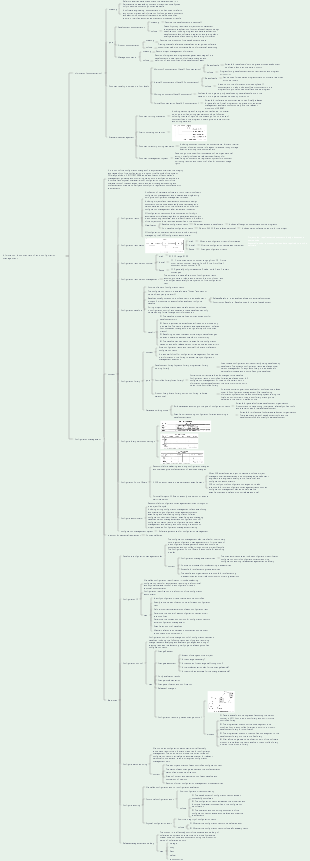
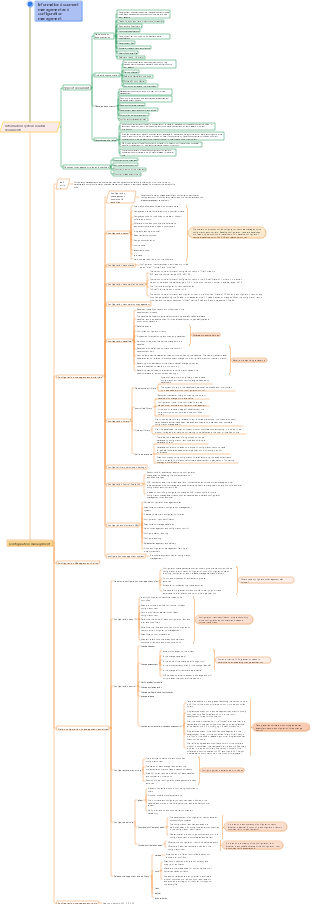
The figure below summarizes project document management and configuration management. The knowledge points include software documentation, document quality level, configuration management activities, configuration items, configuration library, etc.
Edited at 2021-10-27 17:07:31This is a mind map about bacteria, and its main contents include: overview, morphology, types, structure, reproduction, distribution, application, and expansion. The summary is comprehensive and meticulous, suitable as review materials.

This is a mind map about plant asexual reproduction, and its main contents include: concept, spore reproduction, vegetative reproduction, tissue culture, and buds. The summary is comprehensive and meticulous, suitable as review materials.
This is a mind map about the reproductive development of animals, and its main contents include: insects, frogs, birds, sexual reproduction, and asexual reproduction. The summary is comprehensive and meticulous, suitable as review materials.
This is a mind map about bacteria, and its main contents include: overview, morphology, types, structure, reproduction, distribution, application, and expansion. The summary is comprehensive and meticulous, suitable as review materials.
This is a mind map about plant asexual reproduction, and its main contents include: concept, spore reproduction, vegetative reproduction, tissue culture, and buds. The summary is comprehensive and meticulous, suitable as review materials.
This is a mind map about the reproductive development of animals, and its main contents include: insects, frogs, birds, sexual reproduction, and asexual reproduction. The summary is comprehensive and meticulous, suitable as review materials.
Project document management and configuration management knowledge points
Software documentation
Development documentation
Describe the development process itself.
feasibility study report
Requirements Specification
Functional specifications
design specifications
Development Plan
Software integration and test planning
Quality Assurance Plan
Safety and testing information
Product documentation
Describe the products of the development process
Training Manual
Reference manual and user guide
Software Support Manual
Product manual
Information advertising, etc.
Manage documents
Record project management information
Record of progress and progress changes at each stage
Records of software changes
Development team responsibilities defined
Project plan, project phase report
Configuration management plan, etc.
Document quality level
1. Minimum documentation (Level 1 documentation)
(1) Documentation for developers themselves
2. Internal documents (level 2 documents)
special program
3. Working documents (level 3 documents)
Documents that can be used by other organizations
4. Formal documents (Level 4 documents)
Commonly used software products
Configuration management activities
1. Develop a configuration management plan
2. Configuration identification
1. Identify software configuration items that need to be controlled
2. Assign a unique identifier to each product and its components and associated documentation
3. Define the important characteristics of each configuration item and identify the owner
4. Guidelines for identifying components, data, and product acquisition points
5. Establish and control baselines
6. Maintain documentation and component revisions in relation to the product
3. Configuration control
1. Change requests should be identified and documented
2. Analyze and evaluate changes
3. Approve or deny change requests
4. Implement, verify, and release modified software items
5. An audit trail should be maintained for each modification, and the reason for the modification and the authorization for the modification should be tracked.
6. All access to controlled software items that handle security and security confidentiality functions should be controlled and audited
4. Configuration status report
1. The representation and status of each controlled item
2. The status of each change request and the implementation status of approved modifications
3. The status of current and past versions of each baseline and comparison of individual versions
4. Records of other configuration management activities
5. Configuration audit
Verify the consistency of configuration items with configuration identifiers to ensure the effectiveness of configuration management and do not allow confusion, such as
(1) Prevent substandard products from being delivered to users, such as incorrect versions of user manuals
(2) Identification of imperfect implementations, such as development that does not meet initial specifications or changes that are not implemented in response to change requests
(3) Find mismatches or incompatibilities between configuration items
(4) Confirm that the configuration item has been stored as a baseline after the required quality control review
(5) Verify records and documentation maintain traceability
6. Release management and delivery
Configuration items
In order to control changes without seriously hindering reasonable changes, the concept of baselines is introduced
For each baseline, define the following
Baseline events
Controlled configuration items
Procedures for establishing and changing baselines
Permissions required to approve changes to the baseline
Baseline configuration items
Including all design documents and source programs, etc.
Function Baseline
Initial passed function configuration
Assign baseline
Initial passed distribution configuration
product baseline
Product configurations that pass initially or conditionally
Open read access to software developers
Non-baseline configuration items
Including various plans and reports for the project, etc.
Open read access to PM, CCB and related personnel
Typical configuration items
program planning proposal
Requirements document
Design documentation
source code
executable code
test case
Various data required to run the software
Three states of configuration items
draft
Version number: 0.YZ
formal
Version number: X.Y
Revise
Version number: X.YZ
Version control steps
Create configuration items
Modify configuration items in "Draft" status
Technical review or leadership approval
Officially released
change
Main attributes
Name, identifier, file status, version, author, date, etc.
Configuration library
Store configuration items and record all information related to configuration items
1. Dynamic library (development library, programmer library, work library, dynamic system, development system, work space)
1.1. Used to save the configuration entity currently being developed by the developer
1.2. The configuration items of the dynamic library are placed under version management
1.3. Is the workspace of software engineers, controlled by developers
1.4. Dynamic library information changes frequently and no configuration control is required unless necessary.
It is at the developer's discretion and there is no need to go through the change process. Developed entities are edited here.
2. Controlled library (main library, system library, main system, controlled system)
2.1. Suitable for managing current baselines and controlling changes to baselines
2.2. Software engineers and other authorized personnel may freely copy units and components in the controlled library
2.3. Configuration items in the main library are placed under complete configuration management
At the end of a certain phase of information system development, the current work product is stored.
3. Static library (software warehouse, software product library, product library)
3.1. For archiving a variety of widely used published baselines
3.2. Placed under full configuration management
After the developed information system product completes system testing, it is stored in the product library as the final product, waiting to be delivered to the user or installed on site.